


ASTM C1166: Flame Propagation Testing Services
The ASTM C1166 standard stands out when it comes to fire and flammability tests for materials used in the construction, aerospace, and transportation industries since it can quantify the flame spread of dense or cellular elastomeric gaskets and accessories. Given the extensive usage of gaskets, shims, and other elastomeric materials in everything from train window frames to car seat cushions, this test is crucial.
TRUSTED BY


Get ASTM C1166 compliant results — request your flame propagation testing quote
- Overview
- Scope, Applications, and Benefits
- Test Process
- Specifications
- Instrumentation
- Results and Deliverables
What Is ASTM C1166 Flame Propagation?
ASTM C1166 is the standard test method for evaluating the flame propagation characteristics of dense and cellular elastomeric gaskets and accessories. Elastomeric sealing products -gaskets, setting blocks, glazing tapes, shims, spacers, and similar components -are used extensively in building construction, vehicles, and industrial assemblies. When these products are installed in enclosed or semi-enclosed spaces, their fire behavior becomes a safety consideration. A material that propagates flame aggressively can turn a minor ignition event into a larger fire. ASTM C1166 provides a standardized laboratory method for measuring that propagation behavior.
The test places a specimen in a horizontal position and applies a direct flame for a defined ignition period. After the ignition source is removed, the distance the flame travels along the specimen and whether self-sustained burning continues are recorded. The result is a pass-or-fail determination based on whether the flame propagates beyond a defined limit mark on the specimen. This binary outcome makes the test straightforward to specify and apply in product qualification and procurement.
Two specimen orientations are covered -horizontal burning for sheets, strips, and tape forms, and vertical burning for tubular gasket profiles. The applicable orientation depends on the product form and the requirement in the relevant product specification or project document. The test falls under the jurisdiction of ASTM Committee C24 on Building Seals and Sealants. Specifications for glazing gaskets, curtain wall seals, and similar building-envelope components in fire-rated and transit-vehicle applications reference it.

Applications and Benefits of ASTM C1166 Flame Propagation Testing
Scope
ASTM C1166 covers flame propagation testing of dense and cellular elastomeric gaskets and accessories in both horizontal and vertical orientations. Material forms covered include sheets, strips, tapes, and extruded or molded profiles. The test applies a 20-second direct flame ignition using a Bunsen burner under specified flame and distance conditions. For horizontal specimens, flame propagation beyond a 25 mm reference mark after ignition removal is the failure criterion. For vertical specimens, dripping flaming material and flame propagation distance are both evaluated. Specimens are conditioned at 23 ± 2 °C and 50 ± 5% RH for at least 24 hours before testing. A minimum of five specimens are tested per condition. The standard falls under ASTM Committee C24 on Building Seals and Sealants, Subcommittee C24.10.
Applications
- Glazing gaskets and setting blocks for the curtain wall and window system fire performance qualification
- Elastomeric seals and gaskets for transit vehicles -rail cars, buses, and aircraft interior components
- Building envelope sealants and tapes for fire-rated wall and floor assembly applications
- HVAC duct seals, pipe penetration gaskets, and mechanical room elastomeric components
- Automotive door and window seals where flame spread limits are specified
- Industrial equipment gaskets and seals for environments with ignition risk
- Material selection support for elastomeric components used in fire-rated or fire-protected assemblies
- Incoming material verification and supplier qualification for elastomeric sealing products
Benefits
- Simple pass/fail outcome based on a defined flame propagation distance limit -easy to specify and verify
- Covers both dense and cellular elastomeric forms in a single standard
- Two orientation options (horizontal and vertical) accommodate different product geometries
- Directly referenced by glazing, curtain wall, and transit vehicle specifications requiring flame propagation data
- Standardized conditioning and ignition parameters ensure consistent, comparable results across labs
- Fast and cost-effective screen for flammability risk before committing to full assembly fire testing
- Applicable to natural and synthetic rubber, silicone, EPDM, neoprene, and foam elastomeric products
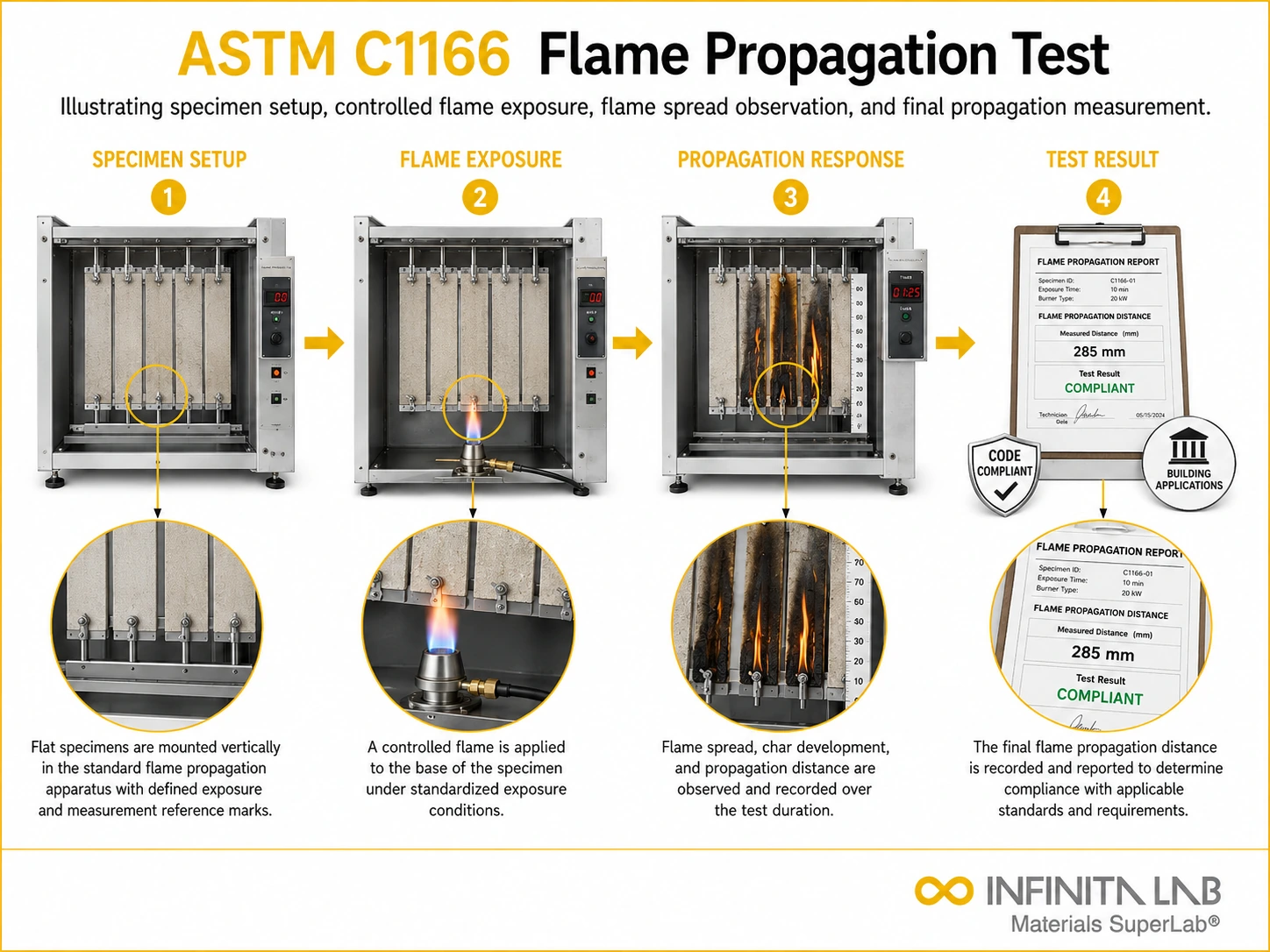
Our ASTM C1166 Testing Procedure
Specimen Preparation and Conditioning
Specimens are cut or sectioned to the required dimensions from the material or product.
1Specimen Marking and Fixture Setup
A reference mark is placed on the specimen at 25 mm from the ignition end for horizontal tests, or at the appropriate distance for vertical tests.
2Flame Application and Ignition
The burner flame is applied to the ignition end of the specimen for 20 seconds under the specified conditions.
3Evaluation and Reporting
Each specimen is evaluated against the pass/fail criteria -flame propagation beyond the reference mark after ignition removal.
4ASTM C1166 Test Parameters and Requirements
| Parameter | Details |
|---|---|
| Standard | ASTM C1166-16 (Reapproved 2022) |
| ASTM Committee | C24 – Building Seals and Sealants, Subcommittee C24.10 |
| Material Types | Dense and cellular elastomeric gaskets and accessories -rubber, silicone, EPDM, neoprene, foam |
| Test Orientations | Horizontal (sheets, strips, tapes) and vertical (tubular, extruded profiles) |
| Ignition Source | Bunsen burner, 20-second application |
| Horizontal Pass Criterion | Flame does not propagate beyond the 25 mm reference mark after ignition removal |


- Bunsen burner with calibrated flame height and angle adjustment
- Test fixture for horizontal or vertical specimen mounting
- Timer for 20-second ignition duration control
- Ruler or measurement scale for flame propagation distance recording
- Temperature and humidity-controlled conditioning chamber per test requirements
- Fume hood or exhaust ventilation system for combustion product management
- Calibrated thermometer and hygrometer for conditioning environment verification
Equipment and Instrumentation Used for ASTM C1166 Testing
What You Receive: Test Report, Data, and Certification
- Pass/fail result for each specimen tested
- Overall pass/fail determination for the material or product lot
- Flame propagation distance recorded for each specimen
- Self-extinguishment behavior -whether the flame continued after ignition removal or extinguished
- Flaming drip observations for vertical orientation tests
- Test orientation used (horizontal or vertical)
- Conditioning temperature, humidity, and duration
- Material description, product form, dimensions, and specimen identification
- Test report formatted for product qualification, procurement specification reference, or project documentation
ASTM C1166 Flame Propagation FAQs
ASTM C1166 measures the flame propagation characteristics of dense and cellular elastomeric materials used in gaskets and sealing accessories. It determines how far and how fast a flame spreads across the material surface.
Flame propagation performance is critical for safety in applications where elastomeric seals are exposed to potential ignition sources. It helps assess fire risk and suitability for transportation, construction, and industrial sealing systems.
The test applies to dense rubber, sponge rubber, and cellular elastomeric materials used in gaskets, seals, insulation strips, and vibration-damping components across automotive and industrial applications.
A controlled flame is applied to the material under specified conditions, and the extent and duration of flame travel are measured. The results indicate whether the material self-extinguishes or continues burning.
Flame behavior is influenced by polymer composition, filler type, density, cell structure, plasticizers, and the presence of flame-retardant additives, all of which affect ignition resistance and burn rate.
Why Choose Infinita Lab for Flame Propagation Testing?
At the core of this breadth is our network of 2,000+ accredited laboratories across the USA, offering access to over 10,000 testing methods and analytical services. From advanced materials characterization (SEM, TEM, RBS, XPS) to mechanical, chemical, environmental, biological, and standardized ASTM/ISO-compliant testing, we deliver unmatched flexibility, specialization, and scale. You are never limited by geography, facility, or methodology — Infinita Lab connects you to the right expertise and testing solution, every time.

Looking for an Accredited Partner for ASTM C1166 Flame Propagation Testing?
Send query us at hello@infinitalab.com or call us at (888) 878-3090 to learn more about our services and how we can support you.



Request a Quote
Submit your material details and receive testing procedures, pricing, and turnaround time within 24 hours.
 Quick Turnaround and Hasslefree process
 Confidentiality Guarantee
 Free, No-obligation Consultation
 100% Customer Satisfaction
