


ASTM D8280: Brominated Flame Retardant Blooming Ic Testing Services
ASTM D8280 test method determines the amount of the brominated flame retardants present on the plastic surface. The bromide deposits are collected from the chromatographic paper placed on the surface of the plastic, and the total amount of bromine obtained through this method is then calculated with the help of an integrator.
TRUSTED BY


Get ASTM D8280 compliant results — request your brominated flame retardant blooming ic testing quote
- Overview
- Scope, Applications, and Benefits
- Test Process
- Specifications
- Instrumentation
- Results and Deliverables
What Is ASTM D8280 Brominated Flame Retardant Blooming Ic?
ASTM D8280 provides a standard test method for determining the blooming of brominated flame retardants (BFRs) in plastics using ion chromatography (IC). Blooming is the migration of flame-retardant additives from the bulk polymer to the surface over time, where they form visible deposits, alter surface properties, and potentially pose environmental or health concerns.
This method quantifies the bromine ion concentration on polymer surfaces as an indicator of BFR blooming intensity, supporting quality control, product development, and environmental compliance for electronics, construction materials, and consumer products containing brominated flame retardants.

Applications and Benefits of ASTM D8280 Brominated Flame Retardant Blooming Ic Testing
Scope
ASTM D8280 evaluates:
- Surface concentration of bromide ions from BFR blooming
- Effect of temperature and time on BFR migration rate
- Comparative blooming tendency of different BFR types and formulations
- Correlation of blooming intensity with surface appearance changes
Applications
- Electronics enclosure and PCB material quality control
- Brominated flame retardant formulation optimization
- Consumer electronics and appliance surface quality assessment
- Environmental compliance monitoring for BFR-containing products
- Plastic compound development to minimize BFR migration
Benefits
- Sensitive and selective quantification of surface bromide from BFR blooming
- Ion chromatography provides interference-free measurement
- Rapid screening method for production QC
- Quantitative data to support formulation optimization
- Enables correlation between blooming and surface performance issues
Our ASTM D8280 Testing Procedure
Specimen Conditioning
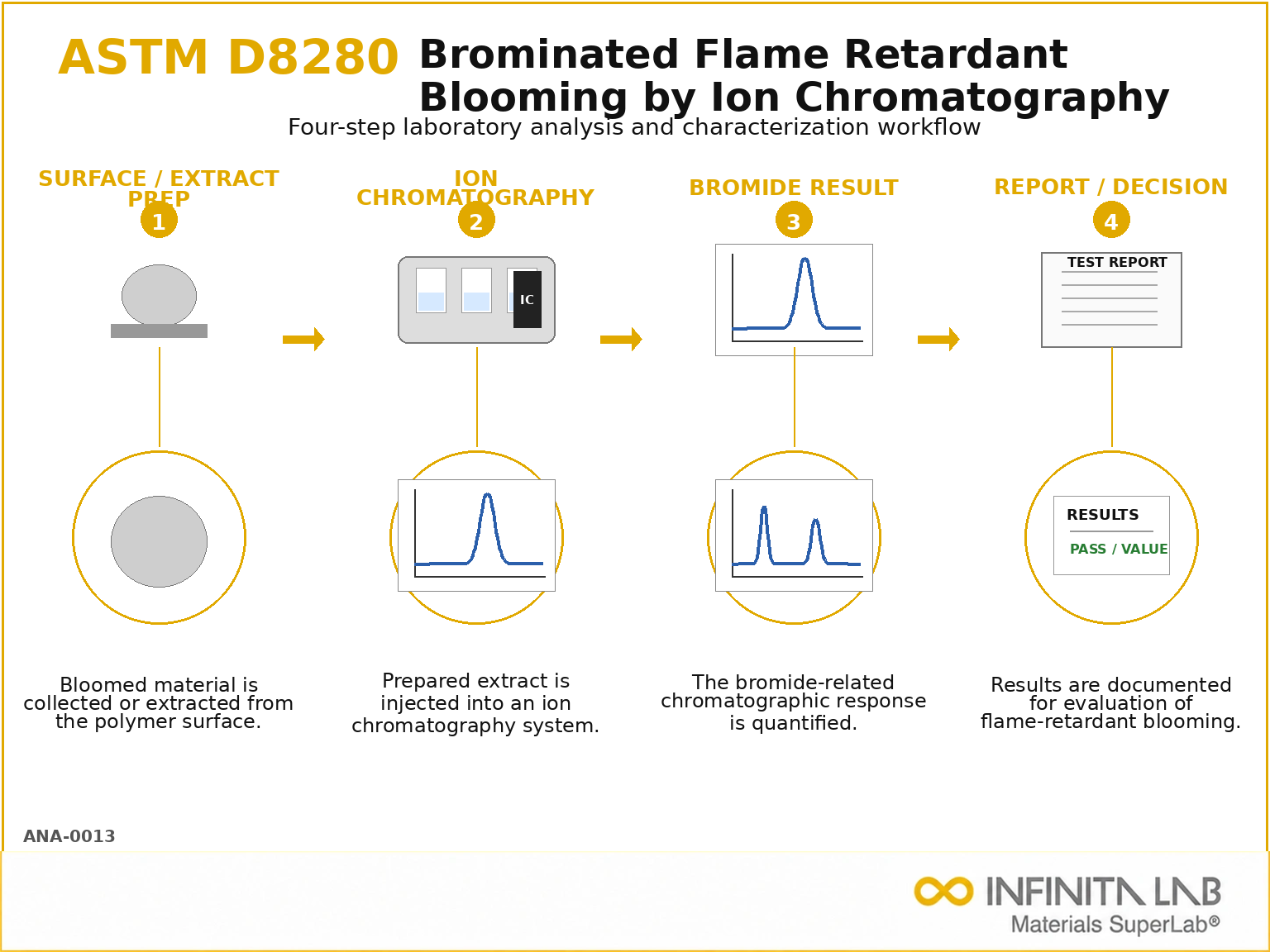
Plastic specimens are conditioned at elevated temperature (e.g., 85 °C for defined hours) to accelerate BFR blooming to the surface before analysis.
1Surface Extraction
The conditioned specimen surface is rinsed or extracted with a defined volume of high-purity water; the extract is collected quantitatively.
2Ion Chromatography Analysis
The extract is analyzed by IC with conductivity detection; bromide ions are separated on an anion exchange column and quantified against certified standards.
3Blooming Calculation
Surface bromide concentration (µg/cm² or ppm) is calculated from the measured bromide concentration, extraction volume, and specimen surface area.
4ASTM D8280 Test Parameters and Requirements
| Parameter | Details |
|---|---|
| Technique | Ion chromatography (IC) with conductivity detection |
| Target Ion | Bromide (Br⁻) |
| Detection Limit | <0.1 µg/cm² (method dependent) |
| Conditioning | 85 °C, defined duration |
| Applicable Materials | BFR-containing plastics (ABS, HIPS, PC/ABS, etc.) |


- Ion chromatograph with an anion exchange column
- Conductivity detector
- High-purity water system
- Calibrated volumetric glassware
- Analytical balance
- Certified bromide standard solutions
Equipment and Instrumentation Used for ASTM D8280 Testing
What You Receive: Test Report, Data, and Certification
- Surface bromide concentration (µg/cm² or ppm)
- IC chromatogram with bromide peak identification
- Comparison to reference formulation or specification limit
- BFR blooming trend data at different conditioning conditions
- Full blooming analysis report per ASTM D8280
ASTM D8280 Brominated Flame Retardant Blooming Ic FAQs
BFR blooming is driven by the thermodynamic incompatibility between the additive and the polymer matrix and by concentration gradients created during processing. At elevated temperatures, increased chain mobility allows BFR molecules to diffuse toward the surface. Additive molecular weight, concentration, and polymer polarity all influence blooming tendency.
Blooming can cause surface whitening or haze, increased surface tackiness, reduced paint adhesion, printability issues, and contact contamination. In electronics, it can affect connector reliability and surface resistance of insulating components.
ASTM D8280 quantifies total surface bromide as a blooming indicator but does not identify the specific BFR compound. For compound identification, GC-MS or HPLC-MS analysis of the polymer extract is required.
ASTM D8280 specifically measures surface-migrated BFR (blooming), not total BFR content. Bulk BFR content is typically determined by XRF (screening) or solvent extraction-GC-MS methods. Both measurements are complementary for product characterization.
Reactive BFRs (chemically bonded to the polymer backbone) bloom very little, while additive BFRs at high loadings in incompatible matrices are most prone to blooming. Low-molecular-weight additive BFRs and those with high vapor pressure at processing temperatures tend to bloom most readily.
Why Choose Infinita Lab for Brominated Flame Retardant Blooming Ic Testing
At the core of this breadth is our network of 2,000+ accredited laboratories across the USA, offering access to over 10,000 testing methods and analytical services. From advanced materials characterization (SEM, TEM, RBS, XPS) to mechanical, chemical, environmental, biological, and standardized ASTM/ISO-compliant testing, we deliver unmatched flexibility, specialization, and scale. You are never limited by geography, facility, or methodology — Infinita Lab connects you to the right expertise and testing solution, every time.

Looking for an Accredited Partner for ASTM D8280 Brominated Flame Retardant Blooming Ic Testing?
Send query us at hello@infinitalab.com or call us at (888) 878-3090 to learn more about our services and how we can support you.



Request a Quote
Submit your material details and receive testing procedures, pricing, and turnaround time within 24 hours.
 Quick Turnaround and Hasslefree process
 Confidentiality Guarantee
 Free, No-obligation Consultation
 100% Customer Satisfaction
