


ASTM D6740 Residue on Ignition Testing for Silanes in Rubber Formulations
The ASTM D6740 test method determines the properties of silanes, especially those used in rubber formulations. The silanes such as those of triethoxysilylpropyl sulfane or their admixtures and solid carriers are studied by determining their residue on ignition. The final results are expressed in SI units.
TRUSTED BY


Precision-driven testing for dimensional accuracy and compliance
- Overview
- Scope, Applications, and Benefits
- Test Process
- Specifications
- Instrumentation
- Results and Deliverables
Overview
ASTM D6740 is a standard test method for determining the residue on ignition (ash content) of silane coupling agents used in rubber formulations. Silanes are widely used in rubber compounding to improve the interaction between silica fillers and the rubber matrix, enhancing mechanical properties and reducing rolling resistance in tire applications.
Residue on ignition measures the inorganic (non-combustible) content remaining after the organic components of the silane are completely burned away. Excessive ash indicates impurities such as inorganic salts or silicates that can affect silane performance, coupling efficiency, and rubber compound properties.

Scope, Applications, and Benefits
Scope
ASTM D6740 evaluates:
- Inorganic residue remaining after combustion of silane coupling agents
- Purity assessment of silane-based rubber additives
- Detection of inorganic impurities from manufacturing or contamination
- Quality uniformity between silane production batches
Applications
- Silane coupling agent quality control in rubber manufacturing
- Tire silica/silane compound development and QC
- Specification compliance for silane additives
- Supplier qualification for silane products
- Research and development of silane-treated filler systems
Benefits
- Rapid detection of inorganic impurities in silane coupling agents
- Ensures consistent silane purity for reproducible compound performance
- Supports supplier qualification and incoming material control
- Complements other silane characterization methods (purity, GC, NMR)
- Simple, low-cost measurement requiring standard laboratory equipment
Test Process
Sample Weighing
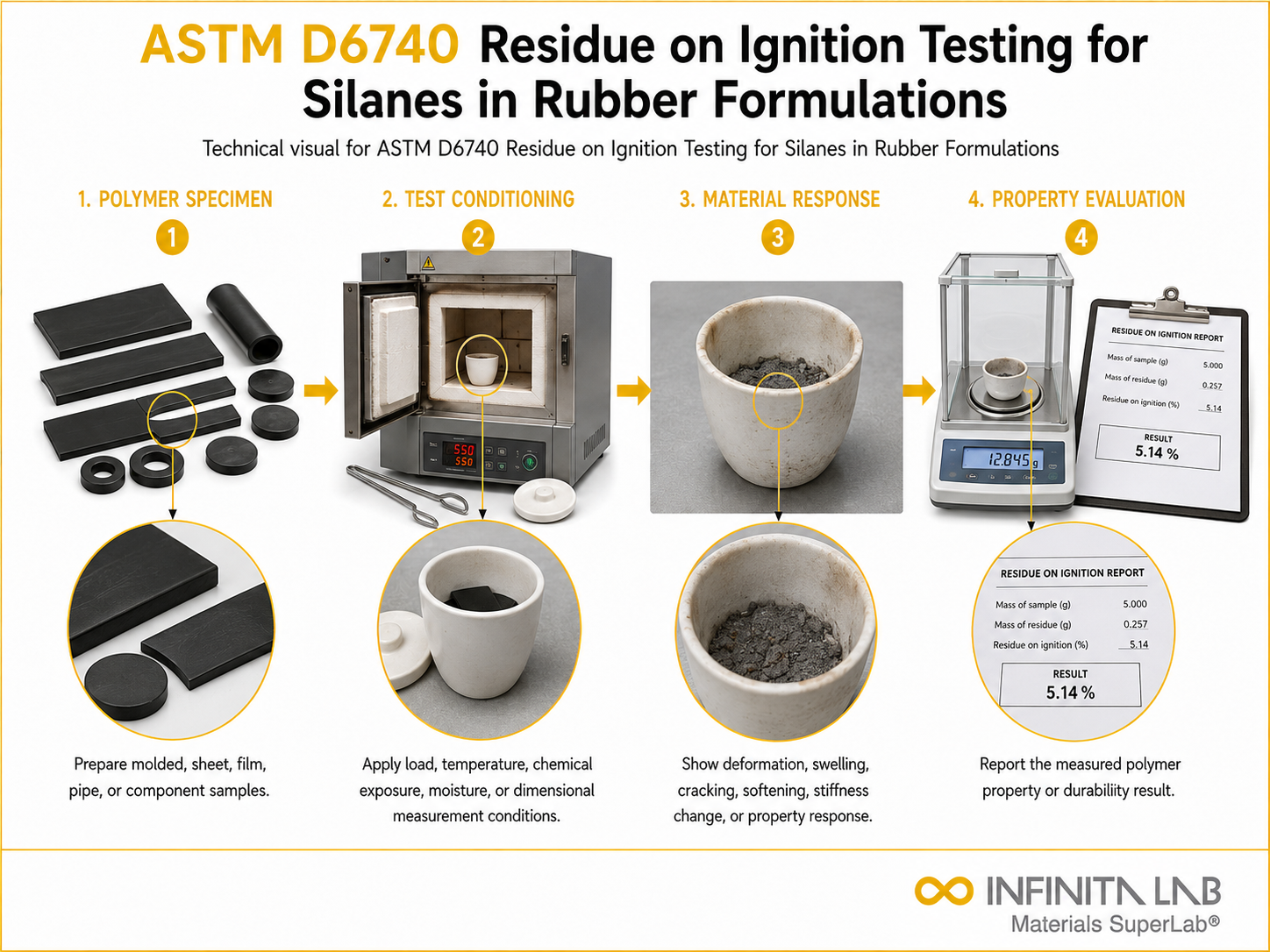
A precise mass of silane coupling agent is weighed into a pre-ignited, tared ceramic or silica crucible.
1Initial Drying
Sample is gently heated on a hot plate or in an oven to remove volatile solvents before high-temperature ignition.
2Ignition
The crucible and sample are placed in a muffle furnace at 800–900°C and ignited to constant weight, burning off all organic matter.
3Residue Determination
The cooled crucible is weighed; residue on ignition is calculated as a percentage of the original sample mass.
4Technical Specifications
| Parameter | Details |
|---|---|
| Standard | ASTM D6740 |
| Applicable Materials | Silane coupling agents for rubber applications |
| Measured Output | Residue on ignition (% by mass) |
| Ignition Temperature | 800–900°C |
| Crucible Type | Pre-ignited ceramic or silica crucible |
| Analytical Balance | 0.1 mg precision |


- Muffle furnace capable of 800–900°C
- Pre-ignited ceramic or silica crucibles
- Analytical balance (0.1 mg precision)
- Desiccator with desiccant for cooling
- Hot plate or oven for initial drying
Instrumentation Used for Testing
Results and Deliverables
- Residue on ignition value (% by mass)
- Triplicate measurement data and mean value
- Comparison against specification limits
- Batch conformance documentation
- Incoming inspection and supplier qualification records
Frequently Asked Question
Residue on ignition represents the inorganic content (ash) remaining after complete combustion. For a pure organosilane, this residue should be very low; elevated values suggest inorganic impurities such as silicates, salts, or metallic compounds.
Impurities in silane coupling agents can interfere with silica surface coverage, reduce coupling efficiency, affect rubber cure chemistry, and introduce variation in mechanical properties of the final compound.
Ignition is typically conducted at 800–900°C in a muffle furnace, which is sufficient to completely combust all organic components of the silane while retaining inorganic residues.
The crucible is pre-ignited at the test temperature to remove any adsorbed organics, cooled in a desiccator, and tared to constant weight before the silane sample is added.
Residue on ignition is a non-specific measure of total inorganic residue. For identification and quantification of specific trace metals, complementary techniques such as ICP-OES or atomic absorption spectroscopy are required.
Why Choose Infinita Lab for Advanced Materials Testing and Characterization?
At the core of this breadth is our network of 2,000+ accredited laboratories across the USA, offering access to over 10,000 testing methods and analytical services. From advanced materials characterization (SEM, TEM, RBS, XPS) to mechanical, chemical, environmental, biological, and standardized ASTM/ISO-compliant testing, we deliver unmatched flexibility, specialization, and scale. You are never limited by geography, facility, or methodology — Infinita Lab connects you to the right expertise and testing solution, every time.

Looking for a Trusted Partner for Accurate and Reliable Testing Services?
Send query us at hello@infinitalab.com or call us at (888) 878-3090 to learn more about our services and how we can support you.



Request a Quote
Submit your material details and receive testing procedures, pricing, and turnaround time within 24 hours.
 Quick Turnaround and Hasslefree process
 Confidentiality Guarantee
 Free, No-obligation Consultation
 100% Customer Satisfaction
