


ASTM D6785 Lead Determination in Workplace Air by Flame AAS
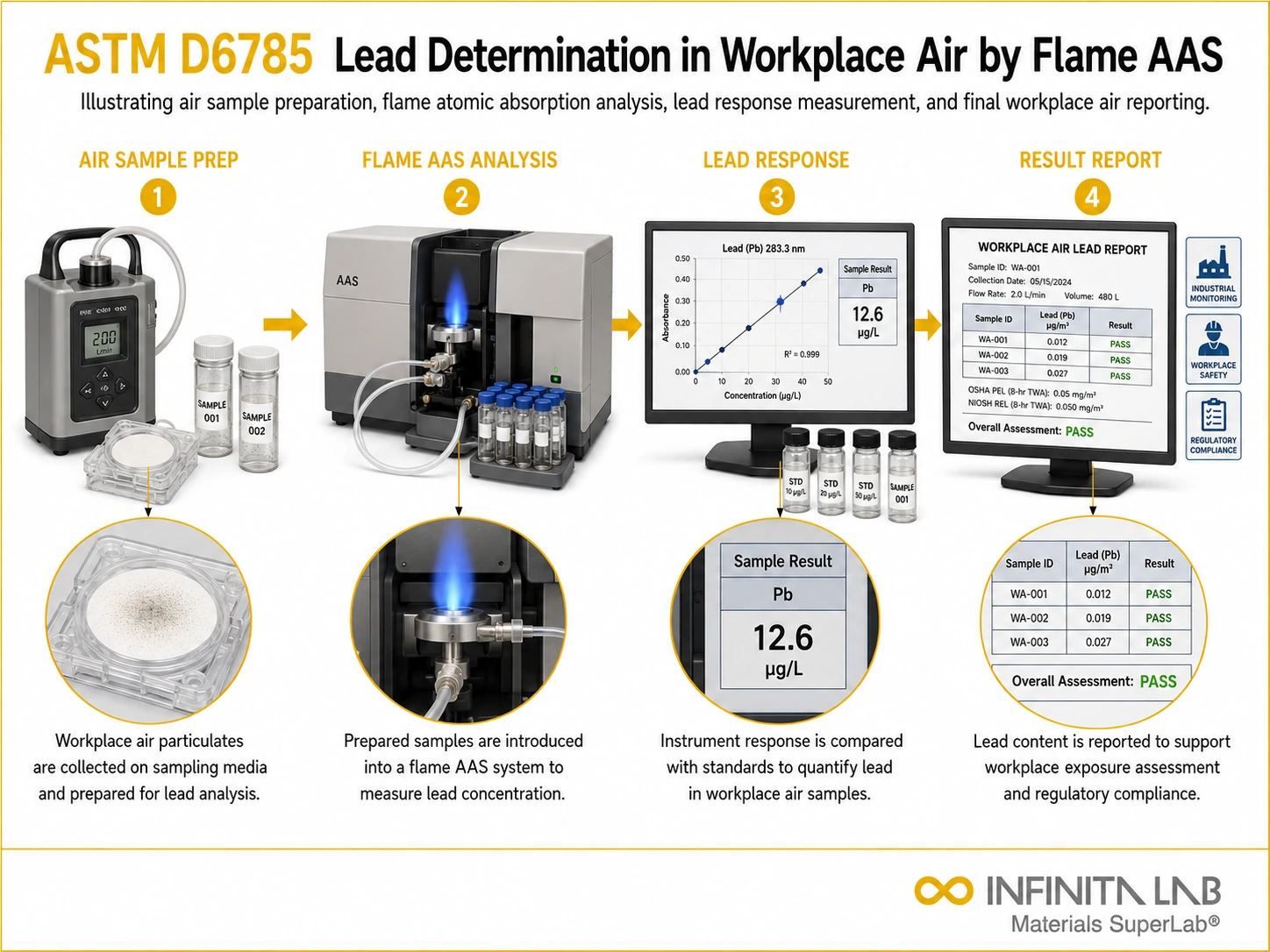
The ASTM D6785 test method determines the mass concentration of lead in workplace air by using flame and graphite furnace atomic absorption spectrometry. The sample dissolution procedure depends on the type of lead being tested and is important for microwave digestion or ultrasonic extraction. The final results are expressed in SI units.
TRUSTED BY


Precision-driven testing for dimensional accuracy and compliance
- Overview
- Scope, Applications, and Benefits
- Test Process
- Specifications
- Instrumentation
- Results and Deliverables
Overview
ASTM D6785 provides a test method for determining the concentration of lead in workplace air using flame atomic absorption spectroscopy (FAAS). Lead is a toxic metal, and monitoring its airborne concentration is essential for occupational health and safety.
This standard is widely used to assess worker exposure to lead in industrial environments and to ensure compliance with safety regulations.

Scope, Applications, and Benefits
Scope
ASTM D6785 focuses on sampling and analyzing airborne lead particles in workplace environments. It ensures accurate determination of lead concentration for exposure assessment.
The test evaluates:
- Concentration of airborne lead
- Worker exposure levels
- Effectiveness of control measures
- Compliance with occupational safety limits
- Workplace air quality
Applications
- Metal processing and smelting industries
- Battery manufacturing
- Construction and painting operations
- Occupational health monitoring
- Environmental and industrial hygiene studies
Benefits
- Ensures worker safety
- Supports regulatory compliance
- Provides accurate exposure data
- Helps in risk assessment
- Improves workplace environment
Test Process
Air Sampling
Airborne particles are collected on filter media.
1Sample Preparation
Filters are digested using acid solution.
2Analysis
Lead concentration is measured using FAAS.
3Data Recording & Evaluation
Results are calculated and compared with standards.
4Technical Specifications
| Parameter | Details |
|---|---|
| Applicable Materials | Workplace air samples |
| Test Method | Flame atomic absorption spectroscopy |
| Detection Range | Typically µg/m³ level |
| Wavelength | 217.0 nm (lead absorption line) |
| Flame Type | Air-acetylene flame |
| Measured Outputs | Lead concentration (µg/m³) |


- Air sampling pump
- Filter collection media
- Acid digestion setup
- Flame atomic absorption spectrometer
- Glassware and sample containers
- Data acquisition system
Instrumentation Used for Testing
Results and Deliverables
- Airborne lead concentration
- Exposure assessment report
- Analytical data and calibration
- Test condition summary
- ASTM compliance report
Frequently Asked Question
ASTM D6785 is a standard test method for determining lead concentration in workplace air using flame atomic absorption spectroscopy, helping monitor occupational exposure to hazardous lead particles.
ASTM D6785 ensures worker safety by accurately measuring airborne lead levels, supporting regulatory compliance and implementation of control measures in industries handling lead-containing materials.
ASTM D6785 involves collecting air samples on filters, digesting the collected material, and analyzing lead content using flame atomic absorption spectroscopy based on light absorption characteristics.
ASTM D6785 requires air sampling pumps, filter media, digestion apparatus, and a flame atomic absorption spectrometer for accurate detection and quantification of lead.
Results are reported as lead concentration in air, typically in micrograms per cubic meter, indicating exposure levels and helping assess workplace safety conditions.
Why Choose Infinita Lab for Advanced Materials Testing and Characterization?
At the core of this breadth is our network of 2,000+ accredited laboratories across the USA, offering access to over 10,000 testing methods and analytical services. From advanced materials characterization (SEM, TEM, RBS, XPS) to mechanical, chemical, environmental, biological, and standardized ASTM/ISO-compliant testing, we deliver unmatched flexibility, specialization, and scale. You are never limited by geography, facility, or methodology — Infinita Lab connects you to the right expertise and testing solution, every time.

Looking for a Trusted Partner for Accurate and Reliable Testing Services?
Send query us at hello@infinitalab.com or call us at (888) 878-3090 to learn more about our services and how we can support you.



Request a Quote
Submit your material details and receive testing procedures, pricing, and turnaround time within 24 hours.
 Quick Turnaround and Hasslefree process
 Confidentiality Guarantee
 Free, No-obligation Consultation
 100% Customer Satisfaction
