


ASTM E814 Firestop Penetration System Fire Testing Guide
A fire protection plan is important if you want to save lives and keep damage to a minimum in case of a fire. Firestop systems are an effective way of slowing and stopping a fire. When there is a fire, they detect it and send an alert, and they are used in the openings of fire-resistant floors and walls. ASTM E814 is a test that determines whether a firestop will gain firestop status under fire conditions. Infinita lab's experts can perform this critical test on your firestop system.
TRUSTED BY


Precision Testing Solutions for Accurate, Reliable, and Standards-Compliant Results
- Overview
- Scope, Applications, and Benefits
- Test Process
- Specifications
- Instrumentation
- Results and Deliverables
ASTM E814 Firestop Test – Overview
ASTM E814 Fire Tests of Penetration Firestop Systems evaluate the ability of firestop assemblies to resist the spread of fire, heat, and smoke through penetrations in fire-resistance-rated walls and floors. These penetrations typically include pipes, cables, ducts, and other service elements that can compromise fire barriers.
The test exposes firestop systems to controlled fire conditions, measuring their performance in maintaining integrity and insulation over time. It determines fire-resistance ratings by assessing flame passage, temperature rise, and structural stability, ensuring that penetration seals perform effectively during fire exposure.

Scope, Applications, and Benefits
Scope
ASTM E814 focuses on evaluating firestop systems installed around service penetrations in fire-resistance-rated assemblies under standardized fire exposure conditions.
It includes assessment of fire containment, thermal insulation performance, and resistance to flame and hot gas passage, ensuring that firestop systems maintain compartmentalization during fire events.
- Evaluation of firestop systems in wall and floor penetrations
- Measurement of flame and hot gas passage through assemblies
- Assessment of temperature rise on the unexposed side
- Testing of various penetration types such as pipes and cables
- Analysis of seal integrity during fire exposure
- Determination of fire-resistance rating (F-rating and T-rating)
- Simulation of real fire exposure conditions using standard time-temperature curves
- Verification of compliance with fire safety standards
Applications
- Building fire protection systems
- Electrical and mechanical service penetrations
- Commercial and residential construction
- Industrial facilities and infrastructure
- Data centers and utility systems
- Fire-rated wall and floor assemblies
Benefits
- Ensures effective fire compartmentalization
- Prevents spread of flames and hot gases
- Supports compliance with fire safety regulations
- Enhances building safety and occupant protection
- Validates performance of firestop materials
- Reduces risk of structural damage during fire
ASTM E814 Firestop Test – Test Process
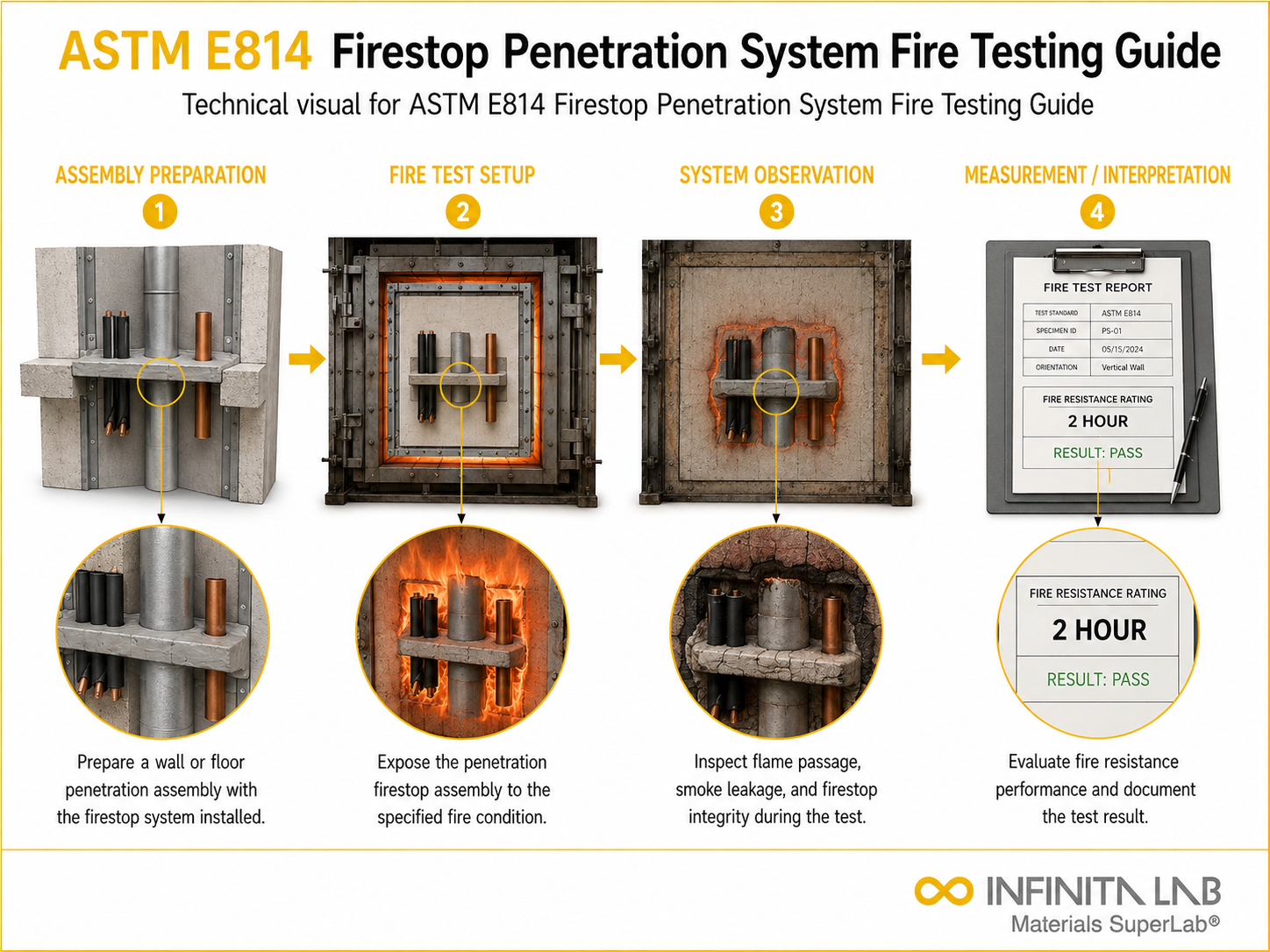
Specimen Construction & Assembly Installation Setup
Firestop system is installed in a representative wall or floor assembly with defined penetrations.
1Furnace Exposure & Standard Fire Curve Application
Specimen is exposed to controlled fire conditions following a standard time-temperature profile.
2Temperature Monitoring & Flame Passage Observation Stage
Thermocouples and visual inspection track heat transfer and any flame or gas leakage.
3Performance Evaluation & Fire Rating Determination Analysis
Results are analyzed to determine F-rating and T-rating based on performance criteria.
4ASTM E814 Firestop Test – Technical Specification
| Parameter | Details |
|---|---|
| Standard | ASTM E814 |
| Test Method | Fire resistance testing of penetration firestop systems |
| Measurement Type | Flame passage and temperature rise |
| Sample Type | Firestop systems in wall or floor penetrations |
| Loading Type | Thermal exposure under standard fire curve |
| Units | Minutes, °C |
| Temperature Curve | Standard time-temperature fire exposure |


Instrumentation Used for Testing
- Fire resistance furnace
- Thermocouples
- Data acquisition system
- Pressure control system
- Specimen frame
- Observation system
Results and Deliverables
- Fire-resistance rating (F-rating and T-rating)
- Temperature rise data
- Flame passage observations
- Integrity and insulation evaluation
- Compliance confirmation
- Detailed test report
Frequently Asked Questions
Both standards test the fire resistance of through-penetration firestop systems and produce F and T ratings using nearly identical methods. The main difference is that UL 1479 includes optional test protocols for L ratings (air leakage / smoke resistance) and W ratings (water leakage) that are not included in ASTM E814. Both are referenced by the IBC and accepted by building codes.
The F rating is the number of hours a firestop system prevents flames from passing through to the unexposed side, rounded down to the last completed hour. A 2-hour F rating means the system held against flame penetration for at least 2 full hours during testing.
The T rating is the number of hours before any thermocouple on the unexposed side records a temperature rise exceeding 325°F above the starting ambient temperature. It measures heat transmission through the firestop system and penetrating items — even if fire doesn't pass through, excessive heat can ignite materials on the other side.
No. ASTM E814 tests the complete firestop system — including the specific penetrant type and size, the wall or floor construction, the annular space, and all firestop materials installed per the system details. A sealant alone does not receive an E814 rating.
The L rating measures air leakage through the firestop system and is used as a proxy for smoke leakage. It is an optional test protocol under UL 1479 only — ASTM E814 does not include an L rating test. L ratings are increasingly required in healthcare facilities and smoke compartmentation applications.
Why Choose Infinita Lab for Advanced Materials Testing and Characterization?
At the core of this breadth is our network of 2,000+ accredited laboratories across the USA, offering access to over 10,000 testing methods and analytical services. From advanced materials characterization (SEM, TEM, RBS, XPS) to mechanical, chemical, environmental, biological, and standardized ASTM/ISO-compliant testing, we deliver unmatched flexibility, specialization, and scale. You are never limited by geography, facility, or methodology — Infinita Lab connects you to the right expertise and testing solution, every time.

Looking for a Trusted Partner for Accurate and Reliable Testing Services?
Send query us at hello@infinitalab.com or call us at (888) 878-3090 to learn more about our services and how we can support you.



Request a Quote
Submit your material details and receive testing procedures, pricing, and turnaround time within 24 hours.
 Quick Turnaround and Hasslefree process
 Confidentiality Guarantee
 Free, No-obligation Consultation
 100% Customer Satisfaction
