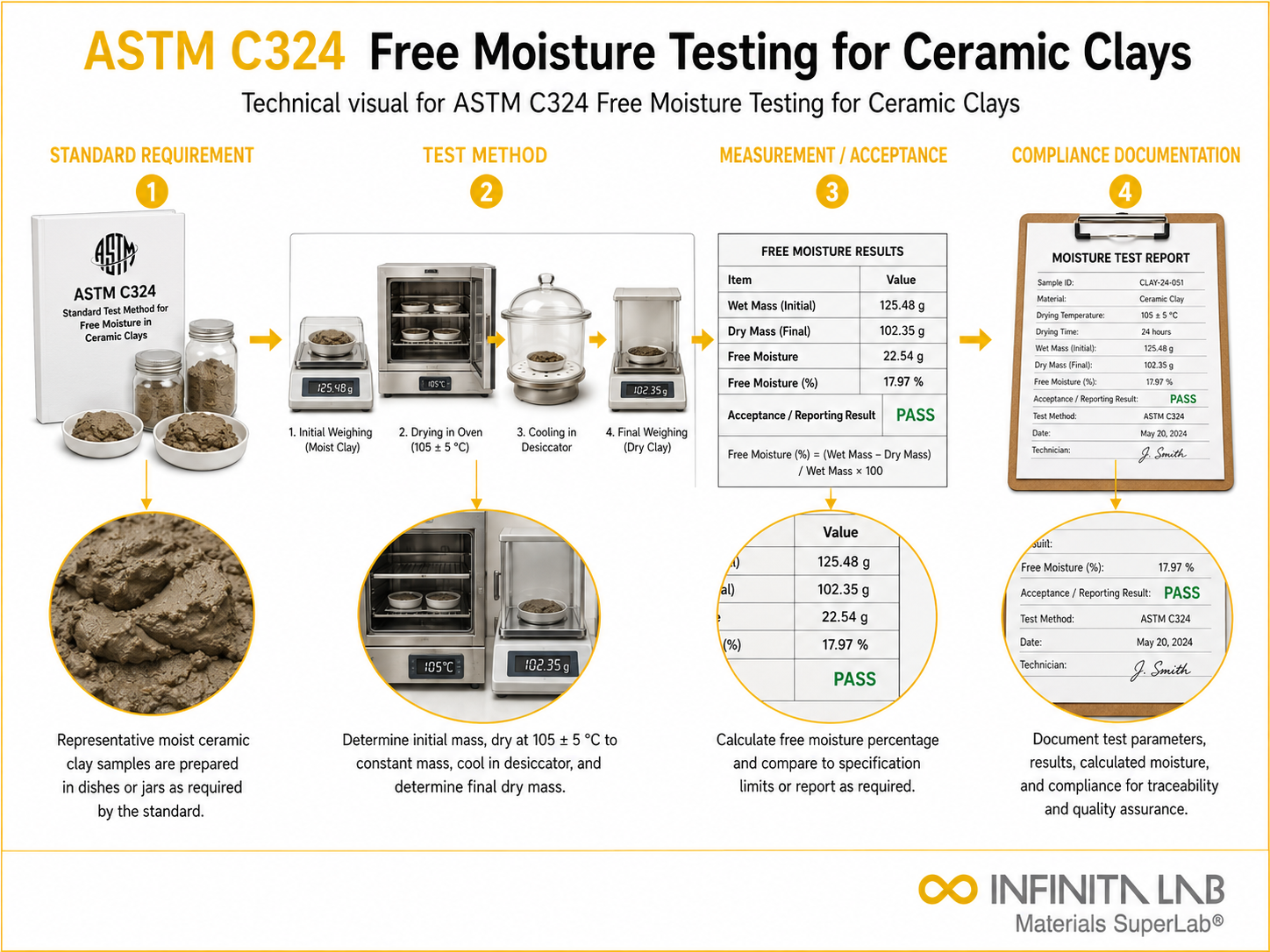


What Is ASTM C324 Ceramic Clay Free Moisture?
ASTM C324 describes a standard test procedure for determining the free moisture content of ceramic clays by oven drying. The test procedure consists of measuring the weight difference of a clay sample before and after controlled drying, to calculate the percentage of free moisture present in it.
This test method represents practical conditions for handling, storage, transportation, and processing of ceramic clays. ASTM C324 provides the necessary data to assess clay workability, compactness, and durability; these data are valuable for manufacturers in preventing deformation, swelling, or damage by excess moisture during shipping and industrial use.

Applications and Benefits of ASTM C324 Ceramic Clay Free Moisture Testing
Scope
ASTM C324 outlines procedures for measuring the free (uncombined) moisture content of ceramic clays through controlled oven drying.
It evaluates:
- Free moisture content by weight difference
- Suitability of clay for storage and transportation
- Influence of moisture on clay handling and processing behavior
- Potential risks of deformation or damage due to moisture variation
The method applies to ceramic clays used in industrial processing, manufacturing, and quality control applications.
Applications
- Quality control of ceramic clay raw materials
- Optimization of clay processing and forming operations
- Assessment of moisture suitability for shipping and storage
- Prevention of deformation or structural instability during transport
- Material evaluation for ceramic manufacturing processes
- Inventory and stockpile moisture management
Benefits
- Provides an accurate determination of free moisture content
- Uses a simple and repeatable oven-drying procedure
- Helps prevent moisture-related damage during storage and transport
- Supports consistent processing and product quality
- Enables optimization of clay handling and preparation
- Improves the reliability of ceramic production operations
Our ASTM C324 Testing Procedure
Specimen Preparation
A representative clay sample is collected, with approximately 500 g selected and evenly spread in a porcelain container to ensure uniform drying.
1Oven Drying
The specimen is dried in an oven at 100–110°C for approximately 24 hours to remove free moisture without altering clay composition.
2Cooling
After drying, the specimen is placed in a desiccator and allowed to cool to room temperature to prevent moisture reabsorption.
3Weighing & Calculation
The dried specimen is reweighed, and the weight difference is used to calculate free moisture content on a dry-weight basis.
4ASTM C324 Test Parameters and Requirements
| Parameter | Details |
|---|---|
| Sample Requirement | Minimum 1000 g representative clay sample |
| Test Portion | Approximately 500 g |
| Drying Temperature | 100–110°C |
| Drying Duration | Approximately 24 hours or until constant weight |
| Cooling Method | Desiccator at room temperature |
| Measured Output | Free moisture content (% dry weight basis) |


- Drying oven with temperature control
- Porcelain or heat-resistant containers
- An analytical balance for accurate mass measurement
- Desiccator for controlled cooling
- Temperature monitoring devices
- Data recording and calculation tools
Equipment and Instrumentation Used for ASTM C324 Testing
What You Receive: Test Report, Data, and Certification
- Percentage free moisture content of ceramic clay
- Documentation of initial and dried sample weights
- Assessment of clay suitability for handling, storage, and transport
- Quality control data for raw material acceptance
- Information supporting process optimization and inventory management
- Reliable moisture content records for manufacturing consistency
ASTM C324 Ceramic Clay Free Moisture FAQs
The primary objective of ASTM C324 is to determine the free moisture content in ceramic clay. This measurement ensures that the material is free from factors such as deformation or damage due to excess moisture, thus making it suitable for storage, shipping, or manufacturing applications.
The high moisture content tends to generate problems during transport and sometimes swelling or instability in the structure, so measuring free moisture is extremely important. Moreover, the compaction and strength of clay products vary with too much moisture content. So, it is necessary to measure free moisture correctly to ensure quality control.
The test requires a minimum clay sample size of 1000 g, of which approximately 500 g is used for oven drying. The sample must be evenly spread in a porcelain container for uniform drying.
The sample is dried at 100–110°C to prevent altering the clay's composition. Higher temperatures may lead to chemical changes or degradation, affecting the accuracy of the test.
ASTM C324 determines free moisture in ceramic whiteware clays by weighing a representative sample before and after drying it to a constant mass. The mass loss is used to calculate moisture content, typically reported to the nearest 0.1%. Although online sensors can monitor moisture continuously during processing, they require appropriate calibration and are not the method specified by ASTM C324.
Why Choose Infinita Lab for Ceramic Clay Free Moisture Testing?
When your Ceramic Clay Free Moisture results have to hold up - for compliance, a customer audit, or an engineering decision - ASTM C324 accuracy and an unbiased third-party report matter more than price. Infinita Lab routes your ASTM C324 ceramic clay free moisture testing to ISO/IEC 17025-accredited U.S. partner labs with hands-on method experience, so you get defensible data, transparent reporting, and turnaround times built around your project deadline - not ours.

Need ASTM C324 Ceramic Clay Free Moisture Testing You Can Rely On?
Send query us at hello@infinitalab.com or call us at (888) 878-3090 to learn more about our services and how we can support you.