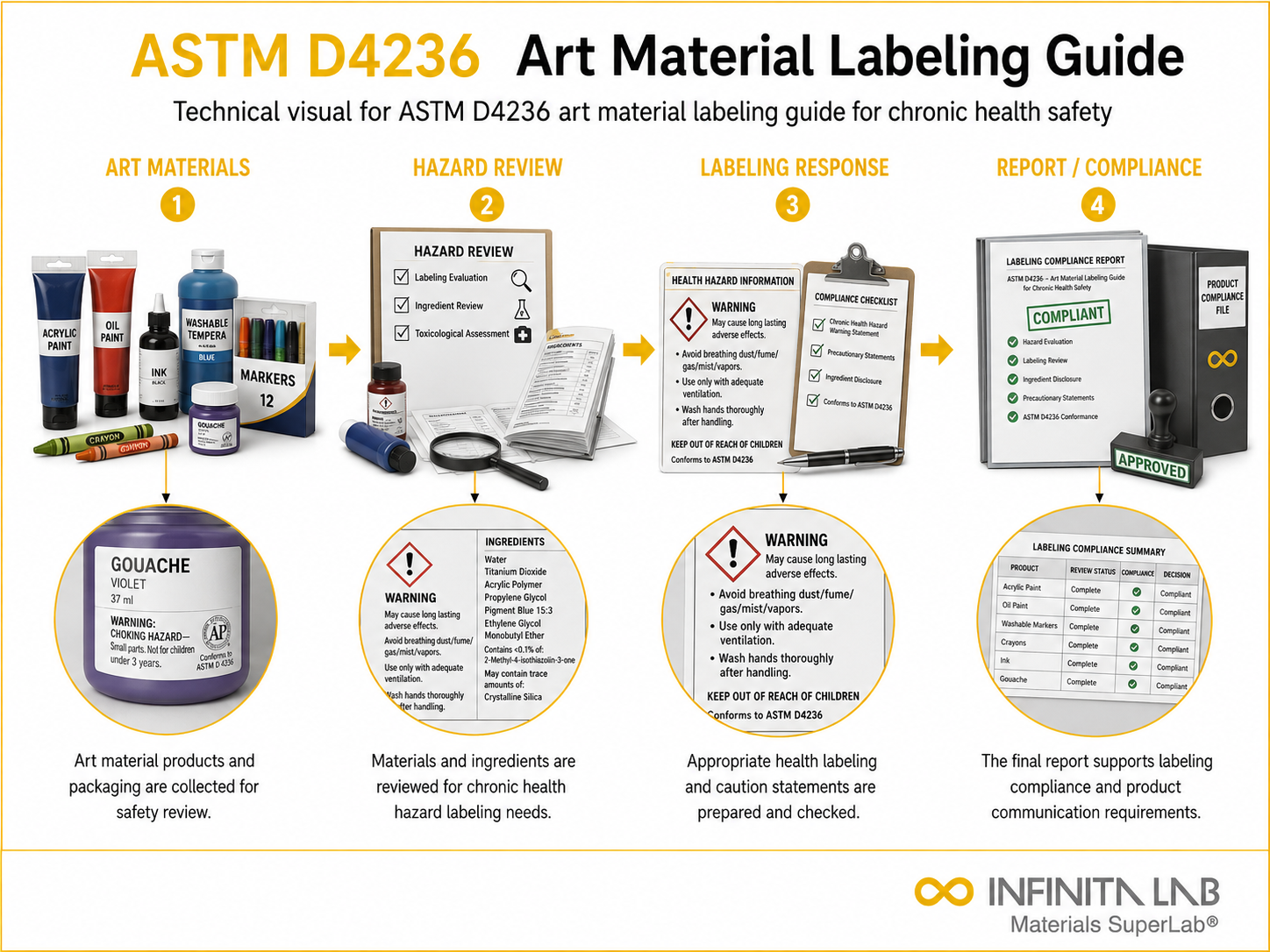


What Is ASTM D4236 Art Material Labeling?
ASTM D4236, the Standard Practice for Labelling Art Materials for Chronic Health Hazards, is not a physical or instrumental test but a toxicological evaluation and labelling practice applied to paints, inks, crayons, markers, clays, adhesives, and similar creative materials sold to consumers. Rather than measuring a physical property in a laboratory, the standard requires a qualified toxicologist to review a product’s complete formulation and assess whether any ingredient, at the concentration present, has the potential to cause a chronic health hazard such as carcinogenicity, reproductive or developmental toxicity, neurotoxicity, organ damage, or sensitisation from repeated or long-term exposure. The outcome of that review determines how the product must be labelled. If the toxicologist finds no ingredient present in a quantity capable of causing chronic harm, the product may carry a conformance statement such as “Conforms to ASTM D4236.” If a potential chronic hazard is identified, the label must instead carry an appropriate signal word, a description of the hazard, identification of the hazardous component, and instructions for safe use. ASTM D4236 underlies the federal Labelling of Hazardous Art Materials Act (LHAMA), which amended the Federal Hazardous Substances Act and is enforced by the U.S. Consumer Product Safety Commission, making toxicological evaluation and correct chronic-hazard labelling a legal requirement rather than a voluntary best practice for most art and craft products sold in the United States. This process matters because children and students use art materials widely in classrooms and at home, and because chronic hazards, unlike acute ones, may not produce visible symptoms until years after repeated exposure. Manufacturers, importers, and private-label brands rely on formulation review and correct labelling to protect consumers, satisfy retailer and school procurement requirements, and remain compliant with CPSC oversight.

Applications and Benefits of ASTM D4236 Art Material Labeling Testing
Scope
- ASTM D4236 requires that a qualified toxicologist review the complete formulation of an art, craft, or creative material for its potential to cause chronic health hazards.
- The evaluation considers chronic effects such as carcinogenicity, reproductive and developmental toxicity, neurotoxicity, organ system damage, and sensitisation arising from repeated or long-term exposure.
- Covered products include paints, inks, pigments, crayons, markers, coloured pencils, chalk, clays, ceramics, glues and adhesives, and comparable materials intended for creative or artistic use.
- Products that the toxicological review finds free of chronic-hazard ingredients in harmful quantities may carry a conformance statement such as “Conforms to ASTM D4236” on the label or packaging.
- Products found to contain a chronic-hazard ingredient must instead carry precautionary labelling that identifies the hazard, names the hazardous component, and provides safe-use instructions.
- This practice is based on the federal Labelling of Hazardous Art Materials Act (LHAMA), which amended the Federal Hazardous Substances Act and is enforced by the U.S. Consumer Product Safety Commission.
- ASTM D4236 addresses only chronic, long-term health hazards. It does not cover acute or physical hazards such as flammability, corrosivity, or immediate toxicity, which are addressed under separate frameworks such as OSHA Hazard Communication (HazCom) and GHS classification.
- Formulations are generally expected to be re-reviewed periodically and whenever a product’s formulation changes, so that the label continues to reflect the product actually being sold.
- The service applies across art, craft, and educational-supply industries, including manufacturers, importers, distributors, and private-label brand owners bringing art materials into the U.S. consumer market.
- The service supports regulatory compliance documentation, retail and school procurement requirements, and consumer-facing safety communication for art and creative materials.
Applications
- Manufacturers of children’s art supplies, including paints, markers, crayons, and modelling compounds.
- Craft product manufacturers producing adhesives, inks, and mixed-media materials for consumer use.
- School and educational suppliers furnishing art materials for classroom and student use.
- Importers bringing foreign-manufactured art and craft materials into the U.S. market.
- Private-label and contract manufacturers producing art materials under retailer or brand-owner labels.
- Speciality and fine-art suppliers marketing paints, pigments, and studio materials to professional and hobbyist artists.
- Retailers seeking documentation that art materials they sell meet LHAMA labelling obligations.
Benefits
- Confirms that a product’s formulation has been reviewed for chronic health hazards before it reaches consumers.
- Supports compliance with the federal Labelling of Hazardous Art Materials Act and reduces exposure to CPSC enforcement action.
- Provides parents, educators, and institutional buyers with clear, standardised safety information on the label.
- Enables use of a recognised conformance statement or certification seal that supports marketability and retailer acceptance.
- Reduces manufacturer liability by documenting a defensible, toxicologist-led hazard evaluation.
- Helps importers and private-label brands meet U.S. labelling expectations before products enter distribution.
Our ASTM D4236 Testing Procedure
Formulation Submission
Art material manufacturer submits complete formulation ingredient list to a certified toxicologist.
1Toxicological Review
Toxicologist evaluates each ingredient for chronic health hazard potential using established toxicological databases.
2Hazard Determination
Products are classified as requiring cautionary labeling or as free of chronic hazards.
3Label Development
Required cautionary statements, safe use instructions, and AP seal are incorporated into the product label.
4ASTM D4236 Test Parameters and Requirements
| Parameter | Details |
|---|---|
| Test Principle | Toxicological formulation review |
| Applicable Materials | Art and craft materials |
| Output | AP seal designation |
| Measured Outputs | Hazard classification, required label statements |


- Toxicological Formulation Review – A qualified toxicologist examines the complete ingredient formulation of the art or craft material to identify substances with chronic-hazard potential.
- Ingredient and Safety Data Sheet Documentation Review – Manufacturer-supplied ingredient disclosures and safety data sheets are reviewed to confirm that the formulation under evaluation is complete and accurate.
- Regulatory and Toxicological Reference Database Consultation – Established toxicological and regulatory references are consulted to assess the carcinogenic, reproductive, neurotoxic, or sensitising potential of individual ingredients.
- Chronic Hazard Risk Assessment – Findings from the ingredient-level review are combined into an overall determination of the product’s chronic-hazard status at its actual use concentrations.
- Label Content Compliance Review – Proposed label language, including any hazard warnings or conformance statements, is checked against ASTM D4236 and LHAMA requirements.
- Certification Program Coordination – Where a manufacturer pursues a recognised seal such as ACMI’s AP or CL program, the evaluation and label are coordinated with that program’s submission requirements.
- Compliance Documentation Compilation – The review findings, determination, and approved label language are organised into a formulation-review record suitable for regulatory files.
Equipment and Instrumentation Used for ASTM D4236 Testing
What You Receive: Test Report, Data, and Certification
- A toxicological formulation review report documenting the evaluation methodology and findings for each ingredient assessed.
- A clear chronic-hazard determination stating whether the product’s formulation warrants a conformance statement or a hazard warning label.
- Approved label language, including any required signal word, hazard description, hazardous component identification, and safe-use instructions.
- Supporting documentation suitable for a manufacturer’s regulatory compliance file and for response to CPSC or retailer inquiries.
- Guidance on coordinating the review and label outcome with a recognised certification program, such as ACMI’s AP or CL seal, where the manufacturer chooses to pursue one.
- A record of the formulation reviewed and the date of evaluation, to support future re-review when the formulation changes.
ASTM D4236 Art Material Labeling FAQs
ASTM D4236 establishes requirements for labeling art materials regarding chronic health hazards. It ensures products are reviewed by toxicologists and properly labeled to inform users about potential long-term health risks during normal use.
Key parameters include toxicological review of ingredients, exposure assessment, hazard identification, and labeling requirements. Evaluation ensures accurate communication of chronic health risks associated with art materials.
ASTM D4236 does not measure physical properties but ensures proper labeling of hazards. Results include compliance with labeling requirements and identification of chronic health risks.
ASTM D4236 applies to art materials such as paints, inks, adhesives, and craft supplies used by consumers, artists, and students where long-term exposure to chemicals may occur.
ASTM D4236 focuses on labeling and toxicological review, not performance testing. It depends on available toxicological data and may require updates as new health information becomes available.
A qualified toxicologist evaluates the material's ingredients, exposure potential, and health hazards to determine appropriate precautionary labelling.
Why Choose Infinita Lab for Advanced Materials Testing and Characterization?
At the core of this breadth is our network of 2,000+ accredited laboratories across the USA, offering access to over 10,000 testing methods and analytical services. From advanced materials characterization (SEM, TEM, RBS, XPS) to mechanical, chemical, environmental, biological, and standardized ASTM/ISO-compliant testing, we deliver unmatched flexibility, specialization, and scale. You are never limited by geography, facility, or methodology — Infinita Lab connects you to the right expertise and testing solution, every time.

Need ASTM D4236 Art Material Labeling Testing You Can Rely On?
Send query us at hello@infinitalab.com or call us at (888) 878-3090 to learn more about our services and how we can support you.





