


ASTM D1598: Plastic Pipe Sustained Pressure Failure Testing Services
Accredited ASTM D1598 plastic pipe sustained pressure failure testing from Infinita Lab, performed to the exact standard requirements - accurate, reproducible results with full documentation for compliance, R&D, and quality control programs.
TRUSTED BY


Get ASTM D1598 compliant results - request your plastic pipe sustained pressure failure testing quote
- Overview
- Scope, Applications, and Benefits
- Test Process
- Specifications
- Instrumentation
- Results and Deliverables
What Is ASTM D1598 Plastic Pipe Sustained Pressure Failure?
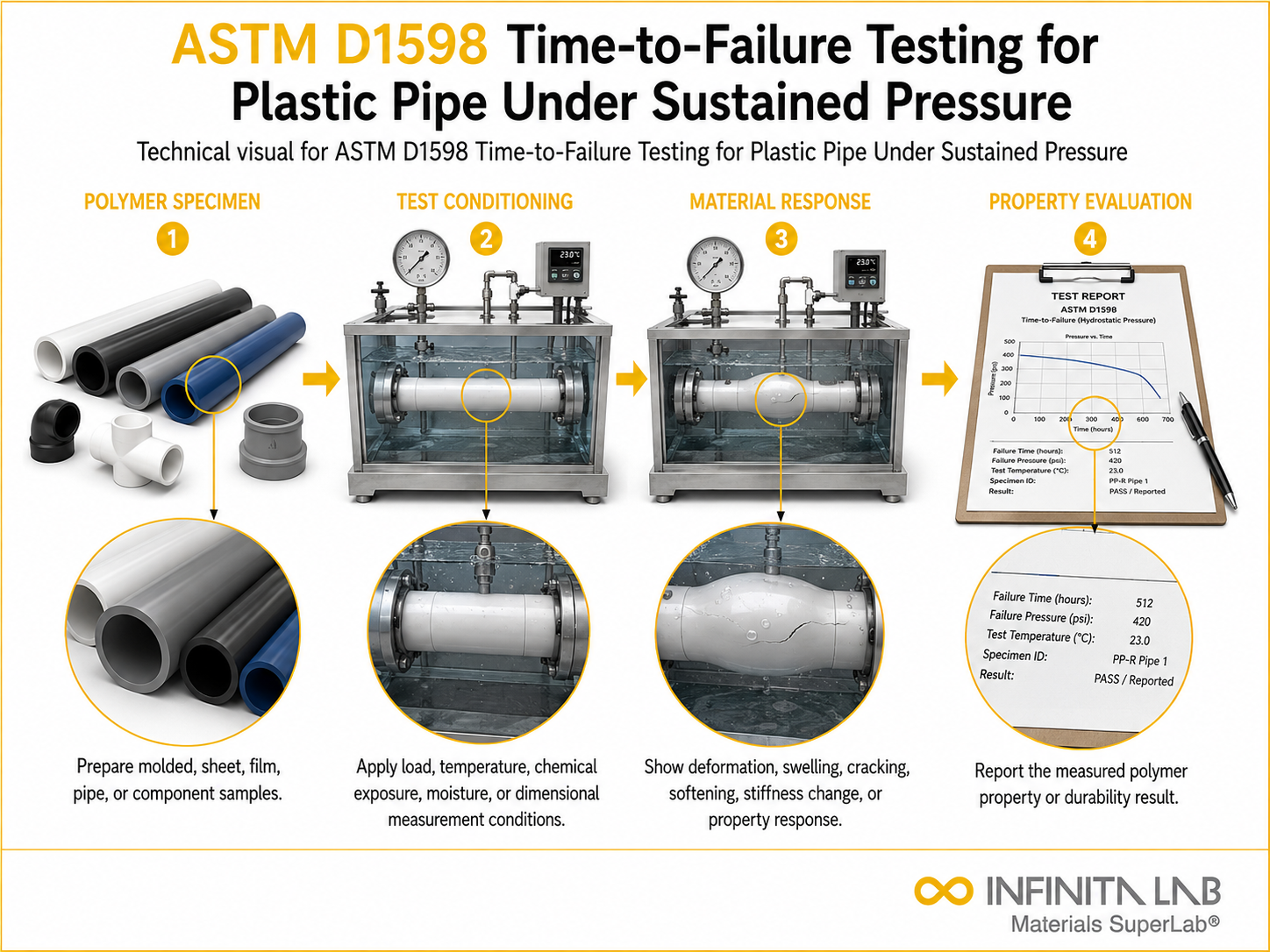
ASTM D1598, Standard Test Method for Time-to-Failure of Plastic Pipe Under Constant Internal Pressure, determines how long thermoplastic and reinforced thermosetting/resin pipe survives when held at a constant internal hydraulic pressure in a controlled environment. The method doesn’t ramp pressure until the pipe bursts. It fixes the pressure, and thus the hoop stress in the pipe wall, then records the time to failure. Each specimen yields one data point of stress against time-to-failure. The standard calls for results spread across at least two logarithmic decades, measured in hours, so that stress-versus-failure-time relationships and their confidence limits can be established. Those relationships are the raw material for calculating a hydrostatic design basis for pipe materials. The method is written around specimens cut from finished pipe. Each gets end closures, either free-end or restrained-end, that withstand the maximum test pressure. It’s then immersed in a temperature-controlled water bath or other fluid bath, or held in a controlled air environment. A pressurizing system holds the set pressure within tolerance while timing equipment records the hours to failure. Failure is defined as any continuous loss of pressure, with or without transmission of the test fluid. The standard distinguishes modes such as ballooning, rupture, and seepage or weeping. Plastics creep, so the standard treats excessive dimensional change as just as important as leakage. D1598 is distinct from ASTM D1599, which measures short-time burst pressure and can’t predict long-term strength. It supplies the individual data points that ASTM D2837 uses to derive hydrostatic design basis categories. The current active edition is D1598-24, which supersedes D1598-21 and earlier revisions. Reports identify the specimen and pipe dimensions, test temperature and environment, test fluid, applied pressure, calculated hoop stress, time-to-failure, and observed failure mode for every specimen tested.

Applications and Benefits of ASTM D1598 Plastic Pipe Sustained Pressure Failure Testing
Scope
ASTM D1598 evaluates plastic pipes’ resistance to constant internal pressure over time, helping determine durability and long-term hydrostatic strength.
- The standard covers the determination of the time-to-failure of both thermoplastic pipe and reinforced thermosetting/resin pipe under constant internal pressure.
- Plastics are characterized in pipe form under specified conditions, not as flat or molded coupons.
- A fixed internal hydraulic pressure is applied, so each specimen experiences a constant hoop stress in the pipe wall for the duration of the test.
- Specimens carry end closures. Free-end or restrained-end designs are both permitted, provided they can withstand the maximum test pressure.
- A temperature-controlled environment is required, typically a water or other fluid bath, so the specimen temperature stays uniform and within tolerance.
- Any continuous loss of pressure counts as failure. Ballooning, rupture, and seepage or weeping are recognized and recorded.
- Data are meant to establish stress-versus-failure-time relationships over two or more logarithmic decades measured in hours.
- Creep and long-term strength factors can influence results; the standard acknowledges this, so representative specimens are essential.
- ASTM D1599 is a different method: it covers short-time burst pressure and isn’t suitable for predicting long-term strength.
- D1598 alone doesn’t set test temperatures, pressures, or durations for a given pipe product. The governing product specification or test plan does.
Applications
- Generating the individual stress-rupture data points used to derive hydrostatic design basis values under ASTM D2837.
- Qualification of new thermoplastic pipe compounds (PVC, polyethylene, polypropylene) for pressure service.
- Checking that production pipe meets the sustained-pressure requirements of product standards and purchase specifications.
- Reinforced thermosetting/resin pipe used in industrial, chemical, and fluid-transport systems.
- Comparing the long-term pressure performance of candidate resins, formulations, or manufacturing processes.
- Root-cause investigations when installed pipe fails prematurely in service.
- Evidence for regulatory, certification, or third-party listing programs that require sustained-pressure performance.
Benefits
- Reveals long-term pressure behavior that short-term burst testing cannot predict.
- Time-to-failure data feed directly into recognized design-basis calculations.
- The failure mode is identified, which helps engineers distinguish ductile ballooning from brittle rupture or seepage.
- It’s the actual pipe under test, so results reflect real wall construction, processing history, and dimensions.
- A standardized, repeatable procedure supports comparison across laboratories and material grades.
- Reduces field-failure risk by exposing weak formulations before pipe enters service.
Our ASTM D1598 Testing Procedure
Specimen Preparation
Pipe samples are cut to required length and sealed with end fittings.
1Pressure Application
Constant internal hydrostatic pressure is applied to the specimen.
2Temperature Control
Test is conducted at a specified constant temperature environment.
3Failure Monitoring
Time until pipe failure is recorded under sustained pressure.
4ASTM D1598 Test Parameters and Requirements
| Parameter | Details |
|---|---|
| Pressure Mode | Constant internal pressure applied |
| Temperature Control | Typically ambient or elevated conditions |
| Specimen Type | Plastic pipes or tubing |
| Failure Criteria | Burst, leakage, or rupture |
| Duration | Short-term to long-term testing |
| Output | Time-to-failure in hours |
| Material Scope | Thermoplastics such as PVC, PE, PP |


- Constant-Pressure Control System – applies and holds the specified internal pressure within tolerance throughout the test.
- Temperature-Controlled Water Bath – keeps fluid temperature uniform around the specimens for the full test duration.
- End Closures (Free-End or Restrained-End) – seal the pipe ends and withstand the maximum test pressure.
- Pressure Transducers and Gauges – verify the applied pressure. They also confirm it stays within the allowed tolerance.
- Failure-Detection and Timing Devices – capture the elapsed hours when continuous pressure loss occurs.
- Calipers and Micrometers – measure outside diameter and wall thickness, which feed the hoop stress calculation and help monitor dimensional change.
- Data Acquisition Software – logs pressure, temperature, and time. It also supports stress-versus-time-to-failure plots.
Equipment and Instrumentation Used for ASTM D1598 Testing
What You Receive: Test Report, Data, and Certification
- Time-to-failure, in hours, for each specimen tested.
- Applied internal pressure and calculated hoop stress for each specimen.
- Classification of the failure mode, such as ballooning, rupture, or seepage.
- Plots of stress versus time-to-failure, suitable for design-basis analysis.
- Full documentation covering specimen identification, pipe dimensions, test temperature, test fluid, and environment.
ASTM D1598 Plastic Pipe Sustained Pressure Failure FAQs
ASTM D1598 is important because it evaluates how long plastic pipes can withstand constant internal pressure before failure. This helps ensure long-term reliability, safety, and suitability of pipes for pressure-based applications in various environments.
Time-to-failure indicates the duration a pipe can sustain internal pressure before failing. It reflects the material’s resistance to creep and stress over time, providing insight into long-term performance and durability.
Temperature affects material behavior and creep characteristics. Maintaining a constant temperature ensures accurate and consistent results, allowing meaningful comparison between different materials and test conditions.
ASTM D1598 focuses on long-term performance under sustained pressure, while short-term tests measure immediate strength. This test provides insight into creep and delayed failure behavior over extended periods.
Higher pressure levels generally reduce time-to-failure, as increased stress accelerates material degradation. Lower pressures may result in longer failure times.
Plastic pipe failure is evaluated by examining the failed area, dimensions, material structure, processing characteristics, and test history to identify defects such as voids, inclusions, poor fusion, wall-thickness variation, or processing flaws. Pressure and failure-time data can then be compared with applicable requirements to determine whether the failure is consistent with a manufacturing-related defect.
ASTM D1598 determines the time-to-failure of plastic pipe under constant internal pressure. Pipe specimens are subjected to controlled internal pressure, and the time to leakage, rupture, or significant nonrecoverable deformation is recorded to evaluate stress–failure behavior.
Why Choose Infinita Lab for Plastic Pipe Sustained Pressure Failure Testing
When your Plastic Pipe Sustained Pressure Failure results have to hold up - for compliance, a customer audit, or an engineering decision - ASTM D1598 accuracy and an unbiased third-party report matter more than price. Infinita Lab routes your ASTM D1598 plastic pipe sustained pressure failure testing to ISO/IEC 17025-accredited U.S. partner labs with hands-on method experience, so you get defensible data, transparent reporting, and turnaround times built around your project deadline - not ours.

Need ASTM D1598 Plastic Pipe Sustained Pressure Failure Testing You Can Rely On?
Send query us at hello@infinitalab.com or call us at (888) 878-3090 to learn more about our services and how we can support you.


Request a Quote
Submit your material details and receive testing procedures, pricing, and turnaround time within 24 hours.
 Quick Turnaround and Hasslefree process
 Confidentiality Guarantee
 Free, No-obligation Consultation
 100% Customer Satisfaction
