


Hydraulics Testing Services
Hydraulic systems employ fluids to generate power and regulate motion, therefore hydraulic testing entails assessing and measuring how well they work. Measurements of variables including flow rate, pressure, temperature, and efficiency can be part of testing. Particularly in sectors like aerospace, construction, and manufacturing, hydraulics testing is crucial to ensure that hydraulic systems function safely, effectively, and dependably.
TRUSTED BY


Get compliant results — request your hydraulics testing quote
- Overview
- Scope, Applications, and Benefits
- Test Process
- Specifications
- Instrumentation
- Results and Deliverables
What Is Hydraulics?
Hydraulics Testing evaluates the performance, strength, and reliability of hydraulic systems and components under controlled pressure and flow conditions. It ensures that systems operate efficiently without leakage, failure, or performance loss.
This testing is critical in industries such as construction, automotive, aerospace, and manufacturing, where hydraulic systems are widely used for power transmission and control.

Applications and Benefits of Hydraulics Testing
Scope
Hydraulics testing involves assessing pressure resistance, flow characteristics, leakage, and system efficiency. It helps verify whether components meet design and safety requirements.
It supports product validation, quality control, and performance optimization.
The scope includes:
Pressure and burst testing
Flow rate and efficiency evaluation
Leakage detection
Performance testing under load
Validation of hydraulic components and systems
Applications
Hydraulic cylinders and pumps
Valves and actuators
Industrial machinery
Automotive braking systems
Aerospace hydraulic systems
Benefits
Ensures system safety and reliability
Detects leaks and weaknesses
Improves performance efficiency
Reduces maintenance and downtime
Supports compliance with standards
Our Testing Procedure
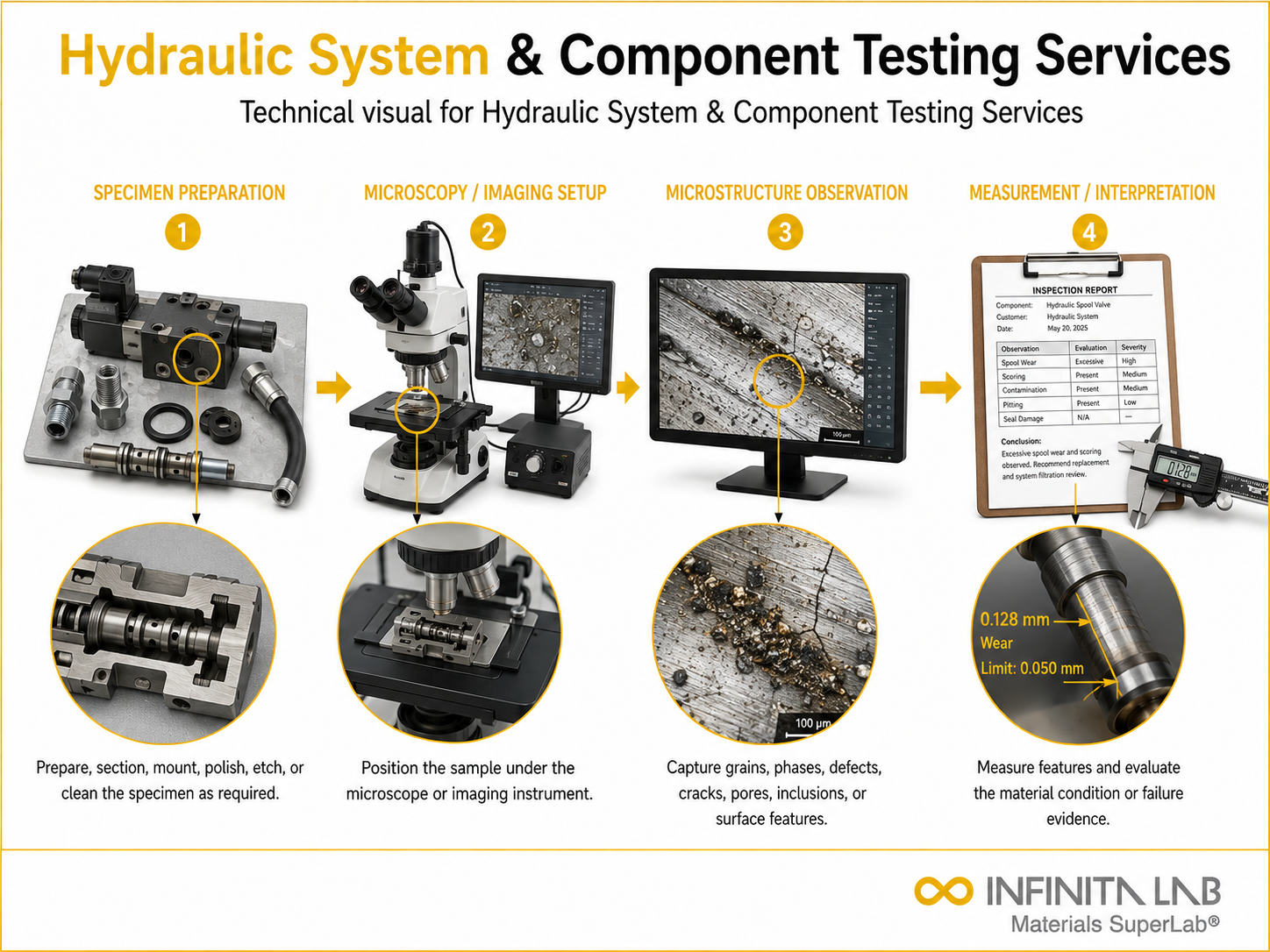
Setup and Preparation
Hydraulic components are connected to the test system and filled with fluid.
1Pressure Application
Controlled pressure is applied to simulate operating conditions.
2Performance Monitoring
Flow rate, pressure stability, and leakage are monitored.
3Result Evaluation
Data is analyzed to assess system performance and compliance.
4Test parameters and requirements
| Parameter | Details |
|---|---|
| Parameters Measured | Pressure, flow rate, leakage, efficiency |
| Pressure Range | Low to very high pressures |
| Test Fluids | Hydraulic oil or specified fluid |
| Test Types | Burst test, proof pressure test, endurance test |
| Measurement Accuracy | High-precision sensors and gauges |
| Control System | Automated or manual control systems |
| Output | Performance data and compliance status |


Hydraulic Test Bench
Pressure Gauges and Transducers
Flow Meters
Leak Detection Systems
Data Acquisition System
Equipment and Instrumentation Used for Testing
What You Receive: Test Report, Data, and Certification
Pressure and flow performance data
Leakage and failure analysis
Efficiency evaluation
Compliance status
Detailed test report
Hydraulics FAQs
Hydraulics testing is the evaluation of hydraulic systems and components to ensure they perform reliably under pressure, flow, and load conditions without leakage or failure.
It ensures system safety, detects potential failures, and improves performance, which is essential for applications where hydraulic systems operate under high pressure.
It determines the maximum pressure a component can withstand before failure, ensuring safety under extreme conditions.
Yes, testing systems are designed to replicate real operating pressures and loads for accurate performance evaluation.
It verifies that a component can safely withstand a specified pressure without permanent deformation or failure.
Why Choose Infinita Lab for Hydraulics Testing?
At the core of this breadth is our network of 2,000+ accredited laboratories across the USA, offering access to over 10,000 testing methods and analytical services. From advanced materials characterization (SEM, TEM, RBS, XPS) to mechanical, chemical, environmental, biological, and standardized ASTM/ISO-compliant testing, we deliver unmatched flexibility, specialization, and scale. You are never limited by geography, facility, or methodology — Infinita Lab connects you to the right expertise and testing solution, every time.

Looking for an Accredited Partner for Hydraulics Testing?
Send query us at hello@infinitalab.com or call us at (888) 878-3090 to learn more about our services and how we can support you.



Request a Quote
Submit your material details and receive testing procedures, pricing, and turnaround time within 24 hours.
 Quick Turnaround and Hasslefree process
 Confidentiality Guarantee
 Free, No-obligation Consultation
 100% Customer Satisfaction
