


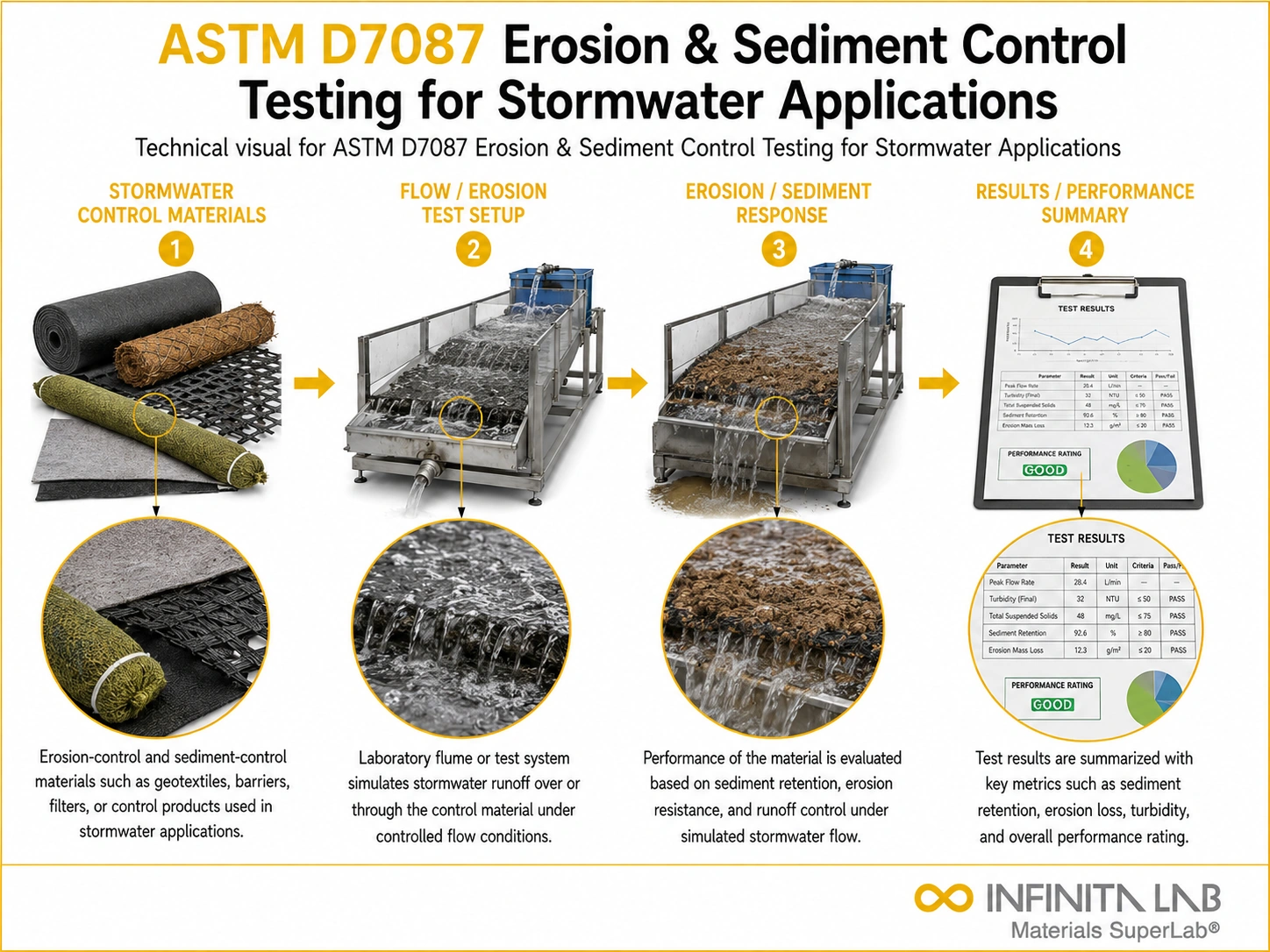
ASTM D7087: Stormwater Erosion Sediment Control Testing Services
ASTM D7087-05a is the standard test method to estimate the rust creepage on coated test panels exposed to corrosive environments. The method utilizes visual imaging software. The values are stated in SI units.
TRUSTED BY


Get ASTM D7087 compliant results — request your stormwater erosion sediment control testing quote
- Overview
- Scope, Applications, and Benefits
- Test Process
- Specifications
- Instrumentation
- Results and Deliverables
What Is ASTM D7087 Stormwater Erosion Sediment Control?
ASTM D7087-05a provides a test method for measuring the increase in light haze resulting from the scratching of polymeric film, coating, or plastic surfaces. Scratching introduces surface irregularities that scatter light, reducing optical clarity — a critical concern for optical films, automotive glazing, consumer displays, and protective coatings.
By quantifying haze increase from scratches, this method provides an objective, instrument-based measure of scratch visibility that correlates with perceived appearance degradation.

Applications and Benefits of ASTM D7087 Stormwater Erosion Sediment Control Testing
Scope
ASTM D7087-05a applies to transparent or semi-transparent polymeric surfaces and measures:
- Percent haze before and after defined scratching
- Haze increase (ΔHaze) as the scratch damage metric
- Effect of scratch severity, tip geometry, and number of passes
- Comparison of scratch resistance across different surface materials
Applications
- Automotive plastic glazing and windshield scratch evaluation
- Optical film and display cover glass alternatives
- Eyewear lens scratch resistance testing
- Anti-scratch coating development and qualification
- Consumer electronics screen protection film assessment
Benefits
- Objective, quantitative measure correlated to scratch visibility
- Sensitive to subtle surface changes invisible to the naked eye
- Enables rapid comparison of anti-scratch coating formulations
- Applicable to both flexible films and rigid plastic substrates
- Complements visual inspection methods with instrument data
Our ASTM D7087 Testing Procedure
Baseline Haze Measurement
Initial haze of the specimen is measured per ASTM D1003 before any scratching.
1Scratching
The specimen surface is scratched using a defined stylus, abrasive, or finger simulation tool under controlled load and stroke conditions.
2Post-Scratch Haze Measurement
Haze is re-measured in the scratched area using a hazemeter aligned to the scratch region.
3ΔHaze Calculation
The change in haze (ΔHaze = post-scratch minus baseline) is calculated and reported as the scratch damage metric.
4ASTM D7087 Test Parameters and Requirements
| Parameter | Details |
|---|---|
| Test Principle | Hazemeter measurement before and after defined scratching |
| Applicable Materials | Transparent polymeric films, coatings, and plastics |
| Haze Measurement | Per ASTM D1003 (D65 illuminant, 2° observer) |
| Key Metric | ΔHaze (%) from scratching |


- Hazemeter (ASTM D1003 compliant)
- Scratch stylus or abrasive pad with defined load
- Controlled-stroke scratch device or scratch tester
- Specimen holder for alignment during haze measurement
- Light booth for visual correlation of haze changes
Equipment and Instrumentation Used for ASTM D7087 Testing
What You Receive: Test Report, Data, and Certification
- Initial and post-scratch haze values (%)
- ΔHaze for each scratch condition tested
- Photographic documentation of the scratch zone
- Ranking of materials by scratch-induced haze increase
- Test report with detailed test conditions and statistics
ASTM D7087 Stormwater Erosion Sediment Control FAQs
Haze is the percentage of transmitted light that deviates from the beam direction by more than 2.5° due to surface or bulk scatter; it quantifies cloudiness or fogginess in transparent materials.
Haze correlates directly to visual appearance degradation — a surface may have shallow scratches that greatly increase haze and are visually objectionable, while deeper scratches on matte surfaces may not.
Yes — anti-reflective and anti-scratch coatings on plastic optics and display components are commonly evaluated by this method.
The method is flexible regarding scratch tool type — stylus, abrader, or cloth; the specific tool and load must be reported for meaningful comparison.
Acceptance criteria vary by application; automotive glazing standards typically allow no more than 2–4% haze increase after defined scratch tests, while optical lens standards may require ΔHaze below 1%.
Why Choose Infinita Lab for Stormwater Erosion Sediment Control Testing
At the core of this breadth is our network of 2,000+ accredited laboratories across the USA, offering access to over 10,000 testing methods and analytical services. From advanced materials characterization (SEM, TEM, RBS, XPS) to mechanical, chemical, environmental, biological, and standardized ASTM/ISO-compliant testing, we deliver unmatched flexibility, specialization, and scale. You are never limited by geography, facility, or methodology — Infinita Lab connects you to the right expertise and testing solution, every time.

Looking for an Accredited Partner for ASTM D7087 Stormwater Erosion Sediment Control Testing?
Send query us at hello@infinitalab.com or call us at (888) 878-3090 to learn more about our services and how we can support you.



Request a Quote
Submit your material details and receive testing procedures, pricing, and turnaround time within 24 hours.
 Quick Turnaround and Hasslefree process
 Confidentiality Guarantee
 Free, No-obligation Consultation
 100% Customer Satisfaction
