


ASTM C1869: Ceramic Open Hole Tensile Testing Services
Accredited ASTM C1869 ceramic open hole tensile testing from Infinita Lab, performed to the exact standard requirements - accurate, reproducible results with full documentation for compliance, R&D, and quality control programs.
TRUSTED BY


Get ASTM C1869 compliant results - request your ceramic open hole tensile testing quote
- Overview
- Scope, Applications, and Benefits
- Test Process
- Specifications
- Instrumentation
- Results and Deliverables
What Is ASTM C1869 Ceramic Open Hole Tensile?
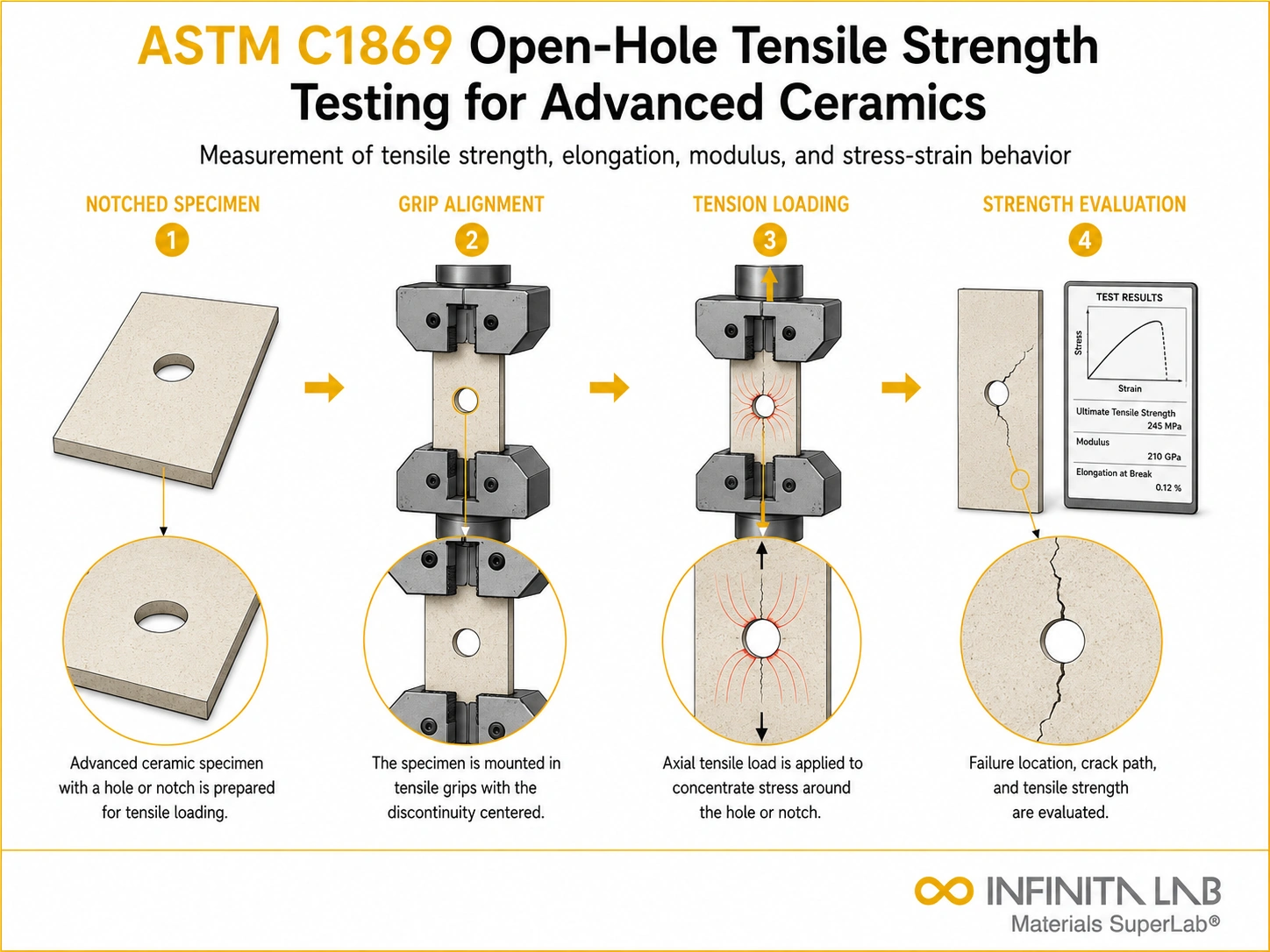
ASTM C1869 specifies a standardized method for determining the open-hole tensile strength of advanced ceramics. It evaluates the tensile behavior of specimens containing a centrally located hole, which introduces stress concentration and simulates real-world design features such as fastener holes.
This test is essential for understanding how ceramic materials perform under tensile loading when discontinuities are present. ASTM C1869 helps engineers assess strength reduction due to holes, enabling safer design, improved material selection, and reliable performance prediction in structural ceramic applications.

Applications and Benefits of ASTM C1869 Ceramic Open Hole Tensile Testing
Scope
ASTM C1869 outlines procedures for measuring tensile strength of ceramic materials with an open hole under controlled loading conditions.
- Applicable to monolithic advanced ceramics
- Evaluates tensile strength with a central hole
- Simulates stress concentration effects
- Includes specimen geometry and hole dimensions
- Ensures controlled tensile loading conditions
- Supports design validation and material comparison
Applications
- Structural ceramic components with fastener holes
- Aerospace and high-performance engineering parts
- Mechanical design validation
- Advanced ceramic research and development
- Quality control in ceramic manufacturing
- Failure analysis and reliability studies
Benefits
- Evaluates strength reduction due to stress concentration
- Supports safe and optimized component design
- Provides realistic performance assessment
- Enhances reliability of ceramic structures
- Enables standardized comparison of materials
- Assists in quality assurance and product development
Our ASTM C1869 Testing Procedure
Specimen Preparation
Machine specimen with a precise central hole and required dimensions.
1Fixture Setup
Mount specimen in tensile grips ensuring proper alignment.
2Load Application
Apply tensile load at a controlled rate until failure occurs.
3Strength Calculation
Calculate open-hole tensile strength using maximum load and net section area.
4ASTM C1869 Test Parameters and Requirements
| Parameter | Details |
|---|---|
| Material Type | Monolithic advanced ceramics |
| Specimen Geometry | Flat specimen with defined hole size |
| Loading Mode | Uniaxial tensile loading |
| Measurement Parameter | Maximum load at failure |
| Stress Calculation | Based on net section area |
| Test Environment | Ambient conditions |
| Failure Mode | Crack initiation at hole edge |
| Output Data | Open-hole tensile strength |


- Universal testing machine (UTM)
- Tensile grips and fixtures
- Precision machining tools for hole creation
- Alignment fixtures
- Extensometer (optional)
- Data acquisition system
Equipment and Instrumentation Used for ASTM C1869 Testing
What You Receive: Test Report, Data, and Certification
- Open-hole tensile strength values
- Load vs displacement data
- Failure location and crack initiation analysis
- Stress concentration behavior assessment
- Comparative material performance
- Detailed test report with calculations
ASTM C1869 Ceramic Open Hole Tensile FAQs
ASTM C1869 measures the open-hole tensile strength of continuous fiber-reinforced ceramic matrix composites (CMCs) to ascertain the impact of notching on these materials' tensile strength and stress response.
A hole or notch will further decrease tensile strength because the hole induces stress concentrations around it and causes delamination or early failure due to large holes.
Failures include cracking, delamination, or fracture at the hole edges. The mode of failure, force, and displacement at failure are documented to measure material behavior and performance during tensile stress.
The proportional limit stress indicates the maximum stress the material can withstand before it starts to experience permanent, non-linear deformation. It is an essential measure of material performance under stress.
Larger holes generally reduce the open-hole tensile (OHT) strength of CMCs, as they cause increased stress concentrations and create potential sites for delamination. The relationship between hole size and OHT strength helps assess the material's sensitivity to notches.
Why Choose Infinita Lab for Ceramic Open Hole Tensile Testing?
When your Ceramic Open Hole Tensile results have to hold up - for compliance, a customer audit, or an engineering decision - ASTM C1869 accuracy and an unbiased third-party report matter more than price. Infinita Lab routes your ASTM C1869 ceramic open hole tensile testing to ISO/IEC 17025-accredited U.S. partner labs with hands-on method experience, so you get defensible data, transparent reporting, and turnaround times built around your project deadline - not ours.

Looking for an Accredited Partner for ASTM C1869 Ceramic Open Hole Tensile Testing?
Send query us at hello@infinitalab.com or call us at (888) 878-3090 to learn more about our services and how we can support you.



Request a Quote
Submit your material details and receive testing procedures, pricing, and turnaround time within 24 hours.
 Quick Turnaround and Hasslefree process
 Confidentiality Guarantee
 Free, No-obligation Consultation
 100% Customer Satisfaction
