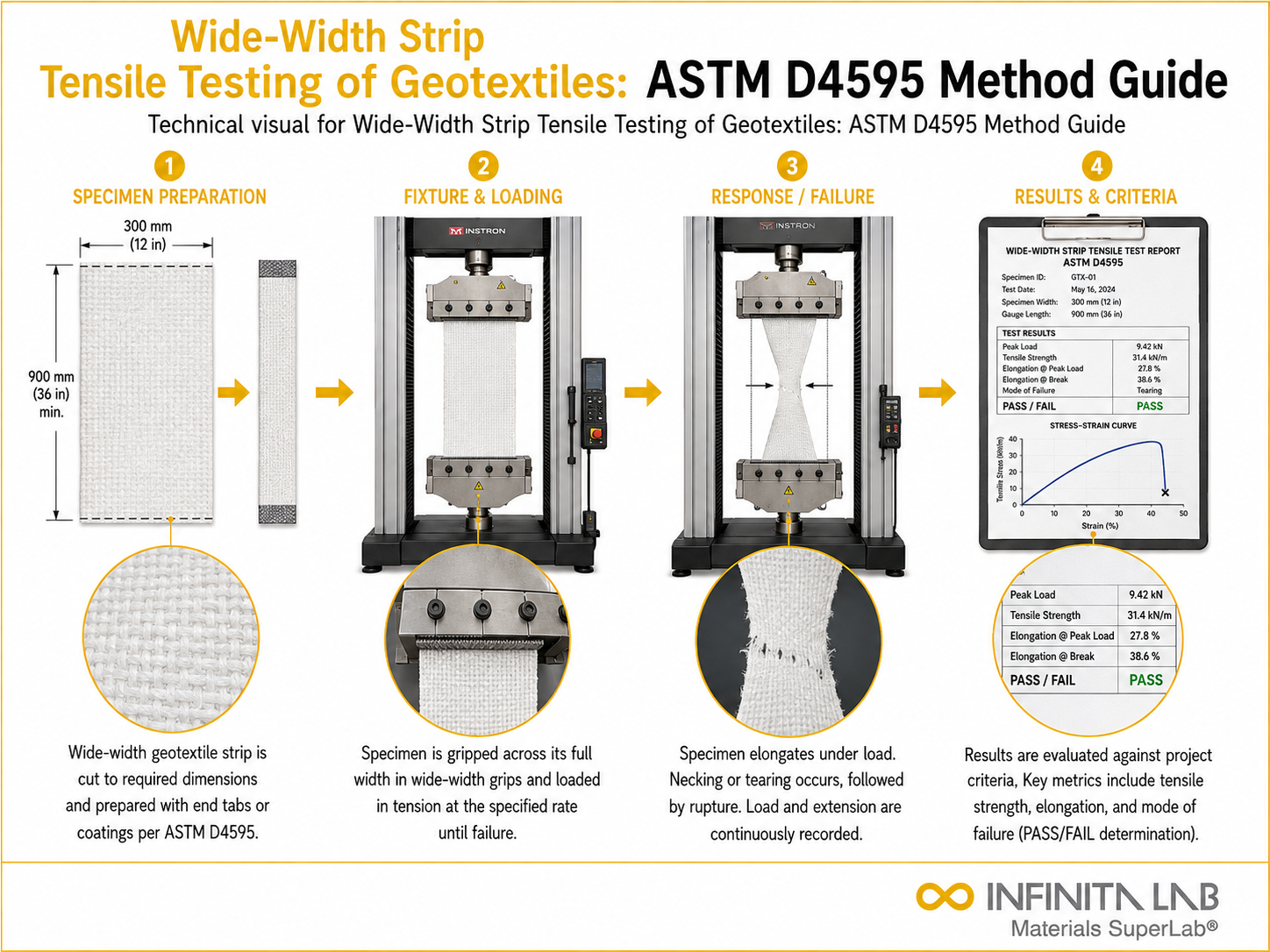


Wide-Width Strip Tensile Testing-Overview
ASTM D4595 is the standard test method for determining tensile properties of geotextiles using the wide-width strip method. Unlike narrow-strip tensile tests, D4595 uses a 200 mm wide specimen to minimise the necking effect — lateral contraction under load — that narrow specimens produce, providing tensile strength and elongation values that more accurately represent the geotextile’s in-service behaviour under plane-strain loading conditions in reinforced soil and drainage applications.
Results are reported separately for the machine direction (MD) and cross-machine direction (CMD), reflecting the directional anisotropy common in woven and nonwoven geotextiles. This MD/CMD distinction is critical for geotechnical engineers designing reinforced soil structures where load orientation relative to the geotextile roll direction determines which property value governs design.

Scope, Applications, and Benefits
Scope
ASTM D4595 applies to woven and nonwoven geotextiles tested as wide-width strip specimens under uniaxial tensile loading. Specimens are conditioned per ASTM D1776 before testing. The standard defines specimen width (200 mm minimum), gauge length, and grip requirements to suppress lateral contraction and generate representative in-plane tensile data. D4595 is the primary tensile standard for geotextile reinforcement design and is complemented by ASTM D6637, which covers tensile properties of geogrids — a distinction engineers must understand when specifying testing for geosynthetic reinforcement systems that use both material types.
ASTM D4595 evaluates:
- Wide-width tensile strength in machine direction (MD) and cross-machine direction (CMD)
- Elongation at peak load and at specified load levels
- Secant modulus at defined strain levels for stiffness characterisation
- Load-elongation behaviour up to failure
Applications
- Reinforced soil wall geotextile qualification for highway embankments and MSE retaining structures.
- Reinforced steep slope design where tensile strength and elongation limits govern geotextile selection.
- Subgrade stabilisation and separation layer specification for road construction over soft ground.
- Coastal and riverbank erosion control geotextile qualification under sustained tensile loading.
- Landfill liner and cover system geotextile tensile verification per project specification.
- Geotextile product certification and incoming material verification against project-specified minimum average roll values (MARV).
Benefits
- 200 mm wide specimen minimises necking, producing tensile data representative of in-service plane-strain conditions.
- MD and CMD results reported separately, enabling directionally correct property selection for reinforcement design.
- Secant modulus output supports deformation-controlled geotextile design in addition to strength-based selection.
- Directly referenced by AASHTO M 288 and FHWA geosynthetic design guidelines for geotextile reinforcement qualification.
- Complementary to ASTM D6637 for projects specifying both geotextile and geogrid reinforcement, enabling consistent test data across the geosynthetic system.
Wide-Width Strip Tensile Testing-Test Process
Sample Preparation
Wide strip specimens are conditioned to specified temperature and humidity.
1Mounting
Specimen is clamped in a tensile testing machine ensuring proper alignment and minimal slippage.
2Loading
Controlled tensile load is applied at a constant rate until specimen failure while recording force and elongation.
3Data Analysis
Tensile strength, elongation, and stress-strain curves are calculated for performance evaluation.
4Wide-Width Strip Tensile Testing-Technical Specifications
| Parameter | Details |
|---|---|
| Standard | ASTM D4595 |
| Method | Wide-width strip uniaxial tensile test |
| Specimen width | 200 mm minimum |
| Specimen directions | Machine direction (MD) and cross-machine direction (CMD) |
| Conditioning | ASTM D1776 — 21°C, 65% RH, 24 hours minimum |
| Loading type | Constant rate of extension to failure |
| Minimum specimen count | 5 per direction (MD and CMD) |
| Key outputs | Tensile strength, elongation at peak load, secant modulus |
| Units | kN/m (strength), % (elongation), kN/m (secant modulus) |


- Universal testing machine (UTM) with wide-jaw grips spanning the full 200 mm specimen width.
- Pneumatic or mechanical clamp grips designed to prevent specimen slippage without causing grip-zone failure.
- Extensometer or crosshead displacement measurement for elongation recording throughout the test.
- Conditioning chamber maintaining 21°C and 65% RH per ASTM D1776 prior to testing.
- Data acquisition system for continuous load and elongation recording to generate the full load-elongation curve.
Instrumentation Used for Testing
Results and Deliverables
- Tensile strength in kN/m for MD and CMD orientations.
- Elongation at peak load as a percentage for MD and CMD.
- Secant modulus at specified strain levels in kN/m.
- Full load-elongation curve for each specimen tested.
- Mean, standard deviation, and coefficient of variation for all reported properties.
- Minimum average roll value (MARV) calculation where required for specification compliance.
- Test report referencing ASTM D4595 for project submission, AASHTO M 288 compliance, or FHWA geosynthetic design documentation.
Frequently Asked Question
Wide-Width Tensile Testing is a method used to measure the tensile strength and elongation properties of geotextiles using a wide specimen that better represents field conditions.
Because geotextiles are installed in wide sheets, wide-width testing better represents real-world load distribution and field performance.
Ultimate tensile strength, elongation at break, load–elongation behaviour, and failure mode.
ASTM D4595 covers tensile properties of geotextiles (solid woven and nonwoven fabrics) by the wide-width strip method. ASTM D6637 covers tensile testing of geogrids — open grid polymer structures — adapted for the unique geometry of grid products.
Wide-width testing distributes load across a larger specimen width, whereas grab testing concentrates load in a smaller central region, resulting in different stress distributions.
Why Choose Infinita Lab for Advanced Materials Testing and Characterization?
At the core of this breadth is our network of 2,000+ accredited laboratories across the USA, offering access to over 10,000 testing methods and analytical services. From advanced materials characterization (SEM, TEM, RBS, XPS) to mechanical, chemical, environmental, biological, and standardized ASTM/ISO-compliant testing, we deliver unmatched flexibility, specialization, and scale. You are never limited by geography, facility, or methodology — Infinita Lab connects you to the right expertise and testing solution, every time.

Looking for a Trusted Partner for Accurate and Reliable Testing Services?
Send query us at hello@infinitalab.com or call us at (888) 878-3090 to learn more about our services and how we can support you.





