


ASTM A615: Rebar Concrete Reinforcement Testing Services
For concrete reinforcement, ASTM A615/A615M comprises deformed and plain carbon-steel bars in cut lengths and coils. Deformed bars for use in various applications are covered in this specification. The final results of this test method are expressed in either SI units or inch-pound units.
TRUSTED BY


Get ASTM A615 compliant results — request your rebar concrete reinforcement testing quote
- Overview
- Scope, Applications, and Benefits
- Test Process
- Specifications
- Instrumentation
- Results and Deliverables
What Is ASTM A615 Rebar Concrete Reinforcement?
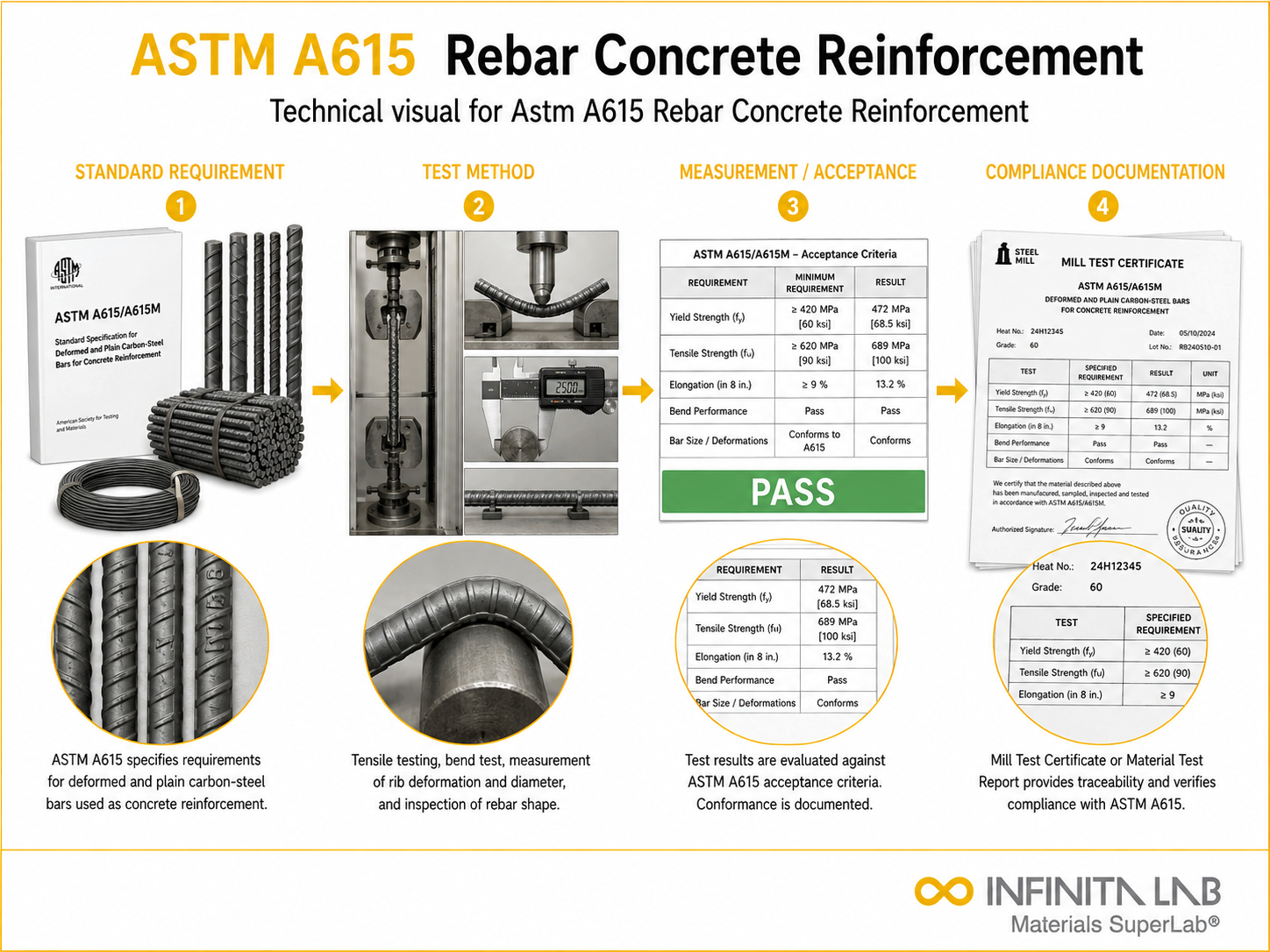
ASTM A615 covers deformed and plain carbon-steel bars used as concrete reinforcement in structural applications. The standard defines three yield strength grades – Grade 40, Grade 60, and Grade 80 (corresponding to 40, 60, and 80 ksi minimum yield strengths) – along with minimum tensile strength, minimum elongation, and bend test requirements for each grade. Grade 60 is the dominant grade used in construction in North America and is the default specification for reinforcing bar in most building and bridge structural applications.
The mechanical property requirements of ASTM A615 are verified by tensile testing using procedures defined in ASTM A370. Yield strength is measured using the 0.35% extension under load method or the 0.2% offset method, depending on the grade and bar size. The specimen is tested in the as-received condition with the deformations intact when the bar size permits, or machined to a standard coupon when deformation geometry would cause grip problems or measurement errors. Elongation is measured over an 8-inch gauge length for bar sizes #3 through #6, and over a 4-inch gauge length for smaller sizes.
Testing to ASTM A615 is performed for incoming material acceptance at construction projects, special inspection requirements under building codes, and forensic evaluation of rebar from existing structures. High-strength Grade 60 rebar that does not meet minimum yield or tensile requirements can result in under-strength reinforced concrete members, making material verification a structural safety issue. Independent testing of rebar is particularly important when mill certifications are unavailable, when the source mill is unfamiliar, or when the project specifications require third-party verification.

Applications and Benefits of ASTM A615 Rebar Concrete Reinforcement Testing
Scope
ASTM A615 testing applies to deformed and plain carbon-steel reinforcing bars from bar size #3 through #18 in Grades 40, 60, and 80. Testing covers mechanical properties and may include bend testing and chemical analysis where required. Key evaluation areas include:
- Yield strength verification against the specified grade minimum
- Ultimate tensile strength verification against grade minimum
- Elongation in 4-inch or 8-inch gauge length against grade minimum
- Bend test to verify ductility without fracture at specified bend angle and diameter
- Chemical composition verification where specified in purchase order
- Bar deformation geometry verification against ASTM A615 dimensional requirements
Applications
- Incoming material acceptance testing at construction sites
- Special inspection for reinforced concrete structures under building codes
- Bridge deck and structural concrete rebar qualification
- Forensic evaluation of rebar from existing structures or failure investigations
- Verification of rebar certifications from unfamiliar or overseas mills
- Material sampling programs for large construction projects
Benefits
- Confirms minimum strength requirements are met before concrete placement
- Provides independent verification of mill certification data
- Identifies substandard rebar that could compromise structural capacity
- Supports building code special inspection documentation requirements
- Required by many construction specifications and owner quality programs
- Fast turnaround enables timely material release decisions on active construction schedules
Our ASTM A615 Testing Procedure
Sample Selection
Bar samples are selected per the lot sampling requirements of ASTM A615.
1Specimen Preparation
For most bar sizes, specimens are tested in the as-received deformed condition.
2Tensile Testing
Specimens are loaded per ASTM A370. Yield strength is determined by the extension under load or offset method.
3Bend Testing
A separate bar sample is bent around a pin of the specified diameter at the required bend angle without fracturing
4ASTM A615 Test Parameters and Requirements
| Parameter | Details |
|---|---|
| Standard | ASTM A615 |
| Grades | Grade 40, Grade 60, Grade 80 |
| Grade 60 Minimum Yield | 60 ksi (420 MPa) |
| Grade 60 Minimum Tensile | 90 ksi (620 MPa) |
| Grade 60 Minimum Elongation | 9% in 8-inch gauge length |
| Test Method Standard | ASTM A370 |


- Universal tensile testing machine with traceable calibration
- Extensometer or strain gauge for yield strength measurement
- Bend test jig with specified pin diameters
- Specimen machining equipment for larger bar sizes
- Optical emission spectrometer for chemical analysis where required
- Data acquisition and reporting software
Equipment and Instrumentation Used for ASTM A615 Testing
What You Receive: Test Report, Data, and Certification
- Yield strength in ksi or MPa
- Ultimate tensile strength in ksi or MPa
- Elongation at break (% in 4-inch or 8-inch gauge)
- Bend test result (pass/no fracture, or fail with fracture description)
- Pass/fail determination against ASTM A615 grade requirements
- Quality assurance documentation
ASTM A615 Rebar Concrete Reinforcement FAQs
ASTM A615 specifies the mechanical and dimensional requirements for carbon steel reinforcing bars, including yield strength, tensile strength, elongation, and deformation characteristics used for reinforced concrete applications.
Deformed bars have surface ribs that improve bonding with concrete, making them suitable for structural reinforcement. Plain bars have a smooth surface and are typically used where mechanical anchorage is not required.
The standard covers multiple strength grades, commonly Grade 40, Grade 60, Grade 75, Grade 80, and Grade 100, allowing engineers to select reinforcement based on project design requirements.
The size, spacing, and height of deformations help ensure effective load transfer between the steel and surrounding concrete, reducing the risk of slippage under service loads.
Why Choose Infinita Lab for Rebar Concrete Reinforcement Testing
At the core of this breadth is our network of 2,000+ accredited laboratories across the USA, offering access to over 10,000 testing methods and analytical services. From advanced materials characterization (SEM, TEM, RBS, XPS) to mechanical, chemical, environmental, biological, and standardized ASTM/ISO-compliant testing, we deliver unmatched flexibility, specialization, and scale. You are never limited by geography, facility, or methodology — Infinita Lab connects you to the right expertise and testing solution, every time.

Need ASTM A615 Rebar Concrete Reinforcement Testing You Can Rely On?
Send query us at hello@infinitalab.com or call us at (888) 878-3090 to learn more about our services and how we can support you.



Request a Quote
Submit your material details and receive testing procedures, pricing, and turnaround time within 24 hours.
 Quick Turnaround and Hasslefree process
 Confidentiality Guarantee
 Free, No-obligation Consultation
 100% Customer Satisfaction
