


ASTM C1366: Monolithic Ceramic Tensile Strength Testing Services
ASTM C1366 test method is used to identify the tensile strength of monolithic advanced ceramics under uniaxial loading at elevated temperatures. This test method is intended for advanced ceramics that have isotropic, homogeneous, continuous behavior macroscopically.
TRUSTED BY


Get ASTM C1366 compliant results — request your monolithic ceramic tensile strength testing quote
- Overview
- Scope, Applications, and Benefits
- Test Process
- Specifications
- Instrumentation
- Results and Deliverables
What Is ASTM C1366 Monolithic Ceramic Tensile Strength?
ASTM C1366 is a standardized test method used to determine the tensile strength of monolithic advanced ceramics at elevated temperatures. It evaluates material behavior under uniaxial tensile loading in high-temperature environments.
The test is conducted using high-temperature furnaces and specialized gripping systems to maintain alignment and minimize bending stresses. It provides critical strength data for ceramics operating at temperatures up to 982°C (1800°F).

Applications and Benefits of ASTM C1366 Monolithic Ceramic Tensile Strength Testing
Scope
ASTM C1366 is relevant to monolithic advanced ceramics and includes both cylindrical and flat tensile specimens. It is the standard of choice for evaluating tensile properties under uniaxial loading, particularly at high temperatures up to 1800°F, to determine the mechanical performance and failure of these materials under heating.
ASTM C1366 evaluates:
- Tensile strength at elevated temperatures
- Fracture behavior under thermal conditions
- Strength degradation with temperature
- Effect of surface flaws at high temperatures
- High-temperature mechanical performance
Applications
- Material development and comparison
- Ceramic material characterization
- Reliability assessment
- Automotive brake components
- Aerospace heat shield materials
- High-temperature bearings
- Industrial high-temperature structural components
Benefits
- Determines tensile strength at elevated temperatures
- Identifies strength-limiting flaws
- Provides stress–strain behaviour data
- Supports high-temperature material qualification
- Assists in engineering design calculations
- Enhances reliability evaluation
- Enables standardized comparison of ceramic materials
Our ASTM C1366 Testing Procedure
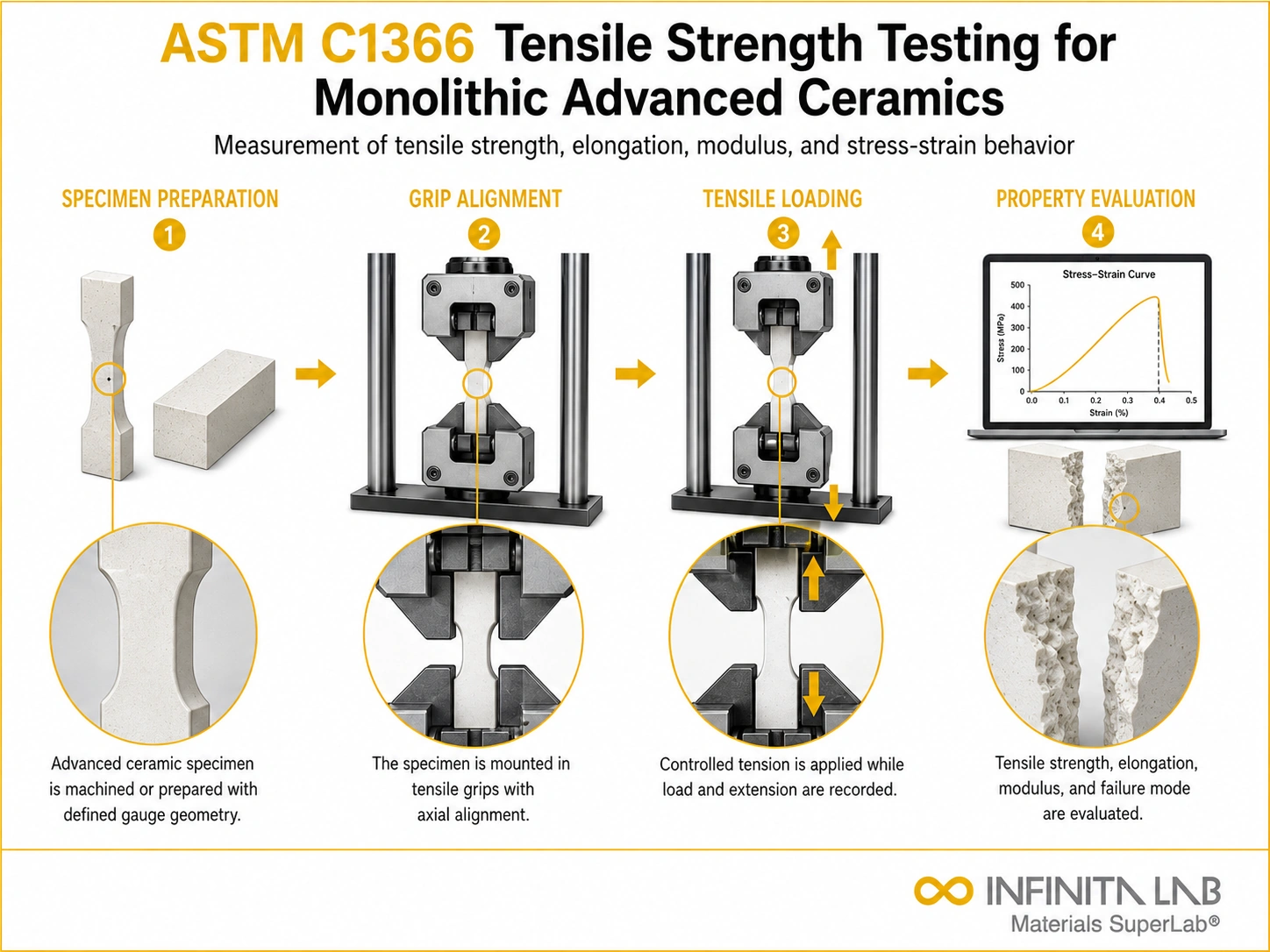
Specimen Preparation & Setup
Cylindrical or flat specimens are machined precisely and mounted in a furnace-integrated tensile testing machine.
1High-Temperature Conditioning
Specimen is heated to the specified temperature before and during testing.
2Tensile Loading & Strain Measurement
Uniaxial load is applied until fracture while an extensometer records strain.
3Failure & Analysis
Maximum load (Pmax) is recorded and a stress–strain curve is generated to determine tensile properties.
4ASTM C1366 Test Parameters and Requirements
| Parameter | Details |
|---|---|
| Applicable Materials | Monolithic advanced ceramics |
| Temperature Range | Ambient to ~982°C (1800°F) |
| Specimen Types | Dog-bone or cylindrical ceramic specimen |
| Gauge Length | Typically ~25–50 mm |
| Diameter Tolerance | ±0.025 mm |
| Grip Type | High-temperature self-aligning grips |
| Cross-head Speed | Constant displacement rate (controlled per standard) |
| Temperature Ramp Rate | Typically ~2–10°C/min |
| Soak Time | Minimum hold to stabilize specimen temperature |
| Measured Property | Tensile strength |
| Output Units | MPa (or Pascals) |


- High-temperature tensile testing machine
- Furnace system
- Extensometer
- Load cell
- High-temperature grips
- Data acquisition system
- Stress–strain analysis software
Equipment and Instrumentation Used for ASTM C1366 Testing
What You Receive: Test Report, Data, and Certification
- Tensile strength at elevated temperature
- Stress–strain curve
- Maximum load at fracture
- Failure mode analysis
- Material deformation characteristics
- Reliability and design data
- Test report as per ASTM C1366
ASTM C1366 Monolithic Ceramic Tensile Strength FAQs
ASTM C1366 is a standard test method used to determine the tensile strength of monolithic advanced ceramics at room or elevated temperatures using a uniaxial tensile loading configuration.
The method applies to monolithic advanced ceramics such as alumina, silicon nitride, silicon carbide, zirconia, and other structural ceramics used in high-performance engineering applications.
Tensile strength testing assesses the material’s resistance to fracture by direct tensile stress, which is important because ceramics are brittle materials that are highly sensitive to surface and internal defects.
The test measures ultimate tensile strength and may also provide stress–strain behavior and elastic modulus when strain measurement devices are used.
Results depend on specimen geometry, surface finish, flaw population, alignment, gripping method, temperature, and loading rate, all of which significantly affect measured tensile strength values.
Why Choose Infinita Lab for Monolithic Ceramic Tensile Strength Testing?
At the core of this breadth is our network of 2,000+ accredited laboratories across the USA, offering access to over 10,000 testing methods and analytical services. From advanced materials characterization (SEM, TEM, RBS, XPS) to mechanical, chemical, environmental, biological, and standardized ASTM/ISO-compliant testing, we deliver unmatched flexibility, specialization, and scale. You are never limited by geography, facility, or methodology — Infinita Lab connects you to the right expertise and testing solution, every time.

Looking for an Accredited Partner for ASTM C1366 Monolithic Ceramic Tensile Strength Testing?
Send query us at hello@infinitalab.com or call us at (888) 878-3090 to learn more about our services and how we can support you.



Request a Quote
Submit your material details and receive testing procedures, pricing, and turnaround time within 24 hours.
 Quick Turnaround and Hasslefree process
 Confidentiality Guarantee
 Free, No-obligation Consultation
 100% Customer Satisfaction
