


ASTM C1359: Advanced Ceramic Elevated Temperature Tensile Testing Services
ASTM C1359 is used to determine the tensile strength, including stress-strain behavior, under monotonic uniaxial loading of continuous fiber-reinforced advanced ceramics (CFCC) at elevated temperatures. The test is used for material development, material comparison, quality assurance, characterization, reliability assessment, and design data generation for CFCCs. The standard values are reported in SI units.
TRUSTED BY


Get ASTM C1359 compliant results — request your advanced ceramic elevated temperature tensile testing quote
- Overview
- Scope, Applications, and Benefits
- Test Process
- Specifications
- Instrumentation
- Results and Deliverables
What Is ASTM C1359 Advanced Ceramic Elevated Temperature Tensile?
ASTM C1359 describes a standard test method to measure the tensile strength of advanced ceramics at elevated temperatures. These materials are being used in high-stress applications at high temperatures, and information on their mechanical behavior under combined thermal and tensile loading is paramount.
This test method provides a controlled, reproducible process for measuring tensile properties, enabling consistent material characterization. ASTM C1359 has widespread applications in aerospace, power generation, and advanced manufacturing, where ceramic components must preserve their structural integrity under intense thermal conditions.

Applications and Benefits of ASTM C1359 Advanced Ceramic Elevated Temperature Tensile Testing
Scope
ASTM C1359 outlines procedures for tensile testing of advanced ceramic matrix composites, primarily those reinforced with continuous fibers.
It evaluates:
- Tensile strength at elevated temperatures
- Engineering stress–strain behavior
- Fracture strength and strain
- Elastic modulus under thermal loading
The method applies to ceramic and glass matrix composites with unidirectional (1D), bidirectional (2D), tridirectional (3D), or multidirectional continuous fiber reinforcement.
Applications
- Aerospace structural and thermal components
- Automotive high-temperature ceramic parts
- Power generation systems and turbines
- Electronic and thermal management components
- Research and development of advanced ceramic composites
Benefits
- Enables accurate tensile property measurement at high temperatures
- Ensures repeatable and standardized test conditions
- Supports material selection for extreme environments
- Improves design confidence and performance prediction
- Assists in quality control and material qualification
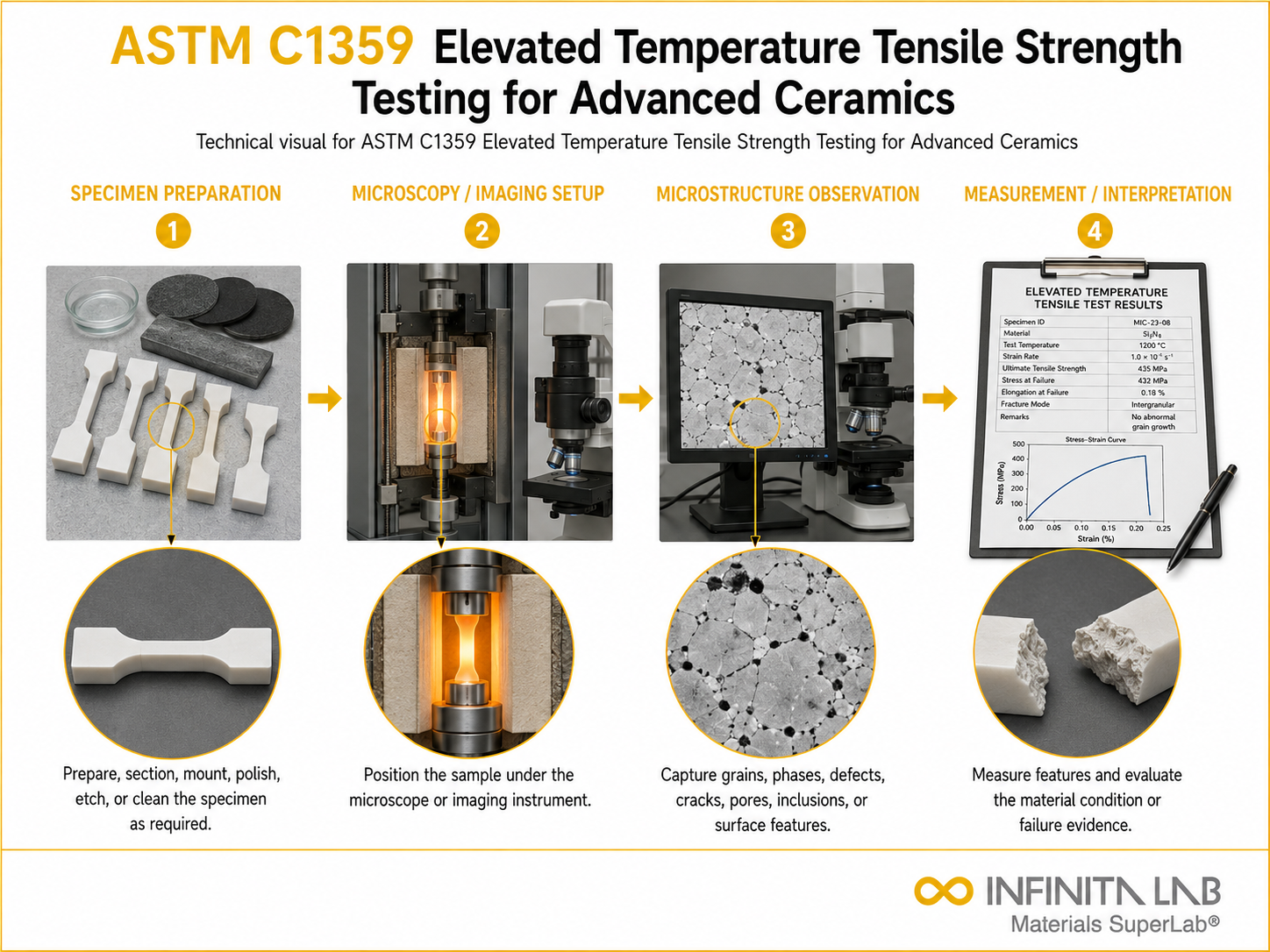
Our ASTM C1359 Testing Procedure
Specimen Mounting
Specimens are installed in the load train using appropriate grip interfaces that match the specimen geometry and reinforcement type.
1Thermal Conditioning
Specimens are heated in a furnace under near-zero load until thermal equilibrium at the test temperature is reached.
2Tensile Loading
A controlled tensile load is applied while continuously measuring load, strain, and temperature until fracture occurs.
3Data Collection & Cooling
Breaking load, strain, and temperature are recorded; specimens are cooled and preserved for post-test analysis.
4ASTM C1359 Test Parameters and Requirements
| Parameter | Details |
|---|---|
| Test Principle | Tensile loading of ceramic composites at elevated temperature |
| Applicable Materials | Advanced ceramic and glass matrix composites with continuous fiber reinforcement |
| Minimum Sample Size | At least five specimens for mean strength determination |
| Measured Outputs | Stress–strain data, tensile strength, fracture strength, modulus |
| Load Measurement Accuracy | ±1.0% of load range |


- High-temperature tensile testing machine
- Load the train with suitable ceramic composite grips
- High-temperature furnace with temperature control
- Extensometer suitable for ambient or elevated temperatures
- Data acquisition and control system
- Environmental sensors for temperature and humidity
Equipment and Instrumentation Used for ASTM C1359 Testing
What You Receive: Test Report, Data, and Certification
- Engineering stress–strain curves
- Tensile strength and fracture strength values
- Strain at fracture and elastic modulus
- Temperature-dependent mechanical performance data
- Material comparison and qualification reports
- Input for design validation and quality assurance
ASTM C1359 Advanced Ceramic Elevated Temperature Tensile FAQs
A tensile test is carried out to ascertain a material or component's tensile qualities. The test sample's ductility or brittleness, as well as essential properties, including toughness, tensile strength, yield point, elastic limit, % elongation, and elastic modulus, are all characterized by its deformation.
Elevated-temperature tensile Testing is a reliable process for evaluating the behavior of metal materials when subjected to high heat and tension.
It determines a material's strength and how much it can be stretched before it breaks. This test method also determines yield strength, ultimate tensile strength, flexibility, strain hardening characteristics, Young's modulus, and Poisson's ratio.
Why Choose Infinita Lab for Advanced Ceramic Elevated Temperature Tensile Testing
At the core of this breadth is our network of 2,000+ accredited laboratories across the USA, offering access to over 10,000 testing methods and analytical services. From advanced materials characterization (SEM, TEM, RBS, XPS) to mechanical, chemical, environmental, biological, and standardized ASTM/ISO-compliant testing, we deliver unmatched flexibility, specialization, and scale. You are never limited by geography, facility, or methodology — Infinita Lab connects you to the right expertise and testing solution, every time.

Need ASTM C1359 Advanced Ceramic Elevated Temperature Tensile Testing You Can Rely On?
Send query us at hello@infinitalab.com or call us at (888) 878-3090 to learn more about our services and how we can support you.



Request a Quote
Submit your material details and receive testing procedures, pricing, and turnaround time within 24 hours.
 Quick Turnaround and Hasslefree process
 Confidentiality Guarantee
 Free, No-obligation Consultation
 100% Customer Satisfaction
