


ASTM C1605: Ceramic Fiber Tensile Testing Services
Accredited ASTM C1605 ceramic fiber tensile testing from Infinita Lab, performed to the exact standard requirements - accurate, reproducible results with full documentation for compliance, R&D, and quality control programs.
TRUSTED BY


Get ASTM C1605 compliant results - request your ceramic fiber tensile testing quote
- Overview
- Scope, Applications, and Benefits
- Test Process
- Specifications
- Instrumentation
- Results and Deliverables
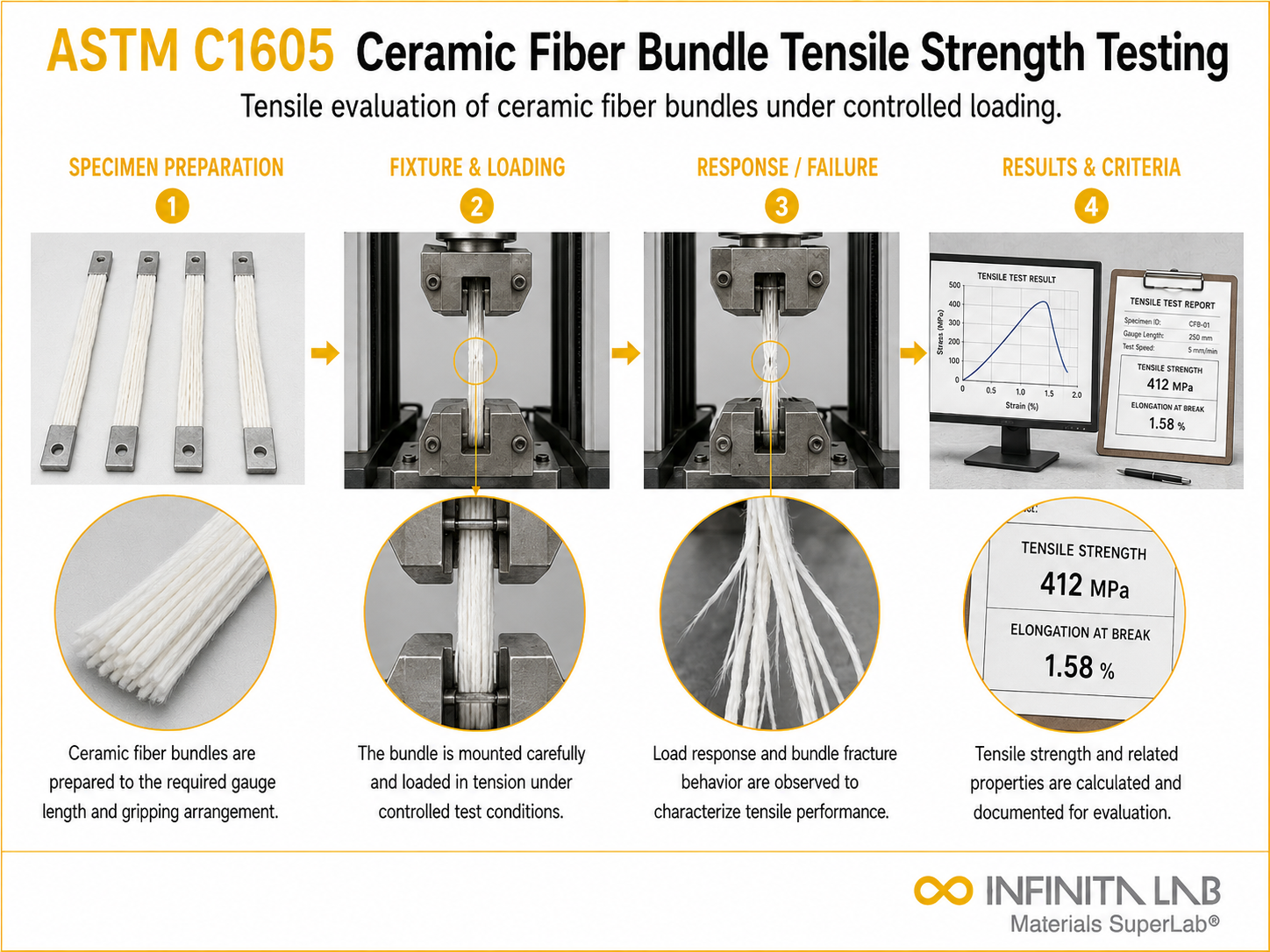
What Is ASTM C1605 Ceramic Fiber Tensile?
ASTM C1605, Standard Test Methods for Chemical Analysis of Ceramic Whiteware Materials Using Wavelength Dispersive X-Ray Fluorescence Spectrometry, defines a procedure for determining the major oxide composition of whiteware clays, minerals, and related ceramic raw materials. It covers ten elemental oxides (silicon, aluminium, iron, magnesium, calcium, sodium, potassium, titanium, phosphorus, and manganese) plus loss on ignition. Reported concentrations span roughly 0.01 percent to 99 percent, depending on the analyte. One point needs to be clear: C1605 is a chemical analysis method, not a tensile test. It says nothing about ceramic fibers or any mechanical property. ASTM withdrew the last edition, C1605-04(2014), in 2023 and named no replacement standard, so it’s best treated as a historical reference method, though the technique itself remains widely practiced. The procedure starts with ignition. That drives off volatile matter and quantifies loss on ignition. Next, the ignited material is fused with lithium tetraborate to form a homogeneous glass disc. Fusion removes particle-size and mineralogical effects that would otherwise distort X-ray intensities and produces a stable specimen that can be measured repeatedly. A tube irradiates the disc with X-rays, and a wavelength-dispersive spectrometer separates and counts the characteristic photons each element emits. Concentrations are calculated against previously prepared calibration standards, with mathematical corrections for absorption and enhancement matrix effects. Results come out as oxides in their most common terrestrial forms, regardless of the original oxidation state of the element. The payoff is a consistent, quantitative picture of composition for producers and users of whiteware materials, the kind of data that governs firing behavior, color, and finished-body properties.

Applications and Benefits of ASTM C1605 Ceramic Fiber Tensile Testing
Scope
ASTM C1605 outlines procedures for quantitative chemical analysis of ceramic materials using WDXRF spectrometry.
It evaluates:
- The method covers chemical analysis of ceramic whiteware materials, including clays and minerals used in whiteware bodies and glazes.
- Ten major element oxides are determined: SiO2, Al2O3, Fe2O3, MgO, CaO, Na2O, K2O, TiO2, P2O5, and MnO.
- Loss on ignition comes out of the same procedure so that results can be related to the ignited material.
- Technique: wavelength dispersive X-ray fluorescence spectrometry on fused glass discs.
- From approximately 0.01 percent up to 99 percent, reported concentrations depend on the element being measured.
- Samples are ignited and then fused with lithium tetraborate, which eliminates structural and particle-size interferences.
- Quantification relies on previously prepared calibration standards plus mathematical corrections for matrix absorption and enhancement.
- Regardless of the oxidation state in the original material, elements are reported in their most common terrestrial oxide forms.
- ASTM withdrew the standard in 2023 without a replacement. It is a historical reference rather than an active specification.
- Not a mechanical test. Tensile strength, fibers, and tows are outside its scope.
Applications
- Incoming inspection of clays, feldspars, silica, and other whiteware raw materials against purchase specifications.
- Controlling batch formulation for porcelain, sanitaryware, tableware, and tile bodies.
- Qualifying suppliers, and comparing lot-to-lot consistency for mined mineral sources.
- Firing defects, color variation, or shrinkage shifts linked to compositional drift can be troubleshot with the data.
- Legacy product specifications that cite C1605 as the analytical basis get verified against it.
- Research and quality laboratories use it as reference data for glaze and body development.
Benefits
- Fusion sample preparation yields homogeneous specimens and reduces mineralogical and particle-size effects.
- One measurement quantifies many major oxides, which saves time compared with separate wet chemical determinations.
- Major constituents and minor impurities both fall within the concentration coverage.
- Because calibration standards and matrix corrections are built in, results are reliable and traceable.
- Stable glass discs. If a result needs confirmation, you can re-measure it.
- Ceramic technologists specify and discuss raw material chemistry in these same terms, so results align directly.
Our ASTM C1605 Testing Procedure
Sample Preparation
Ceramic samples are crushed and ground, then prepared as pressed pellets or fused beads to ensure homogeneity and minimize matrix effects.
1Instrument Calibration
Calibration is performed using certified reference materials (CRMs), with routine drift correction to maintain analytical accuracy.
2X-Ray Excitation & Detection
Primary X-rays excite the sample, causing emission of element-specific secondary X-rays measured by the WDXRF spectrometer.
3Data Analysis & Reporting
Measured intensities are converted to oxide concentrations and compared with specifications.
4ASTM C1605 Test Parameters and Requirements
| Parameter | Details |
|---|---|
| Test Principle | Wavelength Dispersive X-Ray Fluorescence (WDXRF) spectrometry |
| Sample Types | Bulk ceramics, powders, processed ceramic products |
| Preparation Format | Pressed pellets or fused beads |
| Measured Output | Percent (%) composition of oxides and trace elements |
| Calibration | Certified Reference Materials (CRMs) |
| Analysis Type | Non-destructive chemical composition analysis |


- Wavelength Dispersive X-Ray Fluorescence Spectrometer – separates and counts element-specific X-ray photons coming from the sample disc.
- X-Ray Tube – the source of primary radiation that excites the fused sample.
- Fusion Apparatus – melts the sample with lithium tetraborate, producing uniform glass discs.
- Analytical Balance – accurate sample and flux weights, for both fusion and loss of ignition.
- Muffle Furnace – ignites samples before fusion to determine loss on ignition.
- Calibration Standards and Control Materials – anchor the calibration, and they verify accuracy on each analytical run.
- Quantification Software – converts intensities to oxide concentrations after applying matrix corrections.
Equipment and Instrumentation Used for ASTM C1605 Testing
What You Receive: Test Report, Data, and Certification
- A report of oxide concentrations for the ten major analytes, expressed in their most common terrestrial forms.
- Loss on ignition, reported alongside the oxide results.
- The method basis, stated clearly, including the withdrawn status of C1605 and any modern equivalent used.
- You also get calibration and quality control information, such as the standards or control materials analyzed.
- Notes on sample identification and preparation so that results can be traced to the original material.
- The final report arrives electronically, ready for quality files and supplier discussions.
ASTM C1605 Ceramic Fiber Tensile FAQs
Even small changes in material chemistry can heavily influence sintering behavior, mechanical strength, thermal resistance, and product durability.
It applies to advanced ceramics, refractories, electrical ceramics, and traditional clay-based products in either raw or finished form.
The method is considered non-destructive, especially when used on solid surfaces, though some sample grinding may be required.
Why Choose Infinita Lab for Ceramic Fiber Tensile Testing
When your Ceramic Fiber Tensile results have to hold up - for compliance, a customer audit, or an engineering decision - ASTM C1605 accuracy and an unbiased third-party report matter more than price. Infinita Lab routes your ASTM C1605 ceramic fiber tensile testing to ISO/IEC 17025-accredited U.S. partner labs with hands-on method experience, so you get defensible data, transparent reporting, and turnaround times built around your project deadline - not ours.

Need ASTM C1605 Ceramic Fiber Tensile Testing You Can Rely On?
Send query us at hello@infinitalab.com or call us at (888) 878-3090 to learn more about our services and how we can support you.



Request a Quote
Submit your material details and receive testing procedures, pricing, and turnaround time within 24 hours.
 Quick Turnaround and Hasslefree process
 Confidentiality Guarantee
 Free, No-obligation Consultation
 100% Customer Satisfaction
