


ASTM D6415: Composite Curved Beam Strength Testing Services
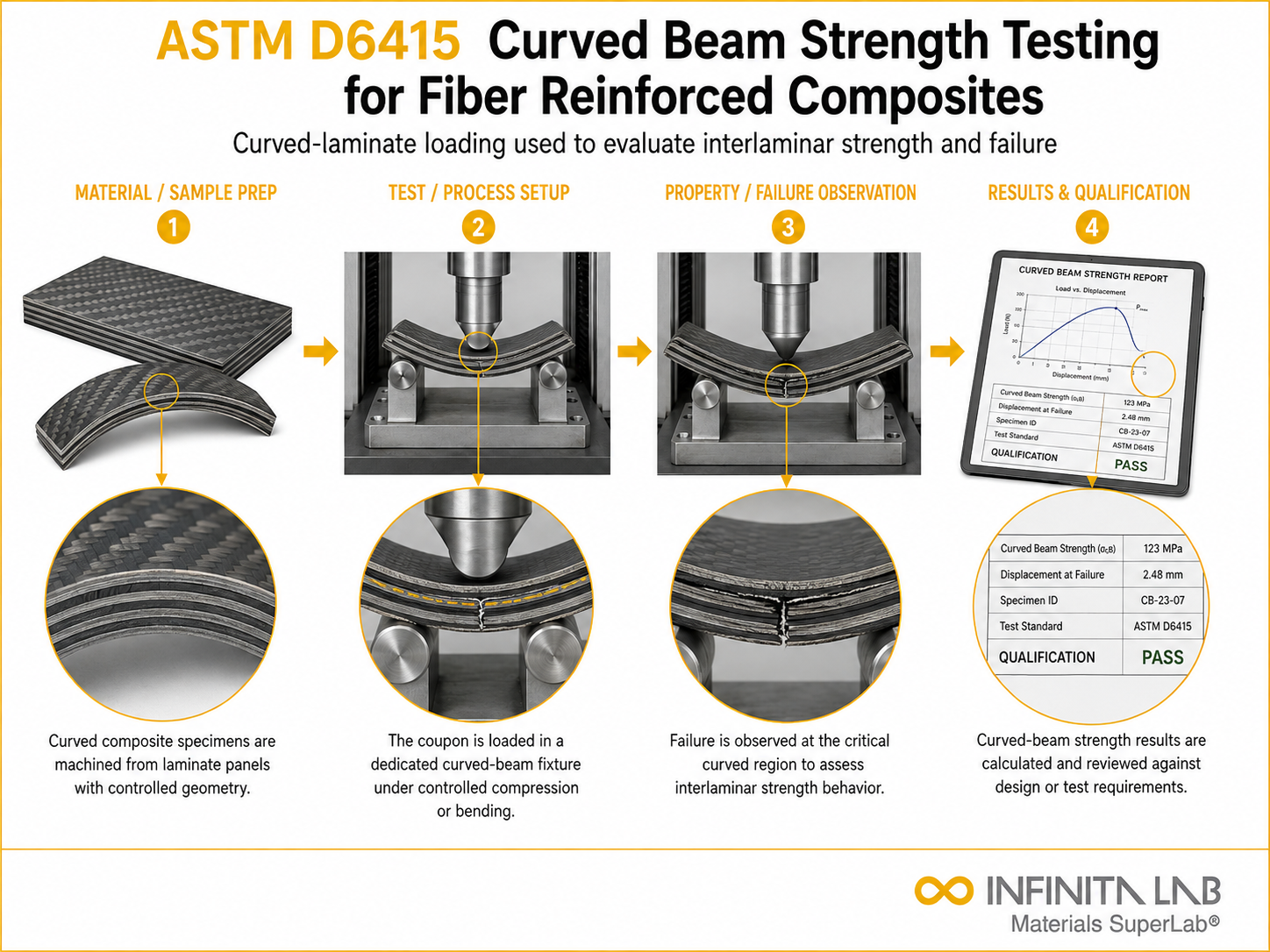
ASTM D6415 covers the testing method of curved beam strength of continuous fiber-reinforced composite material by a 90° curved beam specimen. The apparatus used is composed of two straight legs joined by a 90° bend with a 6.4 mm inner radius. When a force is applied an out-of-plane tensile stress is produced in the curve of the sample.
TRUSTED BY


Get ASTM D6415 compliant results — request your composite curved beam strength testing quote
- Overview
- Scope, Applications, and Benefits
- Test Process
- Specifications
- Instrumentation
- Results and Deliverables
What Is ASTM D6415 Composite Curved Beam Strength?
ASTM D6415 evaluates the curved beam strength of fiber-reinforced polymer (FRP) composites by applying a load to a curved specimen until failure occurs. The method quantifies interlaminar shear and tensile stresses induced by bending, providing critical insight into composite structural integrity.
This standard is widely used in aerospace, automotive, and structural engineering applications where composite reliability under curved loading conditions is essential. It helps determine delamination resistance, stress distribution, and failure behavior, ensuring safe and optimized composite design.

Applications and Benefits of ASTM D6415 Composite Curved Beam Strength Testing
Scope
This test method measures the curved beam strength of polymer matrix composites under controlled loading.
- Evaluation of interlaminar strength under curved loading
- Applicable to fiber-reinforced polymer composites
- Assessment of tensile and shear stress interaction
- Determination of delamination resistance
- Used for structural performance characterization
- Supports composite design and validation
Applications
- Aerospace structural components
- Automotive composite parts
- Wind turbine blades
- Marine and defense structures
- Sporting equipment composites
- Civil engineering reinforcement materials
Benefits
- Determines interlaminar strength accurately
- Identifies delamination failure behavior
- Supports structural design optimization
- Improves composite reliability
- Assists in material selection decisions
- Enhances safety in high-load applications
Our ASTM D6415 Testing Procedure
Specimen Preparation
Curved beam specimens are fabricated and conditioned according to specified dimensions and environmental conditions.
1Fixture Setup
The specimen is mounted in a curved beam testing fixture to ensure proper load application and alignment.
2Load Application
A controlled load is applied to the specimen until failure occurs, inducing stress across layers.
3Failure Analysis
The failure load and mode are recorded to determine curved beam strength and delamination characteristics.
4ASTM D6415 Test Parameters and Requirements
| Parameter | Details |
|---|---|
| Specimen geometry | Defined curved beam configuration |
| Loading rate | Controlled and uniform loading speed |
| Test temperature | Standard or specified environmental condition |
| Failure mode | Interlaminar shear or tensile failure |
| Material type | Fiber-reinforced polymer composites |
| Fixture design | Standard curved beam loading setup |
| Strain measurement | Optional strain gauge usage |
| Load capacity | Depends on material strength |


- Universal testing machine
- Curved beam test fixture
- Load cell with high precision
- Data acquisition system
- Strain gauges (optional)
- Specimen preparation tools
- Environmental conditioning chamber
Equipment and Instrumentation Used for ASTM D6415 Testing
What You Receive: Test Report, Data, and Certification
- Curved beam strength value
- Load versus displacement data
- Failure mode analysis
- Stress distribution behavior
- Interlaminar strength assessment
- Detailed test report with results
ASTM D6415 Composite Curved Beam Strength FAQs
ASTM D6415 applies bending loads to a curved composite specimen, generating interlaminar shear and tensile stresses. The test measures how these stresses cause delamination or failure, providing insight into layer bonding strength and composite structural integrity under real-world curved loading conditions.
Curved geometry introduces combined tensile and shear stresses across layers, unlike flat specimens. This configuration simulates real-life stress concentrations in composite structures, making it essential for evaluating delamination resistance and structural durability.
Failure modes typically include interlaminar shear failure, tensile cracking, and delamination between layers. The observed mode provides insight into the weakest structural interface within the composite material.
Fiber orientation determines load distribution and stress transfer within the composite. Misaligned or unfavorable orientations reduce strength, while optimized fiber alignment enhances resistance to bending and interlaminar failure.
Delamination weakens structural integrity by separating layers, reducing load-carrying capacity. Measuring resistance to delamination ensures composites can withstand stress without catastrophic failure in demanding applications.
Why Choose Infinita Lab for Composite Curved Beam Strength Testing?
At the core of this breadth is our network of 2,000+ accredited laboratories across the USA, offering access to over 10,000 testing methods and analytical services. From advanced materials characterization (SEM, TEM, RBS, XPS) to mechanical, chemical, environmental, biological, and standardized ASTM/ISO-compliant testing, we deliver unmatched flexibility, specialization, and scale. You are never limited by geography, facility, or methodology — Infinita Lab connects you to the right expertise and testing solution, every time.

Need ASTM D6415 Composite Curved Beam Strength Testing You Can Rely On?
Send query us at hello@infinitalab.com or call us at (888) 878-3090 to learn more about our services and how we can support you.



Request a Quote
Submit your material details and receive testing procedures, pricing, and turnaround time within 24 hours.
 Quick Turnaround and Hasslefree process
 Confidentiality Guarantee
 Free, No-obligation Consultation
 100% Customer Satisfaction
