


ASTM D7705: FRP Alkali Resistance Construction Testing Services
Accredited ASTM D7705 FRP alkali resistance construction testing from Infinita Lab, performed to the exact standard requirements - accurate, reproducible results with full documentation for compliance, R&D, and quality control programs.
TRUSTED BY


Get ASTM D7705 compliant results - request your FRP alkali resistance construction testing quote
- Overview
- Scope, Applications, and Benefits
- Test Process
- Specifications
- Instrumentation
- Results and Deliverables
What Is ASTM D7705 FRP Alkali Resistance Construction?
ASTM D7705/D7705M-26, Standard Test Method for Alkali Resistance of Fiber Reinforced Polymer (FRP) Matrix Composite Bars used in Concrete Construction, defines how to evaluate whether FRP reinforcing bars keep their properties in the highly alkaline environment found inside concrete. Bars sit in an aqueous alkaline environment, with or without sustained tensile stress, at a moderately elevated temperature of 60 °C (140 °F). The heat accelerates chemical attack on the polymer matrix, the fibers, and the fiber-matrix interface. Three procedures are provided. Procedure A is an unstressed immersion intended for rapid screening. B adds sustained mechanical loading while the bar is immersed in a standard alkaline solution representing concrete pore water. For C, loaded bars go inside moist Portland cement concrete, which comes closest to service conditions. Conditioned specimens are compared against unconditioned controls on two primary measurements: mass change and retained tensile capacity. Post-exposure tension testing follows ASTM D7205/D7205M. This keeps residual-strength data consistent with the property data used elsewhere in FRP bar qualification. The method applies to bars and to linear segments cut from two- or three-dimensional reinforcing grids. It supports material specifications, research and development, quality assurance, and structural design and analysis. Results feed into product specifications such as ASTM D7957/D7957M for glass FRP bars and into ACI Committee 440 guidance, which sets its own acceptance criteria. Because the test is accelerated and reports retention rather than a predicted service life, results are best read as comparative durability evidence, not as a guarantee of long-term field performance.

Applications and Benefits of ASTM D7705 FRP Alkali Resistance Construction Testing
Scope
ASTM D7705 covers:
- The standard covers the procedure for evaluating the alkali resistance of FRP bars used as reinforcing bars in concrete.
- Bars sit in an aqueous alkaline environment, with or without sustained tensile stress, to represent exposure to concrete pore water.
- Temperature is a moderately elevated 60 °C (140 °F) for all three procedures, which accelerates degradation.
- Procedure A is an unstressed immersion appropriate for rapid screening of bars for alkali resistance.
- Under Procedure B, alkali resistance is characterized with sustained mechanical loading while the bar is immersed in a standard alkaline solution.
- Procedure C does the same under sustained loading, with the bar embedded in Portland cement concrete.
- Primary test results are the mass change and the retained tensile capacity of the conditioned specimens.
- Tensile capacity after conditioning is determined by testing to failure in accordance with ASTM D7205/D7205M.
- Linear segments of FRP reinforcement cut from two- or three-dimensional reinforcing grids are covered too.
- No pass/fail retention limits here. Acceptance criteria come from the governing product specification or design document.
Applications
- Qualifying glass, basalt, and other FRP reinforcing bars for use in reinforced concrete structures.
- Durability evidence that supports conformance to product specifications such as ASTM D7957/D7957M.
- Retention data for structural design approaches that apply durability reduction factors, such as ACI Committee 440 guidance.
- Product development, where candidate resin systems, fiber types, and sizing treatments get compared.
- Quality assurance for FRP bar producers, both incoming-material and lot-level programs.
- Investigating the effect of sustained load on alkali degradation in bridge decks, marine structures, and other durability-critical concrete elements.
Benefits
- Gives a standardized, repeatable way to compare alkali durability across bar products and manufacturers.
- Procedures range from quick screening to concrete-embedded exposure so that you can match one to the question being asked.
- Uses ASTM D7205/D7205M tensile testing, so retention values are directly comparable with baseline property data.
- Mass change is captured alongside strength retention, which helps reveal moisture uptake and matrix or fiber attack.
- Accelerated conditioning at 60 °C delivers durability information in months rather than years.
- Results are documented, so engineers, specifiers, and regulators can review them during product approval.
Our ASTM D7705 Testing Procedure
Baseline Testing
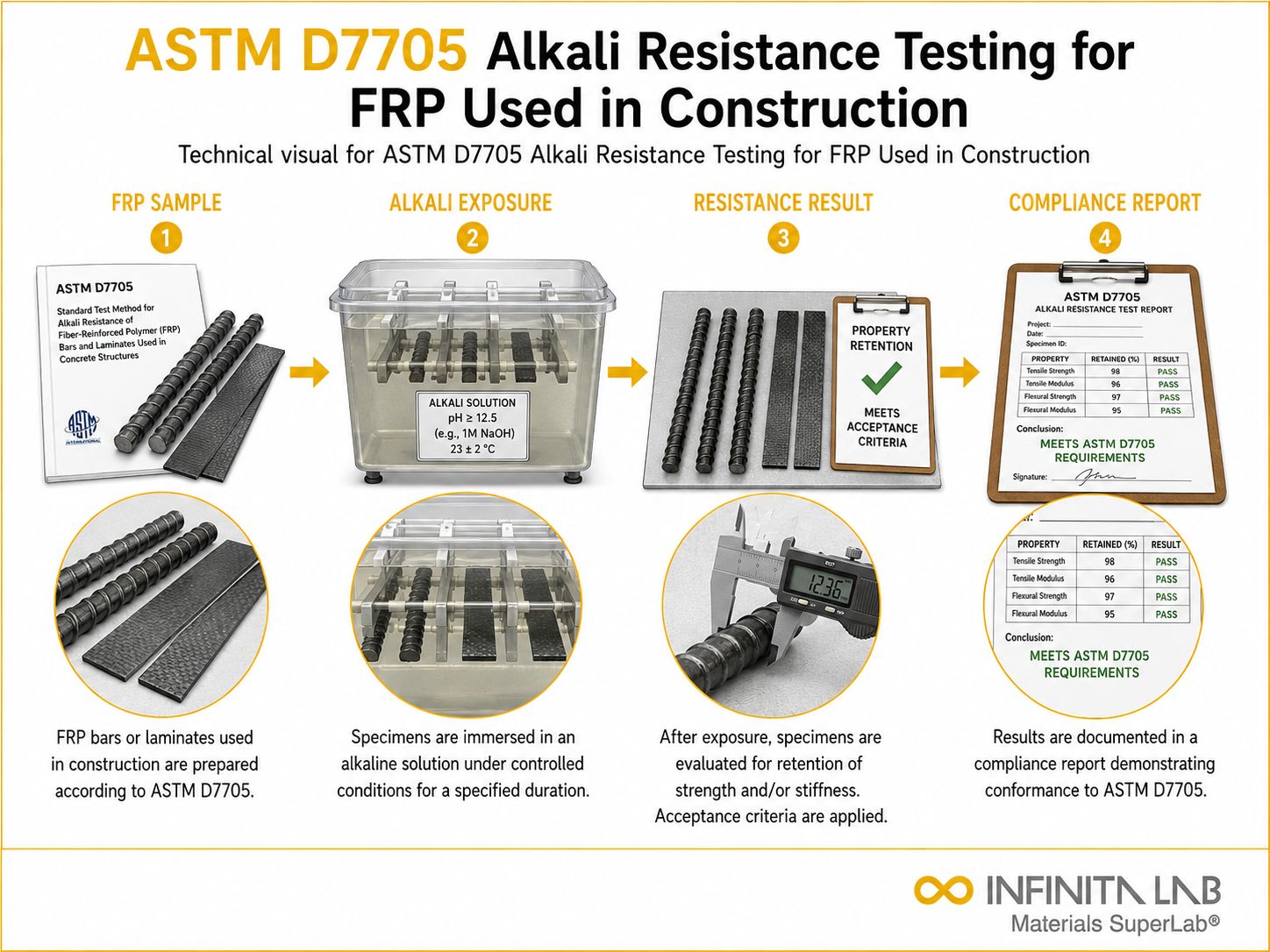
Test control specimens for initial tensile strength and modulus before conditioning to establish baseline properties.
1Alkaline Conditioning
FRP specimens are immersed in a high-pH pore solution at elevated temperature for the specified duration.
2Post-Conditioning Testing
Remove conditioned specimens, dry, and test tensile strength and modulus under the same conditions as baseline testing.
3Retention Calculation
Calculate retained tensile strength and modulus as percentages of baseline values; assess durability against acceptance criteria.
4ASTM D7705 Test Parameters and Requirements
| Parameter | Details |
|---|---|
| Test Principle | Alkaline immersion conditioning + tensile testing |
| Applicable Materials | FRP composites (GFRP, CFRP, AFRP) |
| Conditioning Solution | Simulated concrete pore solution (pH 12–13.5) |
| Conditioning Temperature | Elevated (typically 40–80°C for acceleration) |
| Measured Output | Retained tensile strength and modulus (%) |


- Universal Testing Machine – loads baseline and conditioned bars to failure in tension per ASTM D7205/D7205M.
- Bar Anchorage Systems – grip the bars so the ends don’t fail prematurely during tension testing.
- Environmental Chamber or Temperature-Controlled Bath – keeps the exposure condition at 60 °C throughout conditioning.
- Sustained-Load Fixtures – hold constant tensile force on bars during Procedure B and Procedure C exposure.
- Analytical Balance – weighs specimens before and after exposure to determine mass change.
- pH Meter – monitors the alkalinity of the conditioning solution over the exposure period.
- Extensometer or Strain Gauge Instrumentation – records strain and supports modulus determination during tension testing.
Equipment and Instrumentation Used for ASTM D7705 Testing
What You Receive: Test Report, Data, and Certification
- Retained tensile capacity of each conditioned specimen set, expressed relative to unconditioned control specimens.
- Mass change data for each exposure interval, particularly for Procedure A screening.
- Documentation of the selected procedure, exposure durations, temperature, solution or concrete details, and applied sustained load.
- Tensile test data per ASTM D7205/D7205M, including failure load and failure mode observations.
- A formal test report that names the bar product and specimen conditions and flags any deviations from the standard.
ASTM D7705 FRP Alkali Resistance Construction FAQs
Glass fibers, commonly used in GFRP rebar, are attacked by hydroxyl ions (OH⁻) in high-pH concrete pore solutions, causing fiber degradation and loss of fiber-matrix interface integrity, which reduces tensile strength and durability over time.
Elevated temperature conditioning (typically 40–80°C) accelerates the alkaline degradation reactions, allowing years of in-service exposure to be simulated in a much shorter laboratory timeframe using time-temperature equivalence principles.
Carbon fibers are inherently more resistant to alkali environments than glass fibers. However, CFRP composites can still be tested using ASTM D7705 to evaluate the durability of the polymer matrix and fiber-matrix interface under alkaline conditions.
Design standards and specifications for FRP rebar commonly require retention of at least 70–85% of initial tensile strength after defined alkaline conditioning periods, though exact requirements vary by standard and intended application.
The test provides durability data that, combined with appropriate reduction factors and design standards (such as ACI 440 for FRP reinforcement), can be used to define design tensile strengths for FRP structural members exposed to concrete alkalinity over the design service life.
If you mean FRP blood testing, the specific test depends on the material or medical application. If you mean FRP testing for blood or body-fluid exposure, the sample is exposed to a controlled fluid or challenge medium, and its resistance, penetration, or chemical response is evaluated.
For FRP reinforcing bars, ASTM D7705/D7705M exposes specimens to an aqueous alkaline environment, with or without sustained tensile stress, at controlled temperature. After conditioning, the specimens are tested in tension to evaluate changes such as tensile-capacity retention and mass change.
Why Choose Infinita Lab for FRP Alkali Resistance Construction Testing
When your FRP Alkali Resistance Construction results have to hold up - for compliance, a customer audit, or an engineering decision - ASTM D7705 accuracy and an unbiased third-party report matter more than price. Infinita Lab routes your ASTM D7705 FRP alkali resistance construction testing to ISO/IEC 17025-accredited U.S. partner labs with hands-on method experience, so you get defensible data, transparent reporting, and turnaround times built around your project deadline - not ours.

Need ASTM D7705 FRP Alkali Resistance Construction Testing You Can Rely On?
Send query us at hello@infinitalab.com or call us at (888) 878-3090 to learn more about our services and how we can support you.



Request a Quote
Submit your material details and receive testing procedures, pricing, and turnaround time within 24 hours.
 Quick Turnaround and Hasslefree process
 Confidentiality Guarantee
 Free, No-obligation Consultation
 100% Customer Satisfaction
