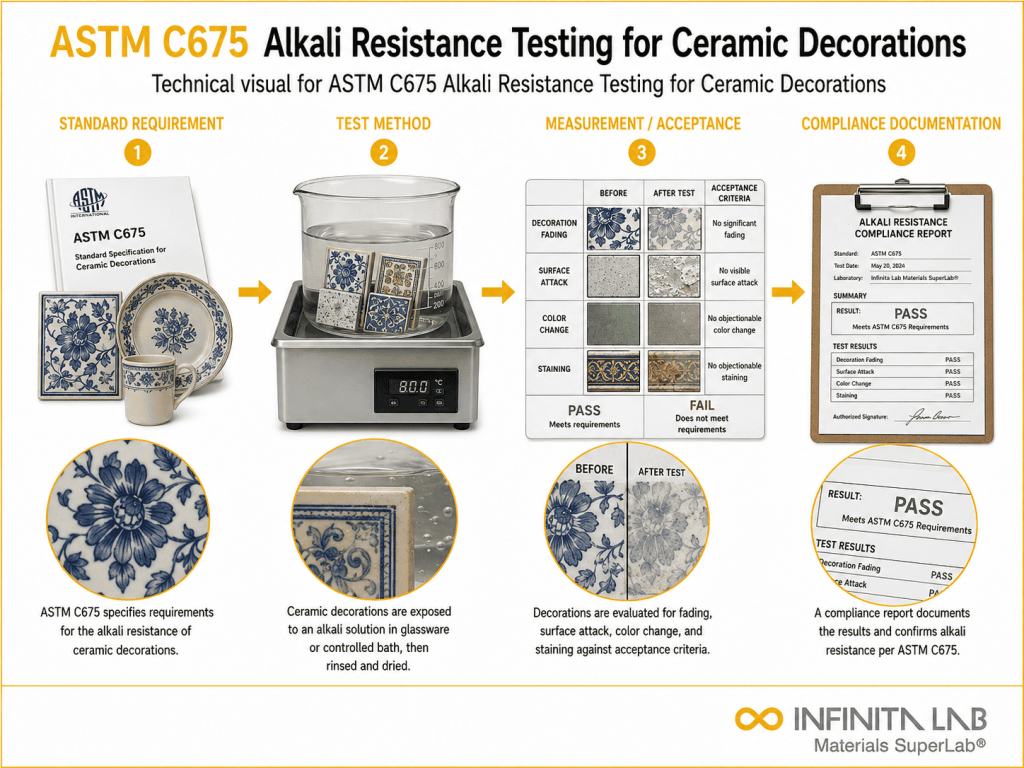


What Is ASTM C675 Alkali Resistance Ceramic Decoration?
ASTM C675 evaluates the resistance of ceramic decorations to alkali attack under controlled conditions. The test determines how decorative coatings withstand exposure to alkaline environments without degradation.
This method is widely used in ceramic tableware, sanitary ware, and decorative products. It ensures that surface decorations maintain their appearance and durability during cleaning and long-term use.
Applications and Benefits of ASTM C675 Alkali Resistance Ceramic Decoration Testing
Scope
ASTM C675 assesses the durability of ceramic decorations by exposing them to alkaline solutions. The test evaluates resistance to chemical attack and surface deterioration.
The test evaluates:
- Resistance of decorations to alkali exposure
- Color stability and fading behavior
- Surface degradation or loss of decoration
- Durability under cleaning conditions
- Suitability for consumer use
Applications
- Ceramic tableware and dinnerware
- Decorative porcelain products
- Sanitary ware with printed designs
- Hospitality and food service ceramics
- Consumer household products
- Quality control in ceramic manufacturing
Benefits
- Ensures long-lasting decorative quality
- Prevents fading and chemical damage
- Supports product durability and reliability
- Assists in coating formulation improvement
- Enables comparison of decorative performance
Our ASTM C675 Testing Procedure
Sample Preparation
Decorated ceramic specimens are cleaned and inspected.
1Alkali Exposure
Samples are immersed in a controlled alkaline solution.
2Reaction Period
Specimens are maintained under specified temperature and time conditions.
3Data Recording & Evaluation
Surfaces are examined for color change, fading, or damage.
4ASTM C675 Test Parameters and Requirements
| Parameter | Details |
|---|---|
| Applicable Materials | Decorated ceramic products |
| Alkali Solution | Standard alkaline solution (e.g., sodium carbonate) |
| Test Temperature | ~50°C to 80°C |
| Exposure Time | ~1 hour to 24 hours |
| Evaluation Method | Visual inspection (with optional magnification) |
| Measured Outputs | Color stability, surface integrity |


- Temperature-controlled water bath
- Chemical solution containers
- Heating system
- Inspection tools and magnifiers
- Sample handling equipment
- Data recording system
Equipment and Instrumentation Used for ASTM C675 Testing
What You Receive: Test Report, Data, and Certification
- Alkali resistance evaluation
- Color stability and degradation analysis
- Surface integrity assessment
- Decorative performance evaluation
- Test condition summary
- ASTM compliance report
ASTM C675 Alkali Resistance Ceramic Decoration FAQs
ASTM C675 evaluates resistance of ceramic decorations to alkaline solutions. It simulates exposure to cleaning agents and alkaline environments. This helps assess durability of decorative finishes on ceramic products.
Key parameters include alkali concentration, temperature, exposure time, and solution composition. Specimen preparation and immersion conditions are controlled. These factors influence degradation of ceramic decorations.
The test evaluates color change, gloss loss, and surface damage. Visual inspection is used after exposure. Results indicate resistance of decorations to alkali attack.
ASTM C675 is used for decorated ceramic products. This includes tiles, tableware, and sanitary ware. These materials are commonly exposed to alkaline cleaning agents.
ASTM C675 uses controlled laboratory conditions for alkali exposure. It may not fully represent real-world cleaning variations. Additional testing may be required for long-term durability assessment.
According to ASTM C675, alkali resistance testing evaluates the durability of ceramic decorations or applied color labels on returnable glass beverage containers when exposed to hot alkaline cleaning solutions. The glass container is partially immersed in a controlled alkali solution maintained at approximately 88°C. After an initial two-hour exposure, the specimen is removed, rinsed, dried, and visually inspected for decoration removal. This process is repeated at two-hour intervals until approximately 90% of the decoration is removed. Results are reported as the time required to reach 90% destruction, helping assess the durability of ceramic labels during repeated bottle washing.
Why Choose Infinita Lab for Alkali Resistance Ceramic Decoration Testing?
When your Alkali Resistance Ceramic Decoration results have to hold up - for compliance, a customer audit, or an engineering decision - ASTM C675 accuracy and an unbiased third-party report matter more than price. Infinita Lab routes your ASTM C675 alkali resistance ceramic decoration testing to ISO/IEC 17025-accredited U.S. partner labs with hands-on method experience, so you get defensible data, transparent reporting, and turnaround times built around your project deadline - not ours.

Looking for an Accredited Partner for ASTM C675 Alkali Resistance Ceramic Decoration Testing?
Send query us at hello@infinitalab.com or call us at (888) 878-3090 to learn more about our services and how we can support you.



