


ASTM E606 Strain-Controlled Fatigue Testing for Metallic Materials
The ASTM E606 standard test technique uses uniaxial forces to assess the strain-controlled fatigue parameters of supposedly homogenous materials. The same factors that affect force-controlled fatigue also affect the phenomena of strain-controlled fatigue. The ASTM E606 test is designed to serve as a manual for fatigue testing of inelastic and plastic materials at low and high cycles. Read more about ASTM E606 Strain-Controlled Fatigue Test below.
TRUSTED BY


Precision Testing Solutions for Accurate, Reliable, and Standards-Compliant Results
- Overview
- Scope, Applications, and Benefits
- Test Process
- Specifications
- Instrumentation
- Results and Deliverables
ASTM E606 Strain-Controlled Fatigue Testing – Overview
ASTM E606 defines procedures for evaluating fatigue behavior of metallic materials under strain-controlled cyclic loading conditions. The method measures how materials respond to repeated deformation, particularly in low-cycle fatigue regimes where plastic strain dominates crack initiation and growth.
This standard is critical for understanding material durability under cyclic stresses encountered in real service conditions. It provides detailed insight into strain-life relationships, cyclic hardening or softening behavior, and fatigue life prediction, supporting reliable design and failure prevention in critical engineering applications.

Scope, Applications, and Benefits
Scope
ASTM E606 establishes a laboratory method for determining fatigue properties of metallic materials under controlled strain amplitudes. It focuses on low-cycle fatigue behavior where strain, rather than stress, governs material response.
The method evaluates cyclic deformation characteristics, including hysteresis behavior, strain-life curves, and damage accumulation. It is widely used for materials subjected to thermal cycling, mechanical loading, and plastic deformation conditions.
- Applicable to ferrous and non-ferrous metallic materials
- Evaluates low-cycle fatigue under strain-controlled loading
- Measures cyclic stress-strain response and fatigue life
- Suitable for plastic and elastic strain regimes
- Supports development of strain-life (ε–N) curves
- Ensures controlled loading and environmental conditions
Applications
- Fatigue life prediction of structural components
- Aerospace and automotive component testing
- Power plant and pressure vessel analysis
- Thermal fatigue evaluation in high-temperature systems
- Material development and alloy optimization
- Failure analysis under cyclic deformation
- Quality control in metal manufacturing
- Research in fatigue and fracture mechanics
Benefits
- Provides accurate strain-life fatigue data
- Captures cyclic hardening and softening behavior
- Enables prediction of low-cycle fatigue failure
- Supports safe and optimized component design
- Improves reliability under cyclic loading conditions
- Helps identify fatigue-resistant materials
- Reduces risk of unexpected structural failure
- Complements stress-based fatigue testing methods
ASTM E606 Strain-Controlled Fatigue – Test Process
Specimen Preparation
Machine and finish specimen as per standard geometry and surface requirements.
1Test Setup Configuration
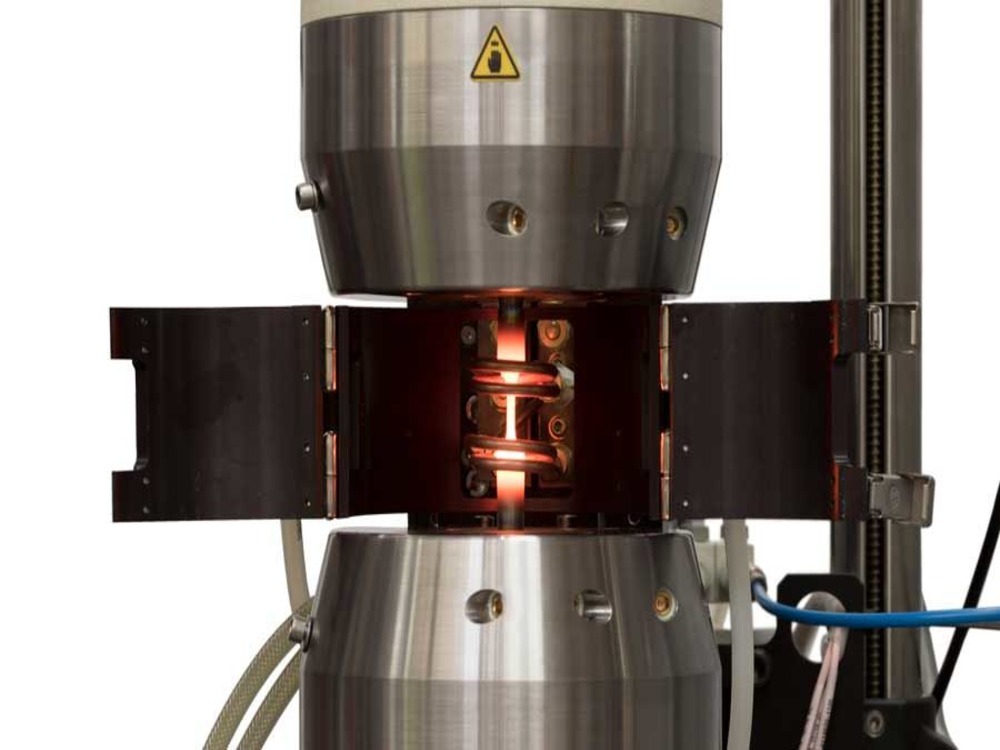
Mount specimen in servo-hydraulic testing machine with extensometer for accurate strain control.
2Cyclic Loading Application
Apply controlled cyclic strain amplitudes at specified frequency to induce fatigue damage.
3Data Recording & Analysis
Monitor stress-strain response, cycles to failure, and hysteresis behavior to generate fatigue life data.
4ASTM E606 Strain-Controlled Fatigue – Technical Specification
| Parameter | Details |
|---|---|
| Loading Mode | Fully reversed or with specified mean strain |
| Strain Rate | Constant, as defined in the test program |
| Specimen Geometry | Standard cylindrical or flat specimen |
| Data Recorded | Strain, stress, cycles to failure |
| Failure Criterion | Fracture or defined load/strain drop |
| Units | Strain (%), Cycles to failure (N) |
Instrumentation Used
- Servo-hydraulic fatigue testing machine
- High-accuracy load cell
- Strain-controlled extensometer
- Fatigue-rated specimen grips and fixtures
- Controller for cyclic loading and waveform generation
- Data acquisition and fatigue analysis software
Results and Deliverables
- Strain-life (ε–N) curves
- Cycles to failure data
- Cyclic stress-strain curves
- Hysteresis loop analysis
- Final fatigue performance report
Frequently Asked Questions
ASTM E606 directly controls strain, capturing both elastic and plastic deformation effects. This enables accurate modeling of low-cycle fatigue where plastic strain dominates, unlike stress-controlled methods that may underestimate damage under cyclic plastic deformation conditions.
In low-cycle fatigue, plastic deformation governs crack initiation and growth. Strain control ensures consistent deformation amplitude, allowing accurate representation of material response under conditions where stress alone cannot define fatigue behavior.
Hysteresis loops represent stress-strain response during each cycle, revealing energy dissipation, cyclic hardening or softening, and material stability, which are critical for understanding fatigue damage mechanisms.
Cyclic hardening increases material strength over cycles, while softening reduces it. These behaviors affect stress distribution and fatigue life, making them essential parameters in strain-controlled fatigue evaluation.
The method allows controlled mean strain levels, enabling evaluation of asymmetric loading conditions and their influence on fatigue life and crack growth behavior.
Why Choose Infinita Lab for Advanced Materials Testing and Characterization?
At the core of this breadth is our network of 2,000+ accredited laboratories across the USA, offering access to over 10,000 testing methods and analytical services. From advanced materials characterization (SEM, TEM, RBS, XPS) to mechanical, chemical, environmental, biological, and standardized ASTM/ISO-compliant testing, we deliver unmatched flexibility, specialization, and scale. You are never limited by geography, facility, or methodology — Infinita Lab connects you to the right expertise and testing solution, every time.

Looking for a Trusted Partner for Accurate and Reliable Testing Services?
Send query us at hello@infinitlab.com or call us at (888) 878-3090 to learn more about our services and how we can support you.




Request a Quote
Submit your material details and receive testing procedures, pricing, and turnaround time within 24 hours.
 Quick Turnaround and Hasslefree process
 Confidentiality Guarantee
 Free, No-obligation Consultation
 100% Customer Satisfaction
