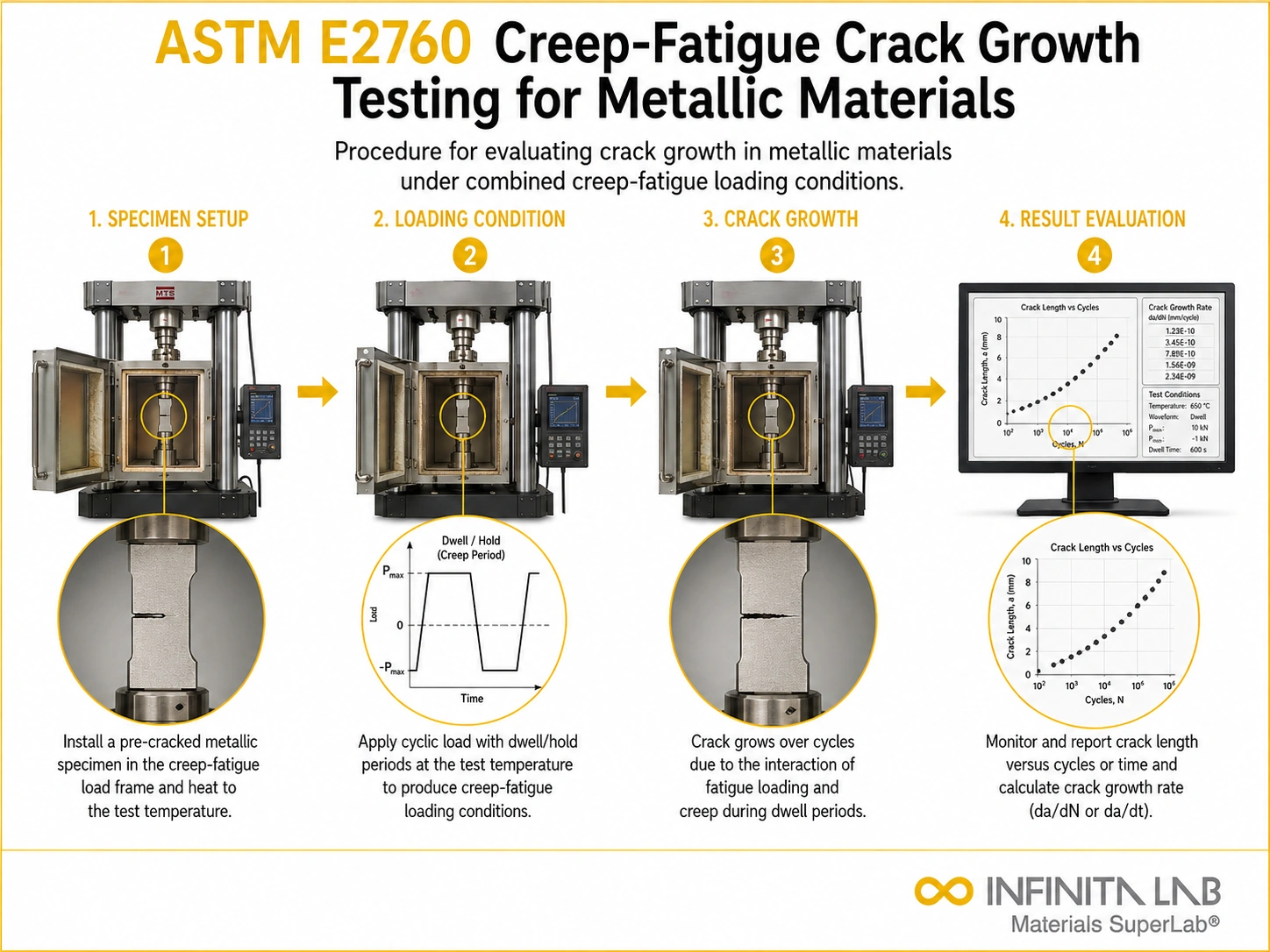


What Is ASTM E2760 Creep Fatigue Crack Growth?
ASTM E2760 provides a standard test method for measuring crack growth rates under creep-fatigue loading conditions, in which cyclic mechanical loading is combined with hold times at elevated temperature that allow time-dependent creep deformation at the crack tip. The test characterizes the interaction between fatigue crack growth and creep crack growth mechanisms that govern damage accumulation in high-temperature components.
This data is essential for the design and life assessment of gas turbine discs, blades, steam turbine rotors, nuclear reactor components, and power plant piping that operate under combined cyclic and sustained loading at elevated temperatures.

Applications and Benefits of ASTM E2760 Creep Fatigue Crack Growth Testing
Scope
ASTM E2760 evaluates:
- Creep-fatigue crack growth rate da/dt and da/dN
- Effect of hold time, temperature, and load ratio on crack growth
- Crack tip characterization parameters: ΔK, ΔJ, C* integral
- Transition between fatigue-dominated and creep-dominated crack growth
Applications
- Gas turbine disc and blade alloy life assessment
- Steam turbine rotor and blade design data generation
- Nuclear reactor structural component crack growth characterization
- Power plant header and piping fitness-for-service evaluation
- Aerospace high-temperature structural alloy qualification
Benefits
- Characterizes the combined creep-fatigue damage mechanism governing high-temperature crack growth
- Provides life-limiting data for damage tolerance design
- Supports ASME NH and API 579 high-temperature structural integrity codes
- Applicable to Ni superalloys, Cr-Mo steels, and titanium alloys
- Enables material comparison and alloy optimization for elevated temperature service
Our ASTM E2760 Testing Procedure
Specimen Preparation
Pre-crack C(T) or SE(B) specimens per ASTM E647
1Elevated Temperature Setup
Heat specimen in furnace, stabilize at test temperature
2Creep-Fatigue Loading
Apply cyclic load waveform, monitor crack growth continuously
3Crack Growth Rate Analysis
Calculate da/dN, correlate with ΔK, ΔJ, or C*
4ASTM E2760 Test Parameters and Requirements
| Parameter | Details |
|---|---|
| Temperature Range | 300 °C to 1100 °C |
| Hold Time Range | 1 s to 1000+ s |
| Crack Monitoring | DCPD or elastic compliance |
| Applicable Materials | Ni superalloys, Cr-Mo steels, stainless steels, Ti alloys |


- Servo-hydraulic testing machine with high-temperature capability
- High-temperature furnace (3-zone with ±2 °C uniformity)
- DCPD current source and precision nanovoltmeter
- Calibrated thermocouples (Type K, R, or S)
- High-temperature extensometer
- Waveform generator and digital control system
Equipment and Instrumentation Used for ASTM E2760 Testing
What You Receive: Test Report, Data, and Certification
- Crack growth rate curves (da/dN or da/dt vs. ΔK, ΔJ, or C*)
- Hold time and temperature dependence of crack growth rate
- Fracture mode characterization (fatigue striations, creep cavitation)
- Crack tip parameter calculations with constraint assessment
- Full creep-fatigue crack growth test report per ASTM E2760
ASTM E2760 Creep Fatigue Crack Growth FAQs
ASTM E2760-19e1 is a standard test method used to evaluate creep-fatigue crack growth behavior of materials under combined cyclic loading and high-temperature conditions in engineering applications.
ASTM E2760-19e1 is important because it helps predict material life and failure under combined creep and fatigue, ensuring safety and reliability in high-temperature components like turbines and reactors.
ASTM E2760-19e1 involves applying cyclic loads with hold times at elevated temperatures to propagate cracks, measuring crack growth rates under creep-fatigue interaction.
ASTM E2760-19e1 requires a high-temperature fatigue testing machine, crack measurement systems, and environmental control equipment for accurate testing.
ASTM E2760-19e1 results are reported as crack growth rate versus loading parameters, helping assess durability and predict service life.
Why Choose Infinita Lab for Creep Fatigue Crack Growth Testing
At the core of this breadth is our network of 2,000+ accredited laboratories across the USA, offering access to over 10,000 testing methods and analytical services. From advanced materials characterization (SEM, TEM, RBS, XPS) to mechanical, chemical, environmental, biological, and standardized ASTM/ISO-compliant testing, we deliver unmatched flexibility, specialization, and scale. You are never limited by geography, facility, or methodology — Infinita Lab connects you to the right expertise and testing solution, every time.

Looking for an Accredited Partner for ASTM E2760 Creep Fatigue Crack Growth Testing?
Send query us at hello@infinitalab.com or call us at (888) 878-3090 to learn more about our services and how we can support you.





