

What Is ASTM E2714 Creep Fatigue?
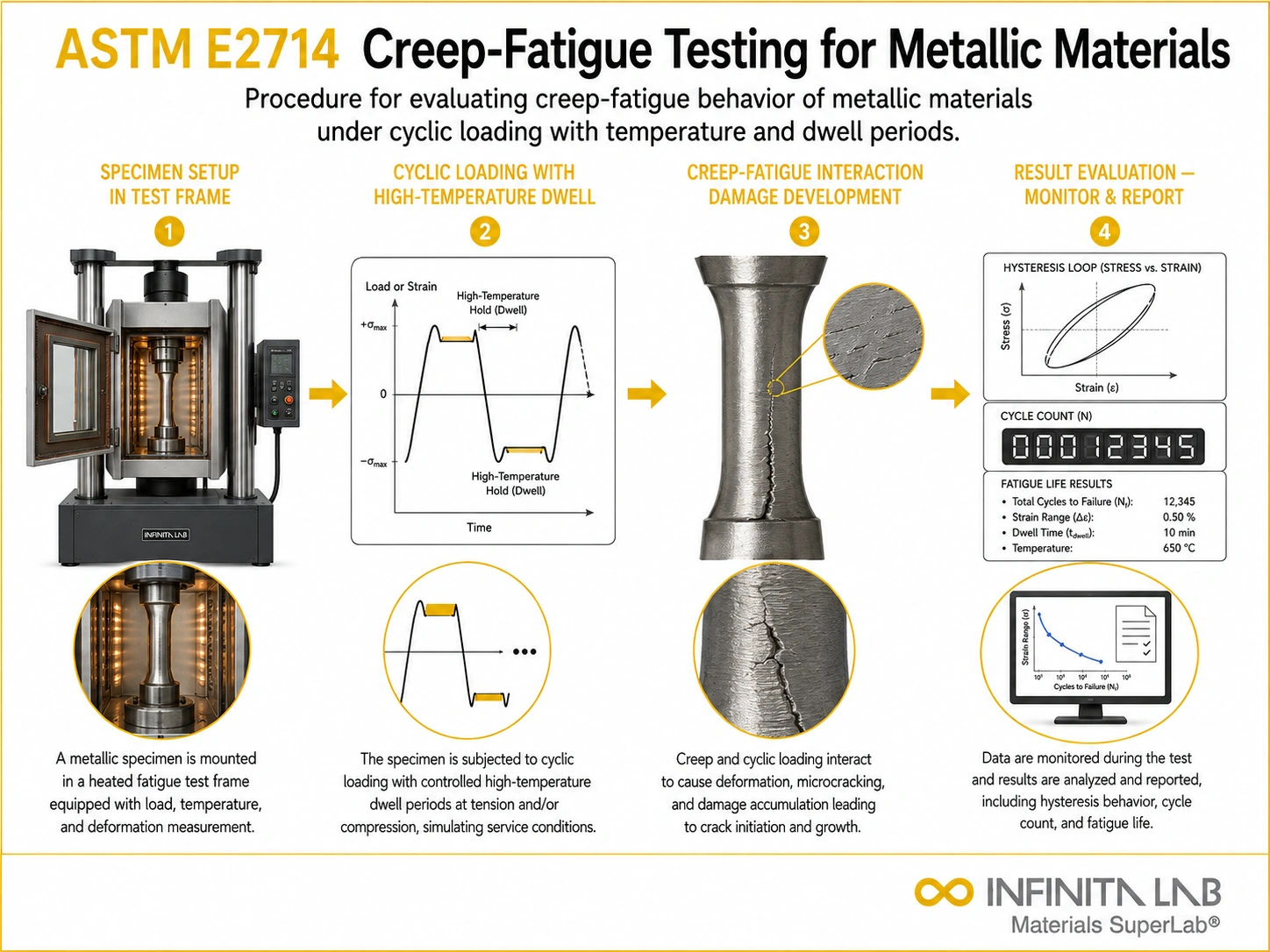
ASTM E2714 delineates a methodology for conducting isothermal, uniaxial creep-fatigue assessments on ostensibly homogeneous materials. The introduction of “hold times” throughout a fatigue cycle underpins this technique.
ASTM E2714 specifies maintaining a constant strain or stress for a predetermined duration, in contrast to conventional fatigue tests that cycle rapidly. This hold period more closely mimics the “start-stop” or “steady-state” cycles that industrial components undergo by allowing creep deformation and environmental degradation (such as oxidation) to accumulate.

Applications and Benefits of ASTM E2714 Creep Fatigue Testing
Scope
In ASTM E2714, materials are tested to determine the effects of fatigue, creep, and oxidation. These phenomena damage materials over time. Creep is the deformation of material under the influence of persistent mechanical stresses. The initiation and propagation of cracks in a material under cyclic loading—applied, unloaded, and reapplied—is known as fatigue.
This test applies cyclic loads to the specimen at elevated temperatures to introduce fatigue and creep. Cyclic loads deform the specimen, and elevated temperatures cause creep deformation.
Applications
- Power generation components (boilers, turbines, steam pipes).
- Aerospace engine and exhaust system materials.
- Petrochemical and refinery equipment operating at high temperatures.
- Nuclear reactor structural and pressure boundary materials.
- High-temperature alloys are used in cyclic thermal environments.
Benefits
- Enables accurate assessment of material performance under realistic service conditions.
- Supports life prediction and damage tolerance analysis for high-temperature components.
- Improves design reliability and safety for both cyclic and sustained-load applications.
- Generates standardized data for material comparison and qualification.
- Assists in identifying failure mechanisms due to creep-fatigue interaction.
Our ASTM E2714 Testing Procedure
Specimen Preparation
Prepare a standard specimen with specified geometry and surface finish.
1Test Setup
Mount the specimen in a strain-controlled, high-temperature testing system.
2Instrumentation
Attach and calibrate high-temperature extensometers.
3Post-Test Evaluation
Examine failure mode and report creep-fatigue life results.
4ASTM E2714 Test Parameters and Requirements
| Parameter | Details |
|---|---|
| Test Control Mode | Strain-controlled |
| Loading Type | Cyclic loading with hold times |
| Test Temperature | Elevated temperature, material-specific |
| Temperature Control | Furnace with ±2 °C stability |
| Data Recorded | Stress, strain, time, cycles |
| End-of-Life Criterion | Fracture or specified stiffness/load drop |


- Servo-hydraulic or electromechanical fatigue testing system
- High-accuracy load cell
- High-temperature furnace or environmental chamber
- High-temperature extensometer or strain measurement device
- Temperature measurement and control system (thermocouples)
- Creep-fatigue rated specimen grips and fixtures
- Closed-loop control and data acquisition system
Equipment and Instrumentation Used for ASTM E2714 Testing
What You Receive: Test Report, Data, and Certification
- Number of cycles to failure under creep-fatigue conditions
- Stress–strain hysteresis behavior over test duration
- Effect of hold time on creep-fatigue life
- Evidence of cyclic softening or hardening
- Accumulated creep damage during hold periods
- Mode and location of specimen failure
- Data for creep-fatigue interaction and life prediction models
ASTM E2714 Creep Fatigue FAQs
ASTM has several standards related to creep testing, such as ASTM E139, ASTM E292, ASTM E328, and ASTM E2714. Each standard specifies the test method, apparatus, specimen preparation, loading, temperature, measurement, analysis, and reporting of creep test results.
Creep tests on plastics are described in the following standards: ISO 899-1 and ISO 899-2, as well as ASTM D2990. Pipes are tested using a full-notch creep test (FNCT) to ISO 16770. Since this type of test runs over a long period, it is typical to test multiple specimens simultaneously.
A creep test, sometimes referred to as a stress-relaxation test, determines the amount of deformation a material experiences over time while under a continuous tensile or compressive load at a constant temperature.
While fatigue testing focuses on cyclic loading and crack propagation, creep testing assesses the deformation of materials under constant load and temperature conditions.
Textbooks generally describe three stages of creep: primary or transient, secondary or steady-state, and tertiary or acceleration creep. These appear after initial strain ε0 upon loading when the test or homologous temperature is high enough.
ASTM E2994 determines the chemical composition of titanium and titanium alloys using spark atomic emission spectrometry (Spark-AES) or glow discharge atomic emission spectrometry (GD-AES). The prepared specimen is analyzed by measuring characteristic light emitted by its elements, and the results are used to quantify elemental concentrations and verify compliance with material specifications.
Why Choose Infinita Lab for Creep Fatigue Testing?
When your Creep Fatigue results have to hold up - for compliance, a customer audit, or an engineering decision - ASTM E2714 accuracy and an unbiased third-party report matter more than price. Infinita Lab routes your ASTM E2714 creep fatigue testing to ISO/IEC 17025-accredited U.S. partner labs with hands-on method experience, so you get defensible data, transparent reporting, and turnaround times built around your project deadline - not ours.

Need ASTM E2714 Creep Fatigue Testing You Can Rely On?
Send query us at hello@infinitalab.com or call us at (888) 878-3090 to learn more about our services and how we can support you.





