

What Is ASTM E606 Strain Controlled Low Cycle Fatigue?
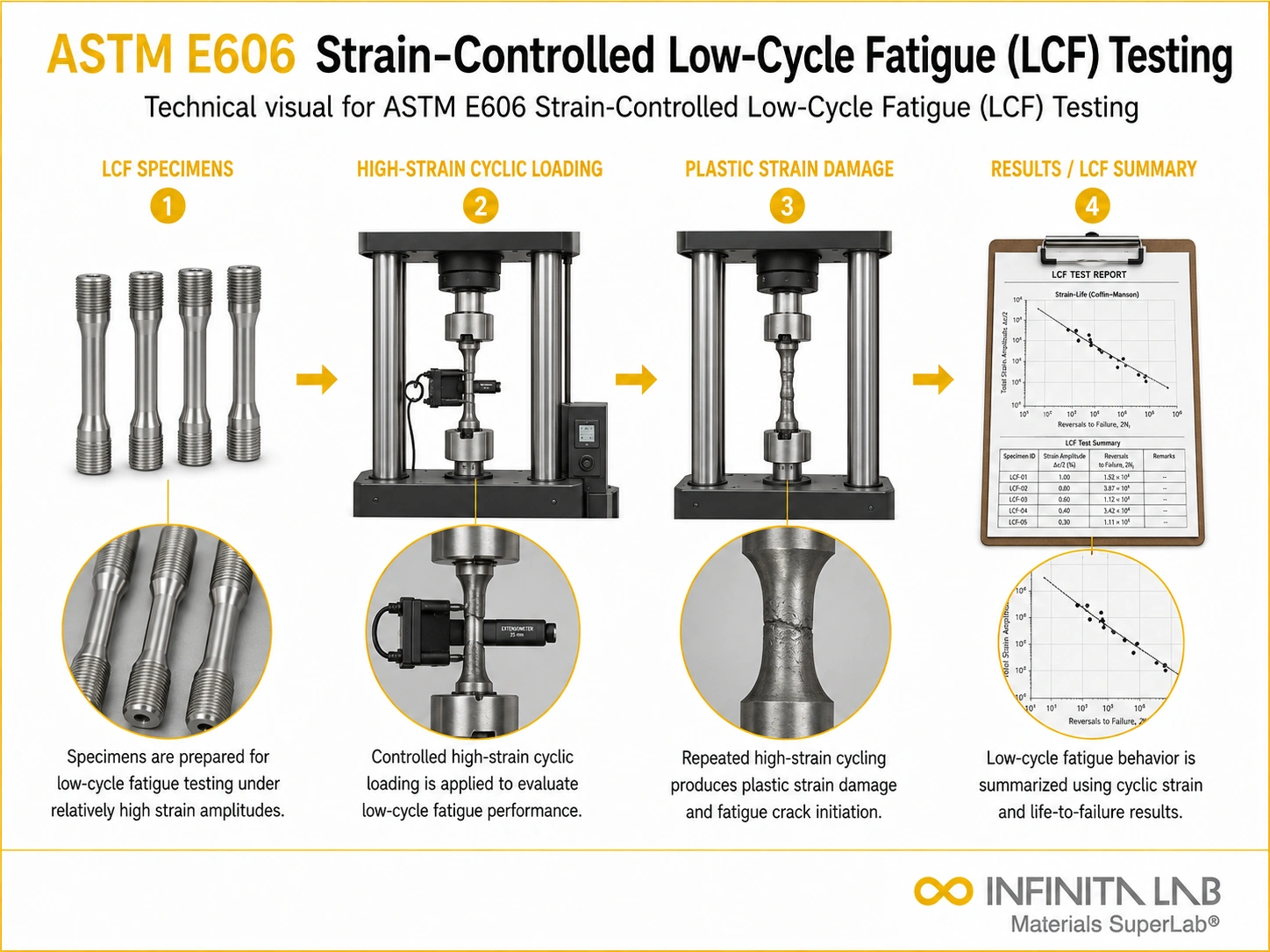
ASTM E606/E606M is the international standard for performing strain-controlled fatigue testing on metallic substances. It is primarily used to describe Low-Cycle Fatigue (LCF), a condition in which materials undergo recurrent plastic (permanent) deformation under high loads.
ASTM E606 regulates the amount of stretch (strain) the material experiences, in contrast to high-cycle fatigue tests that regulate the force applied. This is crucial for components such as turbine blades, engine pistons, and pressure vessels that are subject to mechanical constraints or thermal expansion.

Applications and Benefits of ASTM E606 Strain Controlled Low Cycle Fatigue Testing
Scope
ASTM E606/E606M specifies a standardized method for conducting strain-controlled fatigue tests on metallic materials under uniaxial loading. The test is primarily used to evaluate the low-cycle fatigue (LCF) behavior of materials where deformation is predominantly plastic and fatigue life is governed by strain rather than stress. The standard covers testing under constant-amplitude, fully reversed, or mean-strain conditions, providing fatigue-life data and cyclic stress–strain response necessary for material characterization, design, and durability assessment.
Applications
- Fatigue assessment of materials for aerospace and automotive components
- Evaluation of structural materials subjected to cyclic thermal and mechanical loads
- Material qualification for power generation and pressure vessel components
- Research and development of new alloys and heat treatments
- Failure analysis of components experiencing strain-controlled fatigue
- Generation of input data for fatigue and durability design models
- Quality control and comparison of material fatigue performance
Benefits
- Provides an accurate evaluation of low-cycle fatigue performance
- Enables determination of strain–life (ε–N) relationships
- Captures cyclic stress–strain behavior and material hardening/softening
- Supports fatigue life prediction under plastic deformation conditions
- Applicable to a wide range of metallic materials and alloys
- Ensures repeatable and standardized test results
- Useful for validating material models and design codes
Our ASTM E606 Testing Procedure
Specimen Preparation
Prepare a smooth, uniform test specimen with dimensions as specified in ASTM E606/E606M; ensure proper surface finish and alignment features.
1Measurement Setup
Attach a calibrated axial extensometer to the specimen gauge length to accurately measure and control strain.
2Machine Setup
Mount the specimen in a servo-hydraulic or electromechanical fatigue testing machine capable of strain control.
3Post-Test Examination
Document fatigue life, fracture characteristics, and relevant cyclic material properties.
4ASTM E606 Test Parameters and Requirements
| Parameter | Details |
|---|---|
| Test Method | Uniaxial, constant-amplitude strain-controlled fatigue |
| Loading Mode | Axial tension–compression |
| Specimen Type | Smooth, cylindrical or flat specimen |
| Strain Measurement Accuracy | ±1% of indicated strain or better |
| Failure Criteria | Specimen fracture or defined load/stiffness reduction |
| Output | Strain–life (ε–N) data and cyclic material properties |


- Servo-hydraulic fatigue testing machine
- High-precision load cell
- Axial strain-controlled extensometer
- Fatigue-rated grips and specimen fixtures
- Closed-loop control and waveform generator
- Data acquisition and fatigue analysis software
Equipment and Instrumentation Used for ASTM E606 Testing
What You Receive: Test Report, Data, and Certification
- Number of cycles to failure under specified strain amplitude
- Strain–life (ε–N) relationship of the material
- Cyclic stress–strain response at different fatigue cycles
- Hysteresis loop characteristics (shape, width, and stability)
- Cyclic hardening or softening behavior of the material
- Fatigue ductility and fatigue strength coefficients
- Mean stress evolution during cyclic loading (if applicable)
- Failure mode and fracture characteristics
- Material performance under low-cycle fatigue conditions
ASTM E606 Strain Controlled Low Cycle Fatigue FAQs
ASTM E606 is a standard test method that outlines procedures for measuring the tensile properties of metallic materials at elevated temperatures.
The results are used to predict fatigue life in components subjected to cyclic loading. This helps design parts capable of withstanding repeated loads over time without failure, which improves the safety and reliability of critical structures.
The test is used for metallic materials, especially in structural components that experience cyclic loading in real-world applications. This includes alloys used in aerospace, automotive, and energy sectors.
Strain-controlled fatigue testing is essential for evaluating the low-cycle fatigue behavior of materials, particularly for components that experience high levels of plastic strain during service. It helps predict when materials will fail under repeated load conditions.
ASTM E606 testing helps evaluate material performance under repeated plastic deformation and cyclic loading. The results support materials research, mechanical design, process and quality control, product performance evaluation, and fatigue failure analysis, particularly for components exposed to mechanically or thermally induced cyclic strains.
Low-cycle fatigue (LCF) testing evaluates a material’s resistance to repeated loading that causes plastic deformation. A prepared specimen is subjected to controlled cyclic tension and compression using a fatigue testing machine, with strain measured using an extensometer. Testing continues until the specimen fails or reaches a specified endpoint. The results help determine fatigue life and predict material performance under repeated mechanical and thermal loads. ASTM E606/E606M is commonly used for strain-controlled fatigue testing.
ASTM fatigue testing evaluates how materials withstand repeated loading and unloading over time. A specimen is mounted in a fatigue testing machine and exposed to controlled cyclic forces or strains under specified conditions. The number of cycles to crack initiation or failure is recorded, helping assess fatigue resistance and durability. The applicable ASTM standard depends on the material and test method; ASTM E606/E606M covers strain-controlled fatigue testing, while ASTM E466 covers force-controlled fatigue testing of metallic materials.
Why Choose Infinita Lab for Strain Controlled Low Cycle Fatigue Testing
When your Strain Controlled Low Cycle Fatigue results have to hold up - for compliance, a customer audit, or an engineering decision - ASTM E606 accuracy and an unbiased third-party report matter more than price. Infinita Lab routes your ASTM E606 strain controlled low cycle fatigue testing to ISO/IEC 17025-accredited U.S. partner labs with hands-on method experience, so you get defensible data, transparent reporting, and turnaround times built around your project deadline - not ours.

Need ASTM E606 Strain Controlled Low Cycle Fatigue Testing You Can Rely On?
Send query us at hello@infinitalab.com or call us at (888) 878-3090 to learn more about our services and how we can support you.