


ASTM D3166: Adhesive Shear Fatigue Properties Testing Services
Accredited ASTM D3166 adhesive shear fatigue properties testing from Infinita Lab, performed to the exact standard requirements - accurate, reproducible results with full documentation for compliance, R&D, and quality control programs.
TRUSTED BY


Get ASTM D3166 compliant results - request your adhesive shear fatigue properties testing quote
- Overview
- Scope, Applications, and Benefits
- Test Process
- Specifications
- Instrumentation
- Results and Deliverables
What Is ASTM D3166 Adhesive Shear Fatigue Properties?
Structural adhesive joints don’t usually fail because of one dramatic overload event. More often, they give way slowly, worn down by thousands or even millions of small, repeated stresses that build up over months or years of service. ASTM D3166, the Standard Test Method for Fatigue Properties of Adhesives in Shear by Tension Loading (Metal/Metal), was developed to capture exactly that behavior. It gives engineers a repeatable way to see how an adhesive bond between two metal adherends holds up when it’s cycled in shear, again and again, under tension loading, rather than pulled apart just once.
The method’s concept is simple enough, even though the engineering behind it is demanding. A single-lap shear specimen is bonded using the adhesive under evaluation, prepared and conditioned under controlled conditions, and then mounted in a fatigue-rated tension testing system. Instead of applying one steadily increasing load until the joint breaks, the machine cycles the specimen between a chosen upper and lower stress level, repeatedly. At the same time, the system logs how many cycles the bondline survives before it fails. Run this at several different stress levels, and a lab can build a stress-versus-cycles curve, often called an S-N curve, that shows how fatigue life trends as applied stress rises or falls, and roughly where an adhesive’s practical endurance limit sits.
That data matters anywhere a bonded joint sees vibration, repeated loading, or cyclic stress over its working life- think transportation structures, machinery, and assembled metal components- where an adhesive that looks plenty strong in a single-pull test can still underperform once fatigue enters the picture. D3166 closes that gap, arming designers and quality teams with fatigue data they can actually plan around.

Applications and Benefits of ASTM D3166 Adhesive Shear Fatigue Properties Testing
Scope
ASTM D3166 evaluates the fatigue strength of structural adhesives in shear by cyclic tension loading.
It evaluates:
- This test method covers the measurement of fatigue strength in shear by tension loading for an adhesive bonded to metal adherends.
- Metal-to-metal adhesively bonded joints are the primary focus, though the method can be adapted for plastic adherends when appropriate reinforcement is used.
- Because specimens are prepared, bonded, and conditioned under carefully controlled conditions, results from different labs and adhesive systems can be meaningfully compared.
- A single-lap shear specimen configuration is used for testing, with the adhesive bond line loaded in shear as the specimen is pulled in tension.
- Rather than a single continuous pull to failure, loading is applied cyclically, subjecting the specimen to repeated stress cycles.
- To keep bending and peel effects at the overlap from distorting the shear fatigue result, the standard recommends a specific adherend thickness for metal specimens.
- When thinner or more flexible adherends such as plastics are used, reinforcing doublers are recommended to prevent premature bearing or buckling failure unrelated to the adhesive itself.
- Results are typically reported as the number of cycles to failure at a given applied stress level, which allows a stress-life relationship for the adhesive system to be built.
- Fatigue results are sensitive to specimen geometry, surface preparation, and environmental conditioning, so the method calls for these variables to be documented alongside the data.
- SI units are treated as the standard within the method, and any inch-pound values are provided for reference only.
Applications
- Structural adhesives intended for load-bearing metal joints are evaluated here, particularly in transportation equipment such as automotive, rail, and aerospace assemblies subject to vibration.
- When a bonded joint will face repeated or cyclic loading rather than a single static load, this method helps compare candidate adhesive systems during material selection.
- Design allowable and fatigue life estimates for bonded metal structures used in industrial machinery and equipment draw on this kind of data.
- Appliance, electronics enclosure, and metal fabrication assemblies that experience ongoing mechanical vibration in service can have their adhesive performance validated this way.
- Qualifying new adhesive formulations or process changes often comes down to confirming that fatigue behaviour hasn’t shifted relative to a known baseline.
- In-service bond failures where cyclic loading, rather than a single overload, is suspected as the root cause are a common reason to run this test.
- Research and development programs focused on structural adhesive durability rely on the comparative S-N data this method generates.
Benefits
- Long-term durability characteristics come to light here in a way that a single-point tensile or lap shear test can’t show.
- The stress-life data produced feeds directly into fatigue life estimates and design margins.
- Adhesives that look nearly identical under static loading can behave very differently under repeated stress, and this method helps tell them apart.
- Because the data is traceable to a recognized ASTM method, material and process qualification gets real support.
- Fatigue weaknesses get caught before a product ships, reducing the risk of unexpected in-service bond failures.
- Quality and engineering teams gain a common, repeatable benchmark for comparing adhesive suppliers or formulations over time.
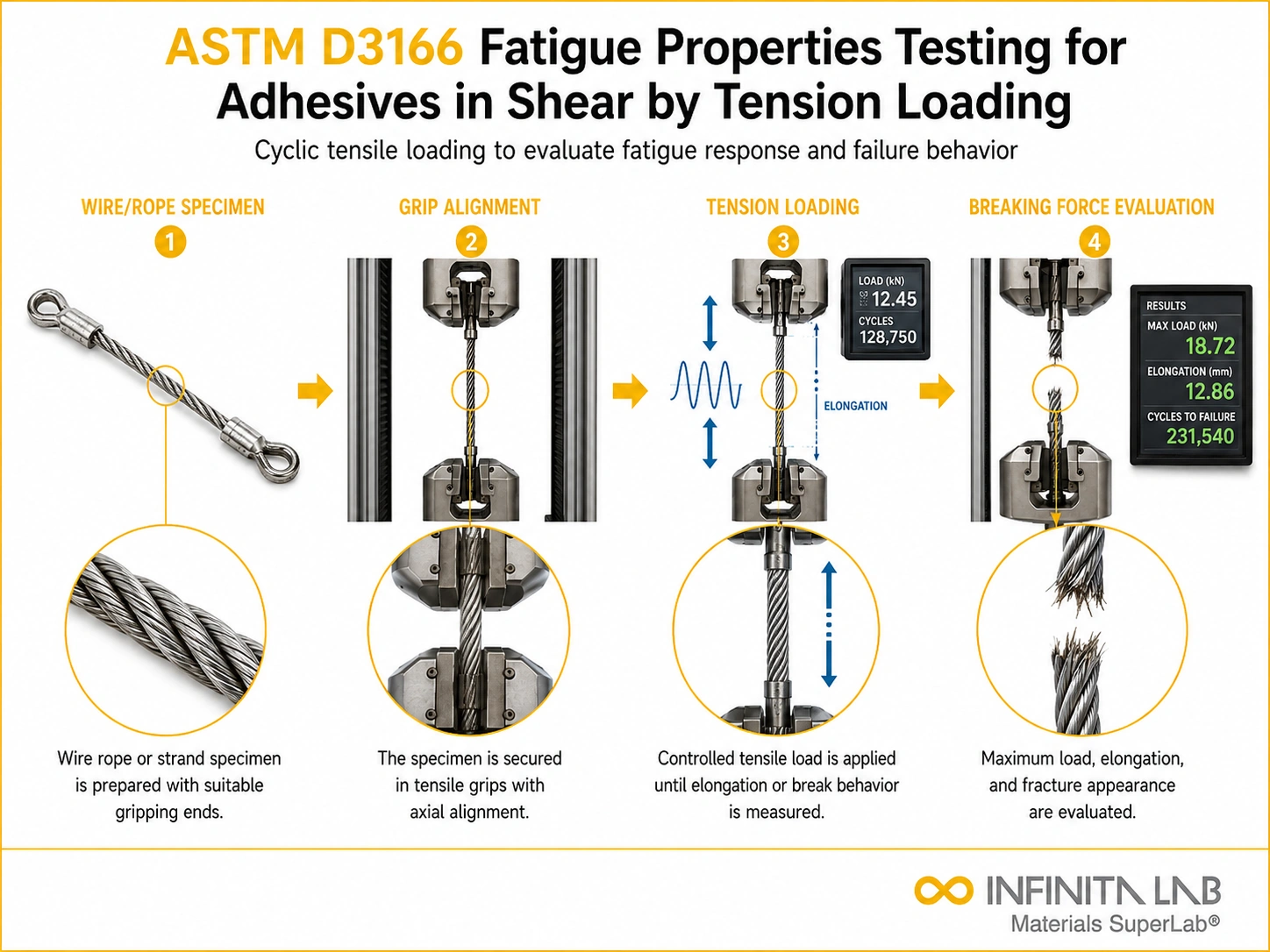
Our ASTM D3166 Testing Procedure
Specimen Preparation & Mounting
Lap-shear specimens are fabricated and securely mounted in fatigue test equipment.
1Cyclic Loading
Repeated tension-shear loads are applied between predefined limits under controlled conditions.
2Monitoring & Evaluation
Specimens are inspected during cycling for damage and tested until failure or target cycles.
3Data Recording & Analysis
Load cycles, failure location, and failure mode are documented for analysis.
4ASTM D3166 Test Parameters and Requirements
| Parameter | Details |
|---|---|
| Applicable Materials | Metal-to-metal and selected plastic-bonded joints |
| Specimen Type | Tension lap-shear geometry |
| Loading Mode | Cyclic fatigue loading |
| Test Control | Load-controlled cycling |
| Output Units | Number of cycles to failure |


- Fatigue-Rated Universal Testing Machine – Applies precisely controlled cyclic tension loading and captures load, displacement, and cycle-count data throughout the test.
- Load Cell – Accurately measures the applied tension force across the full range of stress levels used in the fatigue program.
- Alignment Fixtures and Grips – Hold the lap-shear specimen securely and in proper axial alignment, keeping bending or peel effects from skewing the shear fatigue results.
- Environmental Conditioning Chamber – Maintains controlled temperature and humidity while specimens condition before testing.
- Cycle Counter and Data Acquisition System – Logs stress cycles, load, and displacement continuously, so failure points and trends get captured with precision.
- Extensometer or Displacement Sensor – Tracks specimen deformation as cycling proceeds, adding a fuller picture of fatigue behaviour beyond just the failure cycle count.
- Optical or Digital Inspection Equipment – Comes into play after failure, examining and documenting the fracture surface to classify the failure mode.
Equipment and Instrumentation Used for ASTM D3166 Testing
What You Receive: Test Report, Data, and Certification
- A detailed test report documents specimen preparation, conditioning, test parameters, and results for every specimen evaluated.
- Cycles-to-failure data at each tested stress level are compiled into a stress-versus-cycles (S-N) summary for the adhesive system.
- Each specimen receives a failure mode classification, noting whether failure occurred within the adhesive, at the adhesive-substrate interface, or in the metal adherend itself.
- Photographs or other visual documentation of representative fracture surfaces support engineering review.
- Raw data sets come ready for further statistical analysis, design allowable development, or comparison against alternate adhesive candidates.
- A findings summary translates the fatigue data into practical guidance on adhesive selection or design margin for the client’s application.
ASTM D3166 Adhesive Shear Fatigue Properties FAQs
The ASTM D3166 test method specifies the preparation, loading, and testing parameters for measuring shear fatigue strength by tension loading adhesives on a standard specimen under specified conditions.
While this test method is for metal-to-metal applications, technicians can also use it to measure the fatigue properties of adhesives with plastic adherents if the thickness of the plastic adherents is considered.
Results have shown the adhesive's fatigue strength, the location of failure, and the nature of failure. These are very important when comparing various adhesive systems for their effectiveness in ensuring structural integrity in multiple applications.
Although the test, according to ASTM D3166, provides essential information about adhesive performance, this standard has been designed for metal-to-metal applications. Thus, the complex interactions involved in diverse and challenging environments must be considered entirely.
Railway adhesives can be evaluated using standards such as ASTM D3166 for fatigue resistance of structural adhesives, along with relevant railway-specific vibration, environmental, and durability requirements.
ASTM D3166 is the Standard Test Method for Fatigue Properties of Adhesives in Shear by Tension Loading (Metal/Metal). It evaluates an adhesive joint’s resistance to repeated cyclic loading and helps characterize its fatigue performance.
Why Choose Infinita Lab for Adhesive Shear Fatigue Properties Testing
When your Adhesive Shear Fatigue Properties results have to hold up - for compliance, a customer audit, or an engineering decision - ASTM D3166 accuracy and an unbiased third-party report matter more than price. Infinita Lab routes your ASTM D3166 adhesive shear fatigue properties testing to ISO/IEC 17025-accredited U.S. partner labs with hands-on method experience, so you get defensible data, transparent reporting, and turnaround times built around your project deadline - not ours.

Need ASTM D3166 Adhesive Shear Fatigue Properties Testing You Can Rely On?
Send query us at hello@infinitalab.com or call us at (888) 878-3090 to learn more about our services and how we can support you.



Request a Quote
Submit your material details and receive testing procedures, pricing, and turnaround time within 24 hours.
 Quick Turnaround and Hasslefree process
 Confidentiality Guarantee
 Free, No-obligation Consultation
 100% Customer Satisfaction
