


ASTM D3171: Composite Constituent Content Testing Services
Accredited ASTM D3171 composite constituent content testing from Infinita Lab, performed to the exact standard requirements - accurate, reproducible results with full documentation for compliance, R&D, and quality control programs.
TRUSTED BY


Get ASTM D3171 compliant results - request your composite constituent content testing quote
- Overview
- Scope, Applications, and Benefits
- Test Process
- Specifications
- Instrumentation
- Results and Deliverables
What Is ASTM D3171 Composite Constituent Content?
ASTM D3171, Standard Test Methods for Constituent Content of Composite Materials, is the primary framework used to determine the fibre, resin (matrix), and void content of fibre-reinforced polymer composites. Because fibre volume fraction governs the stiffness, strength, and fatigue performance of a composite laminate, and void content signals processing defects that can compromise structural integrity, this testing is fundamental to material qualification, process validation, and failure analysis across aerospace, wind energy, automotive, marine, and industrial manufacturing programs.
The standard sets out two principal testing approaches. Test Method I physically separates the matrix from the reinforcing fibres through matrix digestion, using an acid or solvent dissolution medium, or through matrix burn-off, in which the resin is ignited away at elevated temperature in a furnace. The recovered fibre mass is then weighed and compared against the original specimen mass to determine constituent weight fractions. Test Method II is a non-destructive, calculated approach limited to laminates of known construction; it derives constituent fractions from measured laminate thickness, ply count, and fibre areal weight without physically removing the matrix. In both approaches, void content is derived indirectly, by comparing the theoretical composite density, calculated from the measured constituent densities and their proportions, against the actual measured density of the specimen, typically obtained in accordance with ASTM D792.
Because digestion chemistry and burn-off conditions must be matched to the specific fibre and matrix system to avoid damaging or falsely dissolving the reinforcement, testing under D3171 demands materials expertise, calibrated furnaces and digestion apparatus, and disciplined mass-balance procedures. Infinita Lab connects manufacturers, fabricators, and engineering teams to accredited laboratories equipped to run these procedures accurately, generating defensible data for design allowables, incoming material verification, and root-cause investigations.

Applications and Benefits of ASTM D3171 Composite Constituent Content Testing
Scope
- ASTM D3171 covers procedures for determining the fibre, matrix (resin), and void content of fibre-reinforced polymer-matrix composite materials.
- Test Method I applies matrix digestion or matrix burn-off to separate the reinforcement from the resin matrix physically.
- Matrix digestion uses an acid or solvent medium selected to dissolve the resin without attacking the fibre reinforcement.
- Matrix burn-off, also called ignition loss, removes the resin by controlled heating in a furnace and is generally reserved for glass fibre and other heat-stable reinforcements.
- Test Method II is a calculated, non-destructive procedure applicable only to laminates of known ply construction and fibre areal weight.
- Void content is calculated by comparing the theoretical density of the composite, based on constituent densities and proportions, to its measured density.
- The standard applies to composites reinforced with carbon, glass, aramid, and certain hybrid fibre systems in thermoset and select thermoplastic matrices.
- Density of the specimen and its constituents is typically determined using methods consistent with ASTM D792.
- Results are reported as fibre, resin, and void content by weight percentage and, where densities are known, by volume percentage.
- Specimen selection, conditioning, and preparation follow the sampling and dimensional requirements defined within the standard.
Applications
- Qualifying composite laminates and prepreg systems against design allowable before production release.
- Verifying fibre volume fraction and void content in aerospace structural composites, where strength-to-weight performance is critical.
- Supporting quality control of wind turbine blade laminates, where high fibre content and low void content are essential to fatigue life.
- Validating lightweight automotive composite components for structural and semi-structural applications.
- Investigating manufacturing process deviations, such as inconsistent resin infusion or cure, through constituent and void analysis.
- Performing failure analysis on in-service or field-returned composite parts to identify processing-related root causes.
- Confirming incoming material conformance for composite fabricators and material suppliers.
Benefits
- Provides objective, standardised data on fibre, resin, and void content that supports material and process qualification.
- Helps identify excessive porosity or void content that can reduce mechanical performance and fatigue resistance.
- Enables comparison of actual laminate composition against design specifications and manufacturer datasheets.
- Supports root-cause investigations into inconsistent part performance or unexpected failures.
- Generates data suitable for statistical process control across production batches.
- Builds a defensible technical record for regulatory submissions, customer qualification packages, and design reviews.
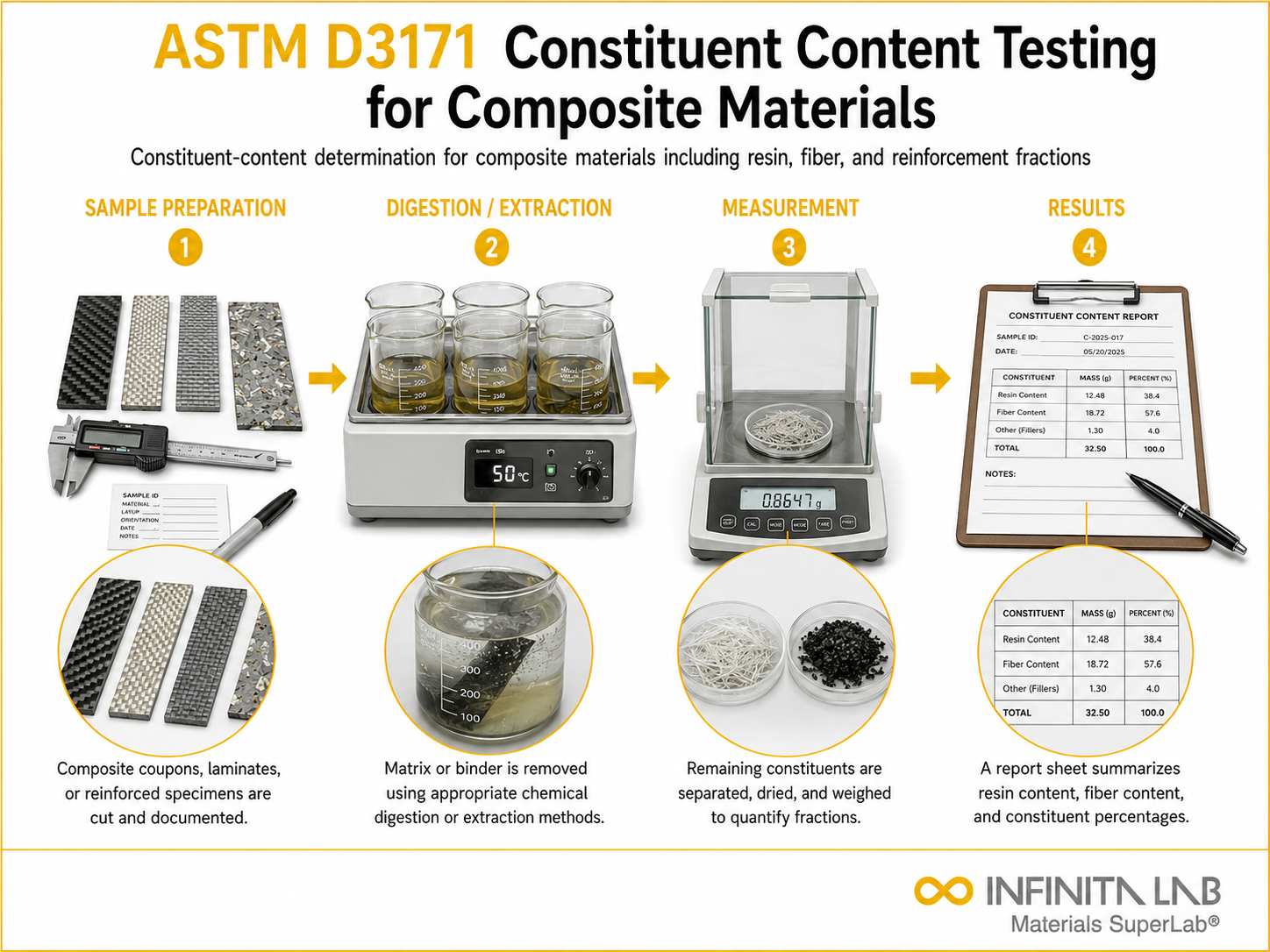
Our ASTM D3171 Testing Procedure
Specimen Preparation
Composite specimens are cut, dried, and weighed accurately.
1Matrix Removal
Matrix is removed by acid digestion (e.g., nitric acid for carbon/epoxy) or combustion at elevated temperature.
2Fibre Weighing
Remaining fiber mass is weighed after matrix removal.
3Calculation
Fiber weight fraction, fiber volume fraction, and void content are calculated using constituent densities.
4ASTM D3171 Test Parameters and Requirements
| Parameter | Details |
|---|---|
| Applicable Materials | Polymer matrix composite materials, laminate composites |
| Specimen Types | Laminated composite coupons / test specimens |
| Reinforcement Content | By weight (%) or volume (%) |
| Matrix Content | By weight (%) or volume (%) |
| Void Content | Percentage void volume (%) |
| Test Environment | Controlled laboratory conditions |


- Analytical balance – Provides precise mass measurements before and after matrix removal for accurate constituent calculations.
- Muffle furnace – Performs controlled matrix burn-off (ignition loss) for glass fibre and other heat-stable composite systems.
- Digestion apparatus with reflux capability – Supports acid or solvent digestion of the resin matrix under controlled heating.
- Density measurement apparatus – Determines specimen and constituent densities, typically in accordance with ASTM D792, to support void content calculations.
- Filtration equipment – Separates recovered fibre residue from the digestion or ash by-products for accurate final mass measurement.
- Drying oven – Brings recovered fibre specimens to constant mass before final weighing.
- Fume extraction and safety systems – Manage the handling of acids, solvents, and combustion by-products used during matrix removal.
Equipment and Instrumentation Used for ASTM D3171 Testing
What You Receive: Test Report, Data, and Certification
- A detailed test report identifying the test method and procedure used, specimen details, and applicable reference standards.
- Calculated fibre content by weight percentage and, where densities are known, by volume percentage.
- Calculated resin (matrix) content by weight percentage and, where applicable, by volume percentage.
- Calculated void content by volume percentage, derived from theoretical versus measured density.
- Supporting mass and density data for each specimen to allow independent verification of calculations.
- Guidance on interpreting results relative to design allowable, specification limits, or historical batch data upon request.
ASTM D3171 Composite Constituent Content FAQs
It measures the fibre, resin (matrix), and void content of composite materials.
It is commonly used for fibre-reinforced polymer composites, such as carbon fibre, glass fibre, and laminate composites.
Higher void content can reduce mechanical strength, fatigue resistance, and durability.
The standard uses chemical digestion, furnace ignition, or carbonization to remove the matrix and determine constituent percentages.
It is widely used in aerospace, automotive, defence, marine, and advanced composites manufacturing.
ASTM D3171 determines the constituent content of composite materials by separating the reinforcement from the resin matrix using chemical digestion or controlled heating. The resulting mass measurements are used to calculate fiber content, matrix content, and void content, where applicable.
ASTM D3171-22 is the Standard Test Methods for Constituent Content of Composite Materials. It determines reinforcement content, matrix content, and void volume using matrix removal or calculations based on known fiber areal weight and laminate thickness. These measurements support composite quality control and material property evaluation.
ASTM D3171-22 Procedure H carbonizes the resin matrix in a nitrogen-purging furnace while leaving the reinforcement essentially unaffected. The specimen is weighed before and after carbonization, and the mass measurements are used to calculate matrix and reinforcement content, with void volume determined when applicable.
Why Choose Infinita Lab for Composite Constituent Content Testing
When your Composite Constituent Content results have to hold up - for compliance, a customer audit, or an engineering decision - ASTM D3171 accuracy and an unbiased third-party report matter more than price. Infinita Lab routes your ASTM D3171 composite constituent content testing to ISO/IEC 17025-accredited U.S. partner labs with hands-on method experience, so you get defensible data, transparent reporting, and turnaround times built around your project deadline - not ours.

Need ASTM D3171 Composite Constituent Content Testing You Can Rely On?
Send query us at hello@infinitalab.com or call us at (888) 878-3090 to learn more about our services and how we can support you.



Request a Quote
Submit your material details and receive testing procedures, pricing, and turnaround time within 24 hours.
 Quick Turnaround and Hasslefree process
 Confidentiality Guarantee
 Free, No-obligation Consultation
 100% Customer Satisfaction
