


Laser Flash Analysis (LFA) Thermal Diffusivity Testing
The Laser-Flash Method for determining Thermal Conductivity (LFA) is a non-destructive and highly accurate technique for measuring the thermal conductivity of materials using instruments such as a laser (heating source), a thermocouple, a pyrometer, an optical system, and a data acquisition system. The LFA technique is used to measure the thermal conductivity of materials for a variety of applications in Automotive, Aerospace, Electronics, etc. The results are reported in terms of thermal conductivity and diffusivity.
TRUSTED BY


Precision Testing Solutions for Accurate, Reliable, and Standards-Compliant Results
- Overview
- Scope, Applications, and Benefits
- Test Process
- Specifications
- Instrumentation
- Results and Deliverables
Laser Flash Overview
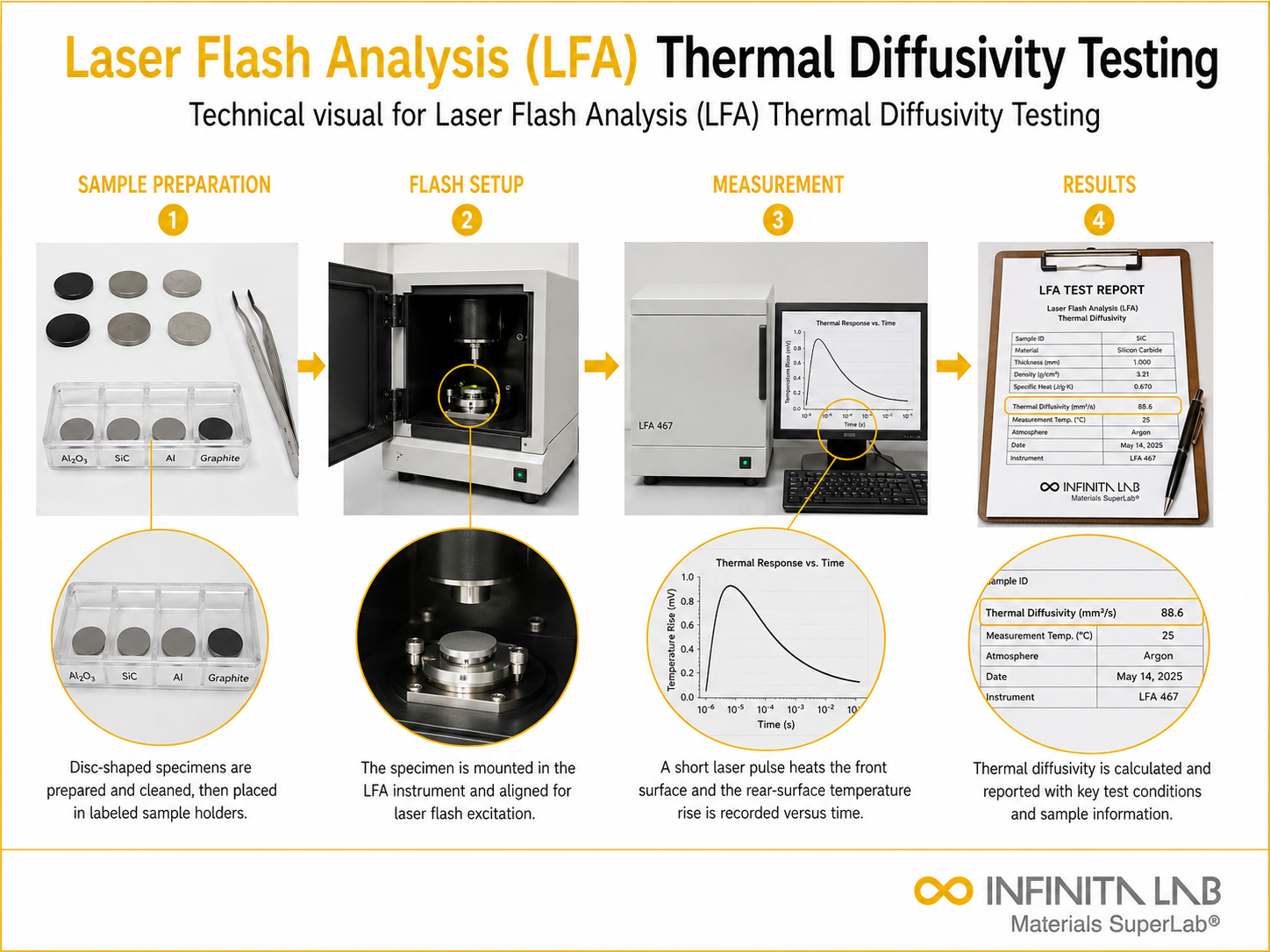
The laser-flash method is a widely used technique for determining the thermal diffusivity of solid materials, which is then used to calculate thermal conductivity. A short laser pulse heats one side of a sample, and the resulting temperature rise on the opposite side is recorded over time to evaluate heat transfer characteristics.
This method is highly accurate, fast, and suitable for a wide range of materials including metals, ceramics, polymers, and composites. It is especially effective at high temperatures and provides reliable thermal property data essential for material design, energy systems, and thermal management applications.

Scope, Applications, and Benefits
Scope
The laser-flash method is applied to measure thermal transport properties of solid materials under controlled laboratory conditions, supporting research, quality control, and high-temperature material evaluation.
- Applicable to metals, ceramics, polymers, and composite materials
- Measures thermal diffusivity as the primary parameter
- Used to calculate thermal conductivity with density and specific heat
- Suitable for high-temperature and controlled atmosphere testing
- Requires minimal sample preparation
- Supports thin, disc-shaped solid specimens
- Enables rapid and repeatable measurements
- Applicable in research, aerospace, and energy sectors
- Supports evaluation of coatings and layered materials
Applications
- Thermal conductivity measurement of engineering materials
- High-temperature material characterization
- Evaluation of thermal barrier coatings
- Research in energy storage and insulation materials
- Aerospace and automotive thermal analysis
Benefits
- High accuracy and repeatability
- Rapid measurement with minimal sample damage
- Suitable for a wide temperature range
- Non-contact heating method
- Applicable to diverse material types
Laser Flash Process
Sample Preparation
Thin, disc-shaped sample is prepared with uniform thickness and surface coating if required.
1Laser Heating
A short laser pulse uniformly heats one side of the sample.
2Temperature Detection
Infrared detector records temperature rise on the opposite surface over time.
3Data Analysis
Thermal diffusivity is calculated and used to determine thermal conductivity.
4Laser Flash Technical Specification
| Parameter | Details |
|---|---|
| Method | Transient heat pulse and temperature response measurement |
| Measurement Type | Thermal diffusivity and derived thermal conductivity |
| Sample Type | Solid materials (disc-shaped specimens) |
| Loading Type | Laser pulse heating (non-contact) |
| Units | mm²/s (diffusivity), W/m·K (thermal conductivity) |
| Temperature Range | Ambient to high temperatures |


Instrumentation Used for Testing
- Laser flash analyzer system
- Pulsed laser source
- Infrared temperature detector
- Sample holder with furnace (for high-temperature testing)
- Data acquisition and analysis software
Results and Deliverables
- Thermal diffusivity values
- Calculated thermal conductivity data
- Temperature vs time response curves
- Material thermal property report
- High-temperature performance analysis
Frequently Asked Questions
The Laser Flash Method measures materials' thermal Diffusivity, which, when combined with specific heat capacity and density, allows for calculating thermal conductivity.
The method is suitable for various materials, including solids like metals, ceramics, polymers, composites, thin films, and coatings.
The primary parameter measured is thermal diffusivity. Thermal conductivity is then calculated using the material's specific heat capacity and density.
The method uses a short-duration heat pulse and measures transient temperature response before significant heat loss occurs. Mathematical models assume one-dimensional heat flow, allowing accurate extraction of thermal diffusivity independent of convection and radiation under controlled conditions.
Emissivity affects infrared detection accuracy. Proper surface preparation ensures consistent emissivity for reliable temperature readings.
Why Choose Infinita Lab for Advanced Materials Testing and Characterization?
At the core of this breadth is our network of 2,000+ accredited laboratories across the USA, offering access to over 10,000 testing methods and analytical services. From advanced materials characterization (SEM, TEM, RBS, XPS) to mechanical, chemical, environmental, biological, and standardized ASTM/ISO-compliant testing, we deliver unmatched flexibility, specialization, and scale. You are never limited by geography, facility, or methodology — Infinita Lab connects you to the right expertise and testing solution, every time.

Looking for a Trusted Partner for Accurate and Reliable Testing Services?
Send query us at hello@infinitlab.com or call us at (888) 878-3090 to learn more about our services and how we can support you.



Request a Quote
Submit your material details and receive testing procedures, pricing, and turnaround time within 24 hours.
 Quick Turnaround and Hasslefree process
 Confidentiality Guarantee
 Free, No-obligation Consultation
 100% Customer Satisfaction
