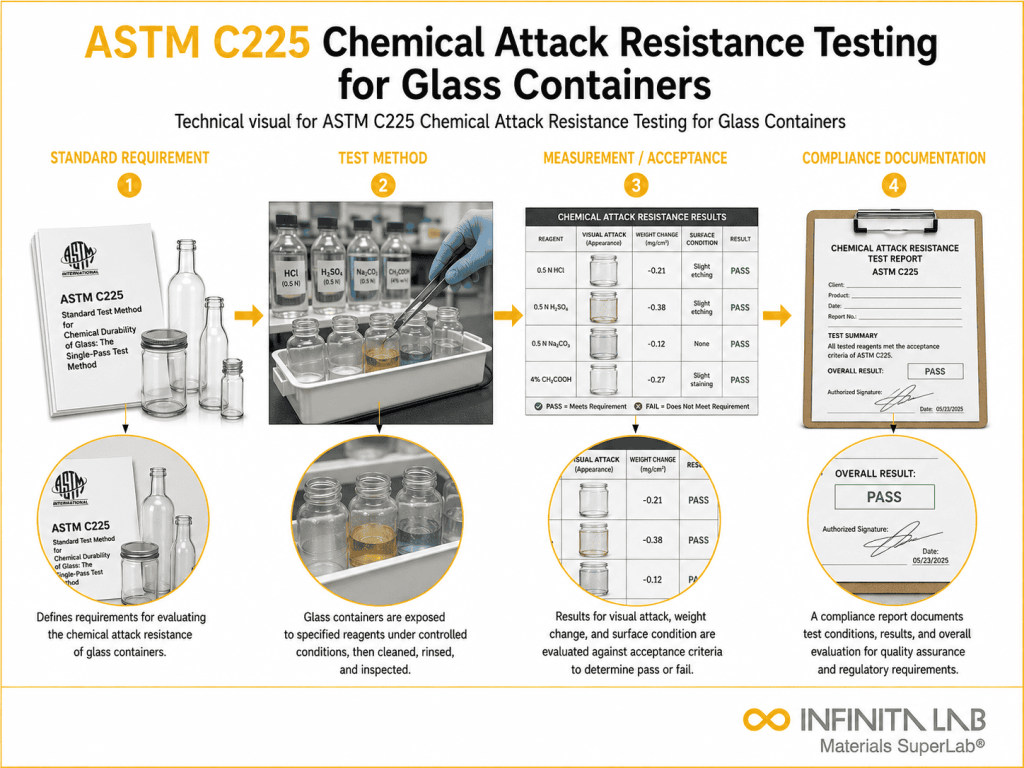


What Is ASTM C225 Glass Container Chemical Attack Resistance?
ASTM C225 covers standard test methods for evaluating the resistance of glass containers to chemical attack by measuring the amount of material leached from the glass surface when exposed to specific aqueous solutions under controlled conditions. It determines how well glass containers withstand degradation from their contents or surrounding environment.
This method is critical for glass containers used in storage of sensitive substances, laboratory glassware, and industrial packaging where chemical durability directly impacts product integrity. Results guide material selection, quality control, and compliance verification for glass manufacturers supplying containers across chemical, laboratory, and industrial packaging sectors.
Applications and Benefits of ASTM C225 Glass Container Chemical Attack Resistance Testing
Scope
ASTM C225 covers three distinct test methods for evaluating glass container chemical resistance: the powder method, the glass grain method, and the surface method. Each method targets different aspects of glass durability and attack mechanisms.
The scope includes:
- Powder method for measuring leached alkali from ground glass exposed to water
- Surface method for evaluating interior surface attack of intact containers
- Glass grain method for bulk glass durability characterization
- Testing with distilled or deionized water as the attacking medium
- Applicable to soda-lime, borosilicate, and other glass compositions
- Suitable for new containers and comparative evaluation of glass formulations
- Results reported as volume of acid equivalent per unit area or mass
Applications
- Chemical durability evaluation of laboratory and industrial glass containers
- Quality control of glass packaging for chemical storage
- Comparative testing of different glass compositions and formulations
- Incoming inspection of glass containers for sensitive material storage
- Failure analysis of glass containers showing surface deterioration or product contamination
- Research and development of new glass compositions with improved durability
- Compliance testing for glass container specifications and procurement standards
- Evaluation of glass containers used in high-purity water and reagent storage
- Characterization of recycled or reformulated glass materials
- Verification of glass durability after surface treatment or coating application
Benefits
- Provides quantitative measure of glass chemical resistance
- Three test methods allow flexibility based on specimen form and test objective
- Applicable to a wide range of glass types and container geometries
- Identifies substandard glass batches before deployment in sensitive applications
- Supports comparative ranking of glass formulations for material selection
- Relatively simple procedure with minimal specialized equipment
- Results directly correlate with real-world leaching and container durability
- Supports supplier qualification and incoming material inspection programs
- Useful for both production quality control and R&D glass development
Our ASTM C225 Testing Procedure
Specimen Preparation
Glass containers or ground glass powder are prepared, cleaned, and conditioned per method-specific requirements.
1Chemical Exposure
Specimens are exposed to distilled water under defined temperature and time conditions in sealed vessels.
2Leachate Analysis
Extracted leachate is titrated or analyzed to quantify dissolved alkali or elemental content per unit area or mass.
3Reporting
Results are expressed as ml of acid equivalent per unit surface area and classified against acceptance criteria.
4ASTM C225 Test Parameters and Requirements
| Parameter | Details |
|---|---|
| Test Methods Covered | Powder method, surface method, glass grain method |
| Attacking Medium | Distilled or deionized water |
| Test Temperature | 121°C (autoclave) or 98°C depending on method |
| Exposure Duration | Typically 30 minutes to 1 hour depending on method |
| Reporting Units | ml of 0.02N H₂SO₄ per container or per 100 cm² |
| Analysis Method | Acid-base titration or ICP elemental analysis |
| Specimen Form | Intact containers or ground glass grains/powder |


- Autoclave or water bath for controlled temperature exposure
- Analytical burette for acid-base titration of leachate
- Analytical balance for specimen mass measurement
- Distillation or deionization unit for preparation of attacking medium
- pH meter for endpoint verification during titration
- ICP-OES for elemental leachate analysis where required
- Desiccator for specimen conditioning and cooling
- Borosilicate glass or PTFE vessels for leaching exposure
Equipment and Instrumentation Used for ASTM C225 Testing
What You Receive: Test Report, Data, and Certification
- Leached alkali volume expressed as ml of 0.02N H₂SO₄ equivalent
- Surface attack values per 100 cm² of interior glass surface
- Pass/fail classification against specified chemical resistance thresholds
- Comparative data across multiple glass types or container lots
- Elemental leachate composition where ICP analysis is performed
- Full test report with method used, specimen details, and exposure conditions
- Titration records and calibration data for QA/QC traceability
- Recommendations for glass type suitability based on results
ASTM C225 Glass Container Chemical Attack Resistance FAQs
ASTM C225 evaluates the chemical durability of glass containers by measuring the amount of material leached when exposed to distilled water under controlled temperature and time, indicating resistance to surface degradation and chemical attack.
Poor chemical resistance allows glass components to leach into stored contents, potentially contaminating sensitive materials, altering pH, or introducing metallic ions that compromise product purity, safety, and shelf life.
Borosilicate glass typically shows significantly lower leaching values than soda-lime glass due to its network-stabilizing boron content, making it more chemically durable and preferred for laboratory and high-purity storage applications.
Yes. ASTM C225 is well suited for incoming inspection and batch-level quality control. Regular testing of production lots helps identify batch-to-batch variability in glass composition or surface quality before containers reach end users.
Glass composition, melting temperature, annealing quality, surface treatments, and storage conditions all influence chemical resistance. Higher silica and boron content generally improve durability while high alkali content reduces it.
A water attack test evaluates the chemical durability of glass by measuring its resistance to water under elevated temperature and pressure. According to ASTM C225, glass containers are partially filled with distilled water and exposed to autoclave conditions at 121°C. The resulting extract is analyzed by titration to assess the amount of alkaline material released from the glass. The results help evaluate glass suitability for packaging food, beverages, and pharmaceutical products.
The powdered glass test measures the resistance of glass to chemical attack by water. Under ASTM C225 Test Method P-W, a powdered glass sample is prepared and exposed to pure water in an autoclave at 121°C. The resulting solution is analyzed by titration to determine the amount of soluble alkaline material released. This method evaluates the chemical durability of the bulk glass and can help distinguish it from the effects of surface treatment.
Glass is generally resistant to many acids because its silicate network has strong chemical bonds that limit dissolution under typical conditions. However, resistance varies with glass composition and acid type. Many common acids attack glass slowly, while hydrofluoric acid can react with silica and significantly damage it. ASTM C225 includes an acid-based test for evaluating the chemical resistance of glass containers intended for acidic products.
Why Choose Infinita Lab for Glass Container Chemical Attack Resistance Testing
When your Glass Container Chemical Attack Resistance results have to hold up - for compliance, a customer audit, or an engineering decision - ASTM C225 accuracy and an unbiased third-party report matter more than price. Infinita Lab routes your ASTM C225 glass container chemical attack resistance testing to ISO/IEC 17025-accredited U.S. partner labs with hands-on method experience, so you get defensible data, transparent reporting, and turnaround times built around your project deadline - not ours.

Looking for an Accredited Partner for ASTM C225 Glass Container Chemical Attack Resistance Testing?
Send query us at hello@infinitalab.com or call us at (888) 878-3090 to learn more about our services and how we can support you.



