


ASTM D4661: Isocyanate Total Chlorine Testing Services
ASTM D4661 test method provides information about polyurethane raw materials by measuring the chlorine content of aromatic isocyanates. The amount of o-dichlorobenzene and other ringed chlorine products is determined by calculating the difference between the total chlorine content and the hydrolyzable chlorine content. The final results are expressed in SI units.
TRUSTED BY


Get ASTM D4661 compliant results — request your isocyanate total chlorine testing quote
- Overview
- Scope, Applications, and Benefits
- Test Process
- Specifications
- Instrumentation
- Results and Deliverables
What Is ASTM D4661 Isocyanate Total Chlorine?
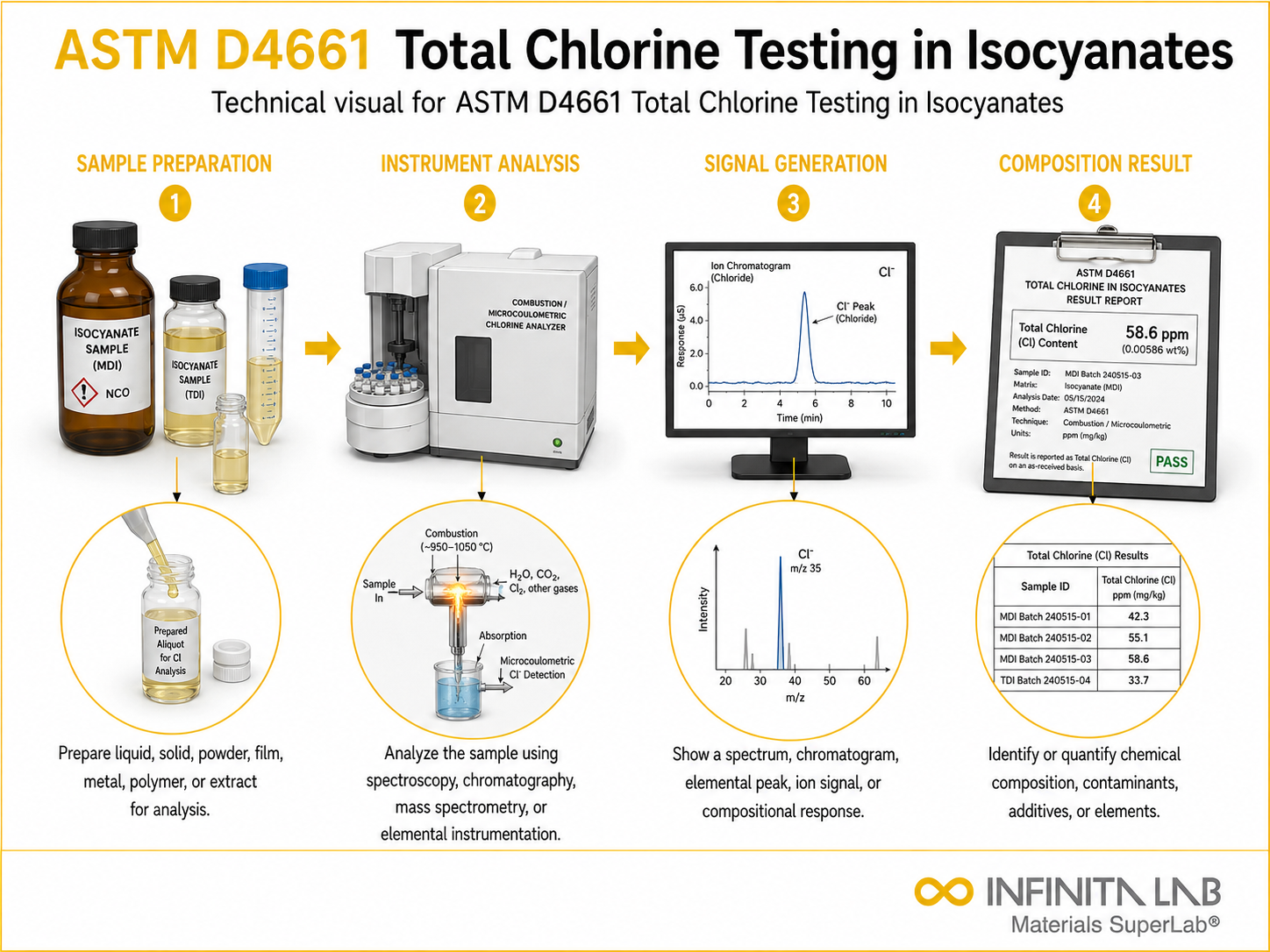
ASTM D4661 provides a standardized method for determining the total chlorine content in isocyanate raw materials used in polyurethane production. Chlorine impurities in isocyanates originate from the phosgenation manufacturing process and can be present as hydrolyzable chlorine (acid chloride groups) or as non-hydrolyzable (total) chlorine. Elevated chlorine content can cause catalyst poisoning, processing difficulties, discoloration of polyurethane products, and corrosion of processing equipment.
The method involves combustion of the isocyanate sample in an oxygen flask (Schöniger combustion), absorption of the resulting hydrogen chloride in an alkaline solution, and determination of the total chlorine by potentiometric or mercurimetric titration. Results are expressed as ppm or weight percent chlorine, providing quality-control data for isocyanate producers and a key incoming-inspection parameter for polyurethane manufacturers.

Applications and Benefits of ASTM D4661 Isocyanate Total Chlorine Testing
Scope
ASTM D4661 evaluates:
- Total chlorine content of MDI, TDI, and polymeric isocyanates
- Compliance with chlorine specification limits
- Batch-to-batch chlorine content consistency
- Effect of purification process on chlorine removal
- Combined hydrolyzable and non-hydrolyzable chlorine
- Correlation of chlorine content with polyurethane processing issues
Applications
- Polyurethane foam isocyanate raw material qualification
- TDI and MDI manufacturer quality control
- Polyurethane elastomer and coating isocyanate inspection
- Incoming raw material inspection programs
- Research and development in isocyanate chemistry
- Corrosion prevention in polyurethane processing equipment
- Color and quality control in light-stable polyurethane products
Benefits
- Prevents catalyst poisoning from chlorine impurities
- Reduces processing equipment corrosion
- Ensures polyurethane product color and quality
- Supports the isocyanate supplier qualification
- Provides traceability for isocyanate quality records
- Reduces batch failures from high-chlorine isocyanates
Our ASTM D4661 Testing Procedure
Sample Weighing
Isocyanate sample is accurately weighed into a combustion flask under inert atmosphere.
1Oxygen Flask Combustion
Sample is combusted in an oxygen-filled Schöniger flask; HCl is absorbed in alkaline solution.
2Titration
Absorbed chloride is determined by potentiometric silver nitrate titration or mercurimetric titration.
3Calculation
Total chlorine content is calculated from the titration data and sample weight.
4ASTM D4661 Test Parameters and Requirements
| Parameter | Details |
|---|---|
| Test Principle | Oxygen flask combustion followed by potentiometric titration |
| Titrant | Silver nitrate (potentiometric) or mercuric nitrate |
| Applicable Materials | MDI, TDI, and polymeric isocyanates |
| Output Units | ppm or weight percent (%) chlorine |
| Measured Outputs | Total chlorine content |


- Schöniger oxygen combustion flask
- Potentiometric titrator with silver/reference electrode
- Standardized silver nitrate or mercuric nitrate titrant
- Analytical balance
- Inert gas supply (nitrogen) for sample handling
- Data recording system
Equipment and Instrumentation Used for ASTM D4661 Testing
What You Receive: Test Report, Data, and Certification
- Total chlorine content (ppm or %)
- Titration curve records
- Batch compliance evaluation against the specification
- Compliance documentation
- Traceability and calibration records
- Quality assurance reports
ASTM D4661 Isocyanate Total Chlorine FAQs
ASTM D4661 determines total chlorine content in isocyanates. It evaluates purity and contamination levels, helping ensure consistent quality and performance in polyurethane production and other chemical applications involving isocyanate materials.
Key parameters include sample preparation, combustion or chemical digestion, titration or analytical measurement, and calibration standards. Controlled conditions ensure accurate determination of chlorine content in isocyanate samples.
The test measures total chlorine content, typically expressed in parts per million. Results indicate contamination levels and influence processing stability and product quality in polyurethane systems.
ASTM D4661 applies to isocyanates used in polyurethane foams, coatings, adhesives, and elastomers where chlorine content affects reactivity and final material performance.
ASTM D4661 results depend on proper sample handling and analytical accuracy. Interferences or incomplete reactions may affect results, requiring additional validation for precise chlorine content determination.
Why Choose Infinita Lab for Isocyanate Total Chlorine Testing?
At the core of this breadth is our network of 2,000+ accredited laboratories across the USA, offering access to over 10,000 testing methods and analytical services. From advanced materials characterization (SEM, TEM, RBS, XPS) to mechanical, chemical, environmental, biological, and standardized ASTM/ISO-compliant testing, we deliver unmatched flexibility, specialization, and scale. You are never limited by geography, facility, or methodology — Infinita Lab connects you to the right expertise and testing solution, every time.

Looking for an Accredited Partner for ASTM D4661 Isocyanate Total Chlorine Testing?
Send query us at hello@infinitalab.com or call us at (888) 878-3090 to learn more about our services and how we can support you.



Request a Quote
Submit your material details and receive testing procedures, pricing, and turnaround time within 24 hours.
 Quick Turnaround and Hasslefree process
 Confidentiality Guarantee
 Free, No-obligation Consultation
 100% Customer Satisfaction
