

What Is ASTM D6745 Electrode Carbon Thermal Expansion?
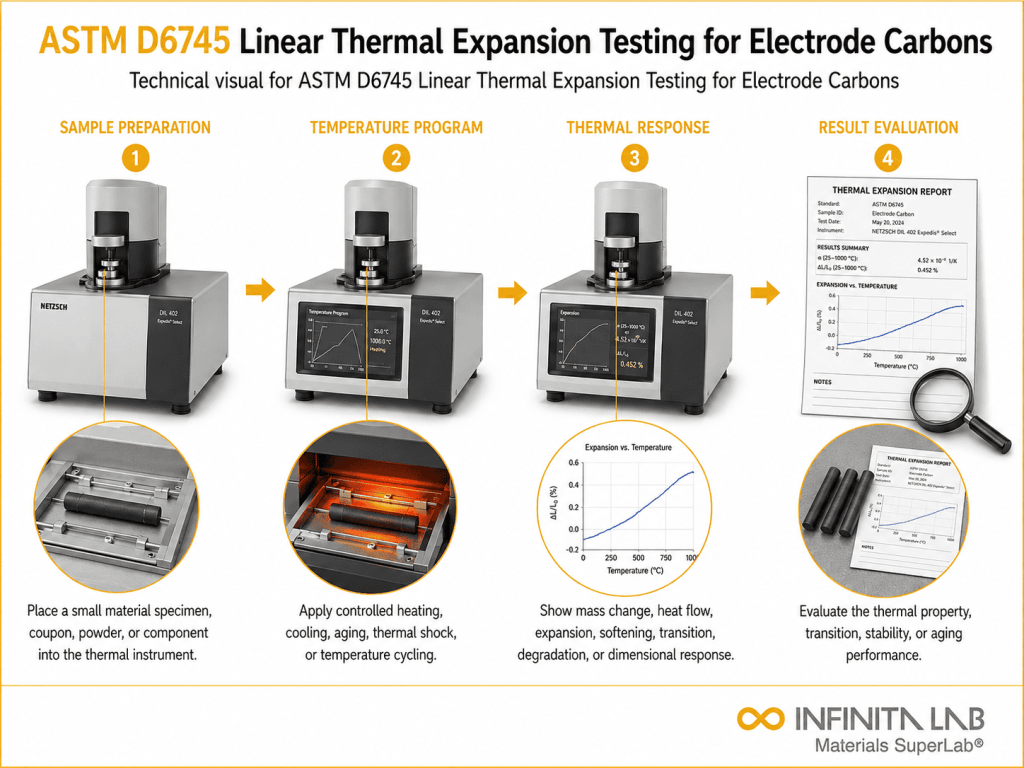
ASTM D6745 is a standard test method that determines the linear thermal expansion of electrode carbons. This is an essential characteristic for high-temperature metallurgical applications, such as aluminum production, where electrodes are subjected to severe thermal conditions.
Measuring the thermal expansion of electrode carbons is essential for determining their dimensional stability. The coefficient of linear thermal expansion is measured in µm · m^-1·°C^-1.
Applications and Benefits of ASTM D6745 Electrode Carbon Thermal Expansion Testing
Scope
ASTM D6745 applies to:
- Graphitized electrode carbons
- Non-graphitized electrode carbons
- Materials used in high-temperature industrial environments
It evaluates:
- Linear thermal expansion behaviour
- Dimensional stability at elevated temperatures
- Material consistency and quality
- Suitability for metallurgical applications
The method applies to electrode carbons used across various metallurgical processes.
Applications
- Aluminium smelting electrodes
- Steel and ferroalloy production
- High-temperature furnaces
- Metallurgical reactors
- Carbon material manufacturing
- Quality control laboratories
- Research and development
Benefits
- Provides standardized CTE values
- Supports material selection
- Ensures dimensional stability in service
- Improves product reliability
- Assists in quality control
- Enables comparison between materials
- Supports product development
Our ASTM D6745 Testing Procedure
Sample Preparation & Calibration
Specimens are prepared, and the dilatometer is calibrated in accordance with standard procedures.
1Initial Measurement
Initial specimen length is recorded at room temperature.
2Controlled Heating & Expansion Measurement
The specimen is heated at a specified rate, and its length is measured.
3Cooling & Verification
The specimen is cooled, and baseline calibration is verified.
4ASTM D6745 Test Parameters and Requirements
| Parameter | Details |
|---|---|
| Applicable Materials | Electrode carbons (graphitized & non-graphitized) |
| Sample Requirement | Minimum one per material type |
| Heating Range | Defined in the standard |
| Output Units | µm/m°C |
| Measured Outputs | Coefficient of thermal expansion (CTE) |


- Dilatometer
- High-temperature furnace
- Precision length measurement sensors
- Temperature controllers
- Calibration standards
- Data acquisition system
Equipment and Instrumentation Used for ASTM D6745 Testing
What You Receive: Test Report, Data, and Certification
- Coefficient of thermal expansion values
- Temperature vs. expansion curves
- Comparative material reports
- Performance evaluation summaries
ASTM D6745 Electrode Carbon Thermal Expansion FAQs
The test method determines the linear thermal expansion of electrode carbons, helping assess their thermal stability and suitability for high-temperature applications.
The method applies to graphitized and non-graphitized electrode carbons used in industrial processes.
No, the test is non-destructive.
It is widely used in industries like aluminum production, metallurgy, and other high-temperature processes where electrode carbons are essential.
Graphite coefficient of thermal expansion (CTE) testing measures how much graphite changes in length when exposed to variations in temperature. The test typically uses a push-rod dilatometer, which measures the dimensional change of a graphite specimen during controlled heating or cooling. A prepared specimen is placed inside the instrument, where temperature is gradually increased over a specified range while a displacement sensor records changes in its length. The instrument accounts for the thermal expansion of its own components to determine the actual dimensional change of the graphite sample. The coefficient of thermal expansion is calculated using the change in length, original specimen length, and temperature difference, generally expressed in K⁻¹ or °C⁻¹. The results help evaluate dimensional stability and thermal stress resistance in graphite electrodes, furnace components, nuclear reactor materials, and other high-temperature applications.
Why Choose Infinita Lab for Electrode Carbon Thermal Expansion Testing?
When your Electrode Carbon Thermal Expansion results have to hold up - for compliance, a customer audit, or an engineering decision - ASTM D6745 accuracy and an unbiased third-party report matter more than price. Infinita Lab routes your ASTM D6745 electrode carbon thermal expansion testing to ISO/IEC 17025-accredited U.S. partner labs with hands-on method experience, so you get defensible data, transparent reporting, and turnaround times built around your project deadline - not ours.

Need ASTM D6745 Electrode Carbon Thermal Expansion Testing You Can Rely On?
Send query us at hello@infinitalab.com or call us at (888) 878-3090 to learn more about our services and how we can support you.