

What Is ASTM D696 Linear Thermal Expansion Plastics?
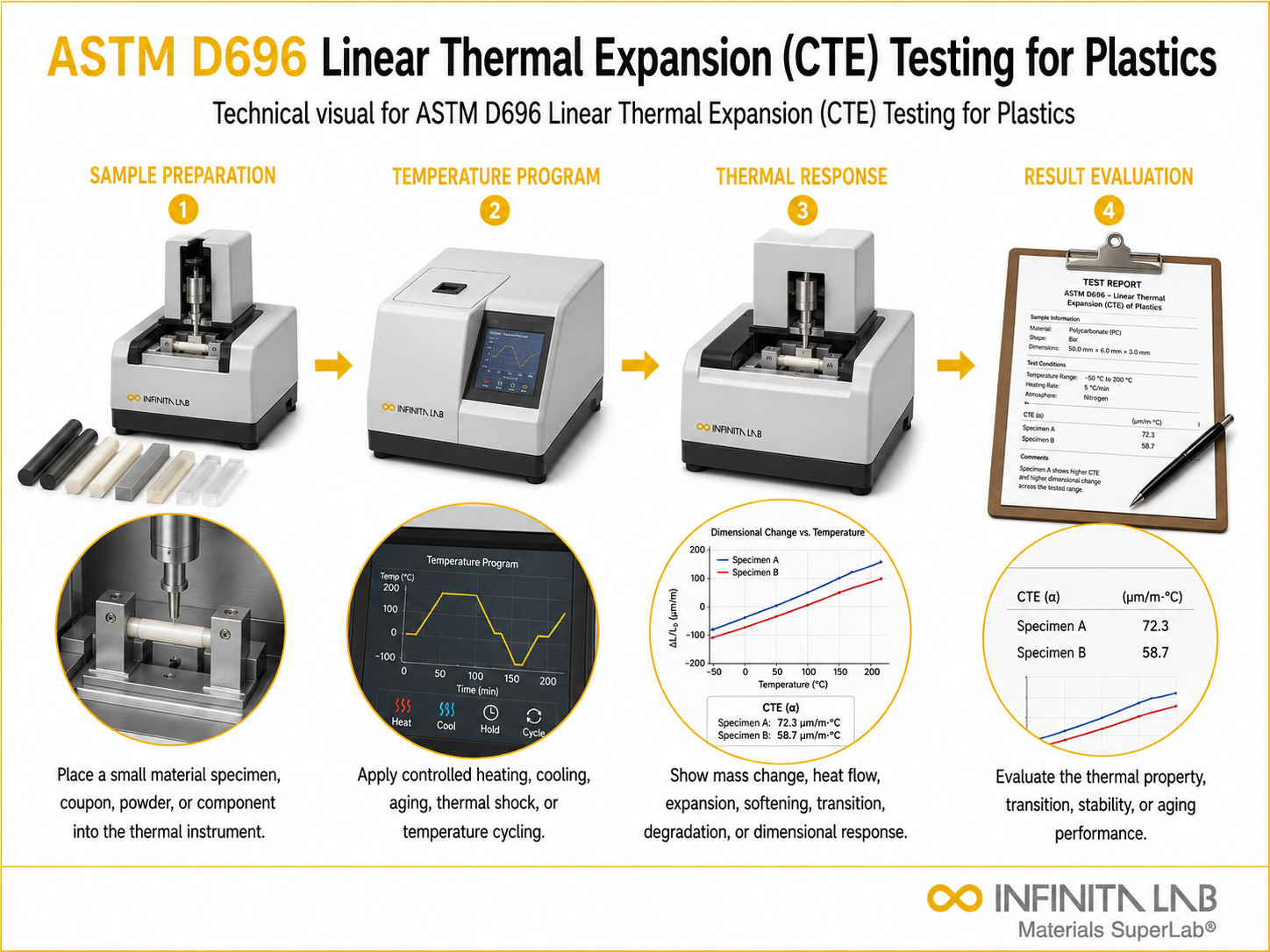
ASTM D696 prescribes the standard test method for determining the linear thermal expansion characteristics of solid plastic materials subjected to controlled temperature changes. Linear thermal expansion describes the change in length of a plastic specimen per degree change in temperature and is an essential indicator of dimensional stability and structural performance.
This test method applies to homogeneous and reinforced plastics in molded, extruded, or fabricated forms. ASTM D696 provides reliable coefficient of linear thermal expansion data helpful in predicting material behavior in real-world situations where plastics are subjected to heating, cooling, or temperature fluctuations. Thermal expansion is significant to understand when plastics are assembled with metals, ceramics, or other materials with differing expansion rates.

Applications and Benefits of ASTM D696 Linear Thermal Expansion Plastics Testing
Scope
ASTM D696 outlines procedures for measuring the coefficient of linear thermal expansion of plastics over a specified temperature range. It evaluates:
- Change in length per unit length per degree of temperature change
- Dimensional stability under thermal exposure
- Thermal behavior of plastics during heating or cooling
- Consistency of material expansion characteristics
The method applies to thermoplastics and thermosetting plastics in forms such as sheets, rods, plates, and fabricated components.
Applications
- Automotive components and assemblies
- Electronic and electrical housings
- Construction and building materials
- Aerospace and defence components
- Packaging and structural plastic parts
- Multi-material assemblies requiring thermal compatibility
Benefits
- Provides accurate CLTE data for design and engineering
- Helps prevent warping, cracking, and thermal stress buildup
- Supports material selection for temperature-sensitive applications
- Enables comparison of materials under standardized conditions
- Enhances quality control and manufacturing consistency
- Improves long-term reliability and dimensional accuracy
Our ASTM D696 Testing Procedure
Sample Preparation & Conditioning
Plastic specimens are cut or machined to precise dimensions and conditioned at standardized temperature and humidity to stabilize material behavior.
1Specimen Placement
The specimen is positioned in a dilatometer or thermomechanical analyzer (TMA) under minimal mechanical stress.
2Controlled Temperature Change
The specimen is gradually heated or cooled over a defined temperature range, typically starting near ambient temperature.
3Dimensional Measurement & Data Recording
Length change is continuously measured as a function of temperature to calculate the coefficient of linear thermal expansion.
4ASTM D696 Test Parameters and Requirements
| Parameter | Details |
|---|---|
| Applicable Materials | Thermoplastics and thermosetting plastics |
| Specimen Forms | Rods, bars, plates, sheets, and fabricated components |
| Typical Specimen Length | 10–100 mm (instrument dependent) |
| Temperature Range | Defined test range based on the application |
| Measured Output | Coefficient of Linear Thermal Expansion (CLTE) |
| Units Reported | µm/m/°C or in./in./°F |


- Dilatometer or thermomechanical analyzer (TMA)
- Temperature-controlled heating and cooling system
- Precision displacement measurement sensors
- Specimen holders with low mechanical restraint
- Data acquisition and thermal analysis software
Equipment and Instrumentation Used for ASTM D696 Testing
What You Receive: Test Report, Data, and Certification
- Coefficient of linear thermal expansion values
- Dimensional change versus temperature curves
- Assessment of thermal stability and compatibility
- Data supporting material selection and design validation
- Quality control documentation for manufacturing consistency
- Comparative thermal expansion data for different plastics
ASTM D696 Linear Thermal Expansion Plastics FAQs
Plastics expand or contract more than metals when heated or cooled. Understanding this behavior prevents dimensional failures, warping, and stresses in product assemblies.
Thermoplastics, thermosets, reinforced composites, molded and extruded parts, and structural plastic components can all be evaluated using this method.
A dilatometer or thermomechanical analyzer (TMA) is typically used to measure precise dimensional change relative to temperature.
Why Choose Infinita Lab for Linear Thermal Expansion Plastics Testing
At the core of this breadth is our network of 2,000+ accredited laboratories across the USA, offering access to over 10,000 testing methods and analytical services. From advanced materials characterization (SEM, TEM, RBS, XPS) to mechanical, chemical, environmental, biological, and standardized ASTM/ISO-compliant testing, we deliver unmatched flexibility, specialization, and scale. You are never limited by geography, facility, or methodology — Infinita Lab connects you to the right expertise and testing solution, every time.

Need ASTM D696 Linear Thermal Expansion Plastics Testing You Can Rely On?
Send query us at hello@infinitalab.com or call us at (888) 878-3090 to learn more about our services and how we can support you.





