


ASTM F2100: Medical Face Mask Performance Testing Services
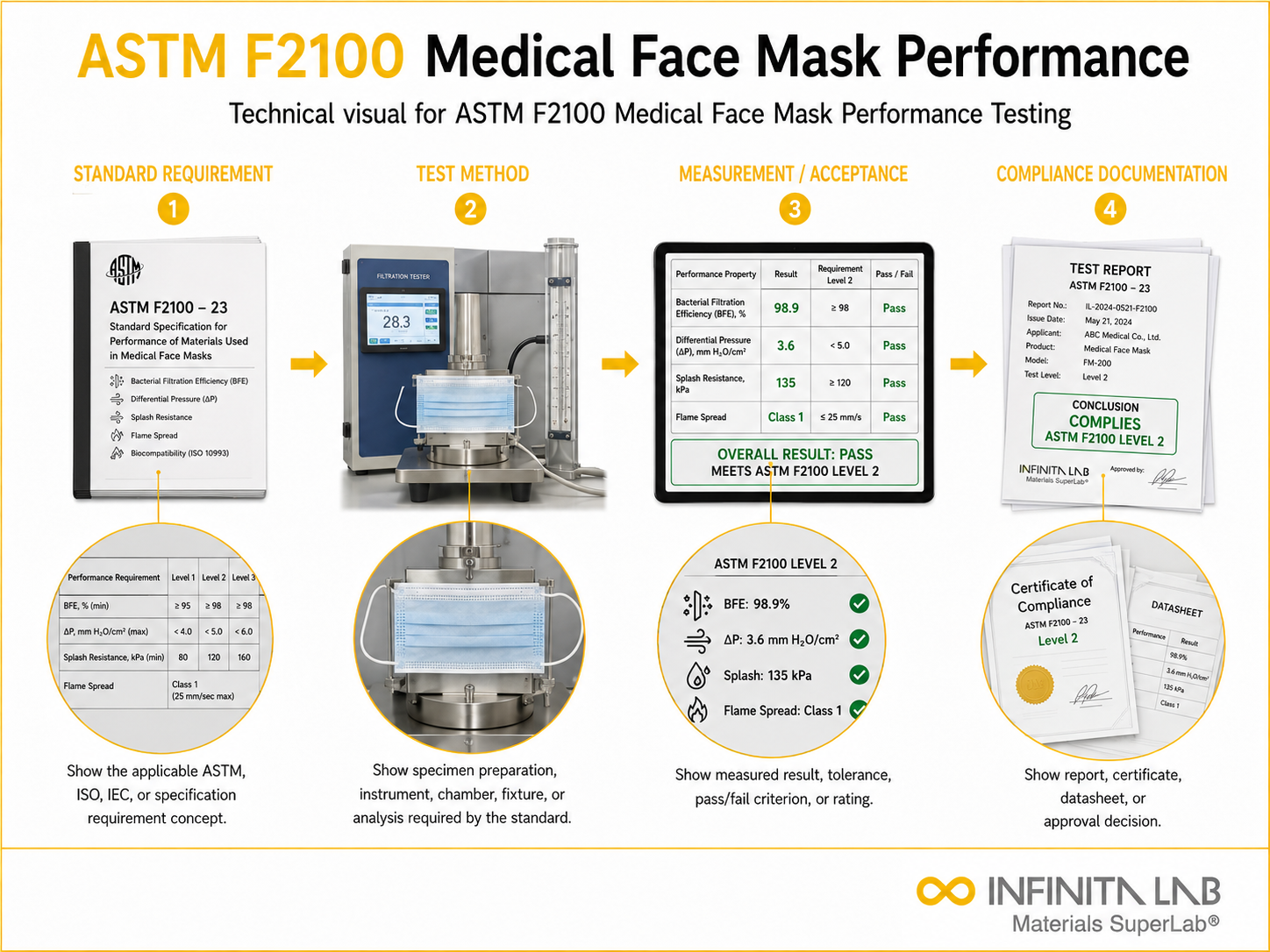
ASTM F2100-19 covers specifications for the performance of materials used to make medical face masks. This specification provides a classification of medical face mask material performance. The mask's performance is determined by testing for bacterial filtration efficiency, differential pressure, sub-micron particulate filtration efficiency, resistance to penetration by synthetic blood, and flammability.
TRUSTED BY


Get ASTM F2100 compliant results — request your medical face mask performance testing quote
- Overview
- Scope, Applications, and Benefits
- Test Process
- Specifications
- Instrumentation
- Results and Deliverables
What Is ASTM F2100 Medical Face Mask Performance?
ASTM F2100 is a standardized specification that defines the performance requirements for medical face masks used in healthcare environments. It classifies masks into different levels based on their ability to provide protection against fluids, bacteria, and particulate matter while maintaining breathability and comfort.
The standard integrates multiple test methods to evaluate bacterial filtration efficiency (BFE), differential pressure (breathability), particulate filtration efficiency (PFE), fluid resistance, and flammability. It ensures that masks meet safety and performance criteria necessary for infection control and patient protection in clinical settings.

Applications and Benefits of ASTM F2100 Medical Face Mask Performance Testing
Scope
ASTM F2100 establishes performance criteria for medical face masks by combining multiple standardized tests to evaluate filtration efficiency, breathability, and resistance to fluid penetration. It provides a classification system for selecting masks based on risk levels in healthcare applications.
The method ensures that masks meet consistent quality and safety requirements for medical use.
- Evaluation of bacterial and particulate filtration efficiency
- Assessment of breathability through differential pressure
- Measurement of resistance to synthetic blood penetration
- Flammability testing for safety compliance
- Classification of masks into performance levels (Level 1, 2, 3)
- Standardized quality evaluation for medical face masks
Applications
- Surgical mask performance validation
- Hospital and clinical infection control
- Medical device manufacturing quality assurance
- Healthcare worker protection assessment
- Regulatory compliance for medical masks
- Product development for face mask manufacturers
- Pandemic and emergency response preparedness
Benefits
- Ensures consistent quality and safety of medical masks
- Supports effective infection prevention and control
- Helps select appropriate mask based on risk level
- Enhances patient and healthcare worker protection
- Enables regulatory approval and certification
- Improves product design and performance optimization
Our ASTM F2100 Testing Procedure
Sample Preparation
Mask samples are conditioned under controlled temperature and humidity before testing to stabilize material properties.
1Performance Testing
Samples undergo BFE, PFE, differential pressure, and fluid resistance testing using standardized methods.
2Flammability Assessment
Masks are evaluated for flammability characteristics to ensure compliance with safety standards.
3Classification & Evaluation
Results are analyzed to classify masks into Level 1, 2, or 3 based on performance criteria.
4ASTM F2100 Test Parameters and Requirements
| Parameter | Details |
|---|---|
| Standard | ASTM F2100 performance specification for medical face masks |
| Method | Multi-test evaluation including BFE, PFE, differential pressure, and fluid resistance |
| Measurement Type | Filtration efficiency, breathability, fluid resistance, flammability |
| Sample Type | Medical face masks (surgical and procedural masks) |
| Loading Type | Aerosol exposure, airflow resistance, and fluid impact |
| Units | %, mm H₂O/cm², mmHg |


- Bacterial Filtration Efficiency (BFE) test apparatus
- Differential pressure (ΔP) / breathability test setup
- Particle filtration efficiency (PFE) testing system
- Synthetic blood penetration test apparatus
- Airflow and pressure control system
- Incubators and microbiological equipment (for BFE)
- Data acquisition and recording system
Equipment and Instrumentation Used for ASTM F2100 Testing
What You Receive: Test Report, Data, and Certification
- Bacterial filtration efficiency (%)
- Particulate filtration efficiency (%)
- Differential pressure (breathability) values
- Fluid resistance performance (mmHg)
- Flammability classification
- Mask performance level classification (Level 1, 2, 3)
- ASTM compliance test report
- Quality and certification documentation
ASTM F2100 Medical Face Mask Performance FAQs
ASTM F2100 combines results from BFE, PFE, differential pressure, fluid resistance, and flammability tests. Each parameter has defined thresholds, and masks are classified into Levels 1–3 based on their ability to meet increasing protection requirements.
BFE measures filtration of biological aerosols containing bacteria, while PFE evaluates filtration of submicron particles. Together, they provide a comprehensive understanding of mask performance against both biological and non-biological contaminants.
Differential pressure indicates airflow resistance through the mask, directly affecting breathability. Lower pressure drop ensures user comfort, while maintaining filtration efficiency is essential for effective protection.
Fluid resistance is tested using synthetic blood projected at defined pressures to simulate exposure to bodily fluids. The mask must prevent penetration to ensure protection against splashes and sprays.
Level 1 masks provide basic protection with lower fluid resistance, Level 2 offers moderate protection, and Level 3 provides the highest barrier performance against fluids and aerosols for high-risk medical procedures.
Why Choose Infinita Lab for Medical Face Mask Performance Testing
At the core of this breadth is our network of 2,000+ accredited laboratories across the USA, offering access to over 10,000 testing methods and analytical services. From advanced materials characterization (SEM, TEM, RBS, XPS) to mechanical, chemical, environmental, biological, and standardized ASTM/ISO-compliant testing, we deliver unmatched flexibility, specialization, and scale. You are never limited by geography, facility, or methodology — Infinita Lab connects you to the right expertise and testing solution, every time.

Need ASTM F2100 Medical Face Mask Performance Testing You Can Rely On?
Send query us at hello@infinitalab.com or call us at (888) 878-3090 to learn more about our services and how we can support you.



Request a Quote
Submit your material details and receive testing procedures, pricing, and turnaround time within 24 hours.
 Quick Turnaround and Hasslefree process
 Confidentiality Guarantee
 Free, No-obligation Consultation
 100% Customer Satisfaction
