


ASTM C177: Guarded Hot Plate Thermal Conductivity Testing Services
Accredited ASTM C177 guarded hot plate thermal conductivity testing from Infinita Lab, performed to the exact standard requirements - accurate, reproducible results with full documentation for compliance, R&D, and quality control programs.
TRUSTED BY


Get ASTM C177 compliant results - request your guarded hot plate thermal conductivity testing quote
- Overview
- Scope, Applications, and Benefits
- Test Process
- Specifications
- Instrumentation
- Results and Deliverables
What Is ASTM C177 Guarded Hot Plate Thermal Conductivity?
ASTM C177 is the standard test method for measuring steady-state heat flux and the thermal transmission properties of flat, homogeneous insulation materials using a guarded-hot-plate apparatus. Published by ASTM International, it is recognised as a primary, or absolute, measurement technique: one that calculates thermal conductivity directly from measured heat input, plate area, specimen thickness, and temperature difference, without relying on comparison to a pre-calibrated reference material.
The guarded-hot-plate method works by placing one or two flat specimens between a central metering plate and outer cold plates. The metering plate is surrounded by a separately controlled guard heater ring, which is held at the same temperature as the metering plate itself. Because no temperature gradient exists between the metering section and its guard, the heat generated in the metering plate cannot escape laterally, and is instead forced to travel in a single, one-dimensional path through the specimen toward the cold plate. Once the assembly reaches steady state, a condition that can take several hours or even days to establish depending on specimen thickness, the power dissipated in the metering plate and the temperature difference across the specimen are used to calculate thermal conductivity and thermal resistance.
ASTM C177 matters because it serves as the reference method against which faster, secondary techniques such as heat-flow-meter testing (ASTM C518) are calibrated and validated. For manufacturers of fiberglass, mineral wool, foam board, and other flat-slab insulation products, C177 data underpins published R-values, supports building-code compliance, and provides the defensible, accredited results needed for regulatory submissions, product certification, and customer-facing performance claims across building, refrigeration, cryogenic, and aerospace insulation applications.

Applications and Benefits of ASTM C177 Guarded Hot Plate Thermal Conductivity Testing
Scope
- ASTM C177 measures steady-state heat flux through a specimen and calculates the resulting thermal conductivity and thermal resistance of flat, homogeneous insulation materials.
- The test method requires flat specimens with a large ratio of surface area to thickness, most commonly tested in matched pairs of similar thickness, density, and thermal history.
- The guarded-hot-plate apparatus places a central metering plate, surrounded by a guard heater ring, between the specimen or specimens, with cold plates positioned on the outer specimen faces.
- The guard ring is held at the same temperature as the metering plate throughout the test, which eliminates lateral heat loss and forces one-dimensional heat flow through the specimen.
- The apparatus can be configured for double-sided (two-specimen) or single-sided (one-specimen) operation, and for horizontal or vertical heat-flow orientation.
- Testing can be conducted across a range of mean temperatures and temperature differentials, from cryogenic to elevated conditions, depending on the capabilities of the specific apparatus used.
- The method is best suited to low-conductivity materials, generally those with a specimen conductance below approximately 16 W/(m²·K), which covers the great majority of commercial thermal insulation products.
- Materials commonly evaluated include fibreglass batt and board, mineral wool, rigid and flexible foam board, and other cellular, fibrous, or porous flat-slab insulation products.
- Because it is an absolute measurement method, ASTM C177 does not require comparison to a calibrated reference specimen, which makes it well suited to validating faster comparative methods such as ASTM C518.
- Results generated under ASTM C177 directly support published R-value and thermal conductivity claims used in building-code compliance, product labelling, and insulation performance certification.
Applications
- R-value certification and thermal performance labelling for fibreglass, mineral wool, and foam board building insulation.
- Qualification of insulation materials used in refrigeration and cold-storage equipment.
- Evaluation of cryogenic insulation systems for LNG, industrial gas, and low-temperature storage applications.
- Testing of insulation blankets and panels used in aerospace thermal protection systems.
- Calibration and validation of secondary heat-flow-meter apparatus, such as those used for ASTM C518, against a primary reference method.
- Quality control and product development testing for insulation manufacturers seeking consistent, reproducible thermal conductivity data.
- Generation of defensible thermal transmission data to support building-code compliance and regulatory submissions.
Benefits
- Provides an absolute, first-principles measurement of thermal conductivity that does not depend on comparison to a reference standard.
- Delivers highly accurate and reproducible steady-state data suitable for regulatory and code-compliance use.
- Serves as the recognised reference method that other, faster thermal conductivity tests are calibrated against.
- Produces data directly usable for R-value labelling and published thermal performance claims.
- Supports a wide range of flat-slab insulation material types and test temperature conditions within a single, standardised method.
- Generates ISO/IEC 17025-accredited results that hold up to customer, code-official, and third-party scrutiny.
Our ASTM C177 Testing Procedure
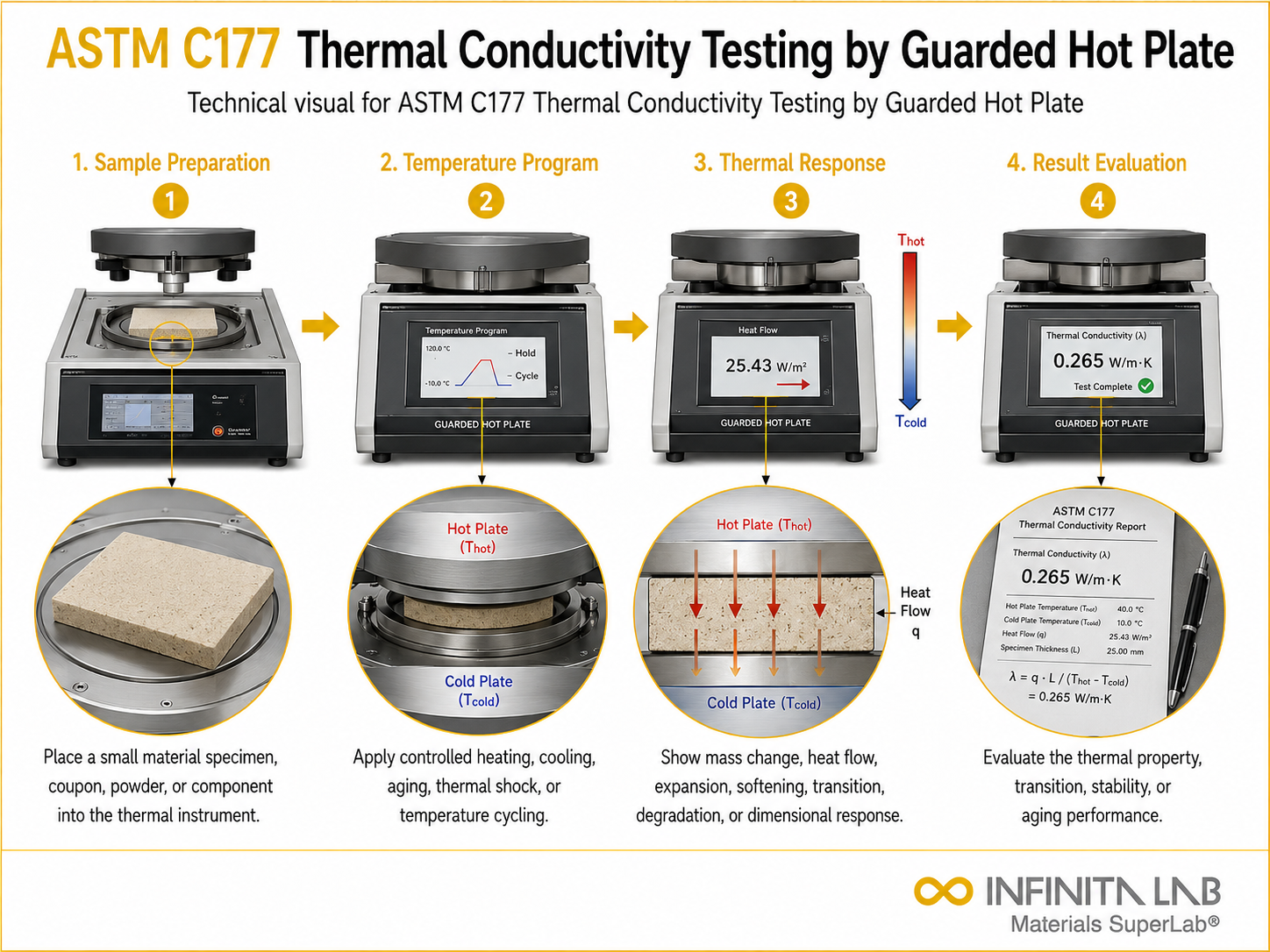
Specimen Preparation
Flat, homogeneous specimens are prepared with uniform thickness, free from surface irregularities and contaminants.
1Apparatus Setup
Specimens are placed on opposite sides of a guarded hot plate with auxiliary heaters to minimize lateral heat loss.
2Steady-State Establishment
Power is applied until thermal equilibrium is achieved and temperature readings stabilize.
3Measurement & Calculation
Heat flow, temperature difference, and specimen thickness are used to calculate thermal conductivity.
4ASTM C177 Test Parameters and Requirements
| Parameter | Details |
|---|---|
| Test Principle | Guarded hot plate steady-state heat flow method |
| Sample Types | Insulations, polymers, metals, ceramics, composites |
| Sample Thickness | Approximately 1–50 mm |
| Thermal Conductivity Range | ~0.02 to 200 W/m·K |
| Measured Output | Thermal conductivity (k) |
| Equilibrium Requirement | Stable temperature and power conditions |


- Guarded Hot Plate Apparatus – Houses the metering plate, guard ring, and specimen assembly, and establishes the controlled one-dimensional heat flow required by the test method.
- Metering and Guard Heaters – Supply precisely controlled electrical power to the central metering section and surrounding guard ring, keeping both at the same temperature to prevent lateral heat loss.
- Cold Plates – Maintain a controlled lower temperature on the outer specimen faces, establishing the temperature differential across the specimen thickness.
- Thermocouples and Temperature Sensors – Measure surface and plate temperatures at multiple points to confirm steady-state conditions and determine the temperature difference across each specimen.
- Power Measurement Instrumentation – Precisely measures the electrical power dissipated in the metering plate, which is used directly in the thermal conductivity calculation.
- Data Acquisition System – Continuously logs temperature, power, and time data throughout the test to confirm steady-state stability and support calculation and reporting.
- Specimen Preparation and Metrology Equipment – Used to cut, condition, and measure specimen thickness, flatness, and density before testing.
Equipment and Instrumentation Used for ASTM C177 Testing
What You Receive: Test Report, Data, and Certification
- Accredited test report referencing ASTM C177, documenting the test configuration, specimen details, and results.
- Thermal conductivity (k-value) reported in W/m·K at the tested mean temperature.
- Thermal resistance (R-value) calculated from the measured conductivity and specimen thickness.
- Recorded heat flux, plate temperatures, and temperature differential data supporting the calculation.
- Statement of measurement uncertainty associated with the reported results.
- Data suitable for supporting R-value labelling, building-code compliance submissions, and product certification.
ASTM C177 Guarded Hot Plate Thermal Conductivity FAQs
ASTM C117 standard test method for materials finer than 75-um (No. 200) sieve in mineral aggregates by washing.
Many industries use ASTM Standards because they provide the best possible guidance or scenarios for handling different materials or products.
The ASTM C127 standard helps to guarantee that aggregates used in building projects are suitable for the intended application by offering exact measurement and preparation processes.
In ASTM C177 testing, the heat flow, metered section, heat flux, and density are calculated. In ASTM C518, thermal transmittance and thermal conductivity are calculated.
ASTM C177 establishes a steady temperature difference across a specimen and measures heat flow to determine thermal conductivity.
ASTM C177 is the Standard Test Method for Steady-State Heat Flux Measurements and Thermal Transmission Properties by the Guarded-Hot-Plate Apparatus.
Nested Stochastic Gradient Langevin Dynamics is a computational method, not a standard thermal-conductivity test. It can be used to estimate thermal properties through numerical modeling and parameter optimization.
Why Choose Infinita Lab for Guarded Hot Plate Thermal Conductivity Testing
When your Guarded Hot Plate Thermal Conductivity results have to hold up - for compliance, a customer audit, or an engineering decision - ASTM C177 accuracy and an unbiased third-party report matter more than price. Infinita Lab routes your ASTM C177 guarded hot plate thermal conductivity testing to ISO/IEC 17025-accredited U.S. partner labs with hands-on method experience, so you get defensible data, transparent reporting, and turnaround times built around your project deadline - not ours.

Need ASTM C177 Guarded Hot Plate Thermal Conductivity Testing You Can Rely On?
Send query us at hello@infinitalab.com or call us at (888) 878-3090 to learn more about our services and how we can support you.



Request a Quote
Submit your material details and receive testing procedures, pricing, and turnaround time within 24 hours.
 Quick Turnaround and Hasslefree process
 Confidentiality Guarantee
 Free, No-obligation Consultation
 100% Customer Satisfaction
