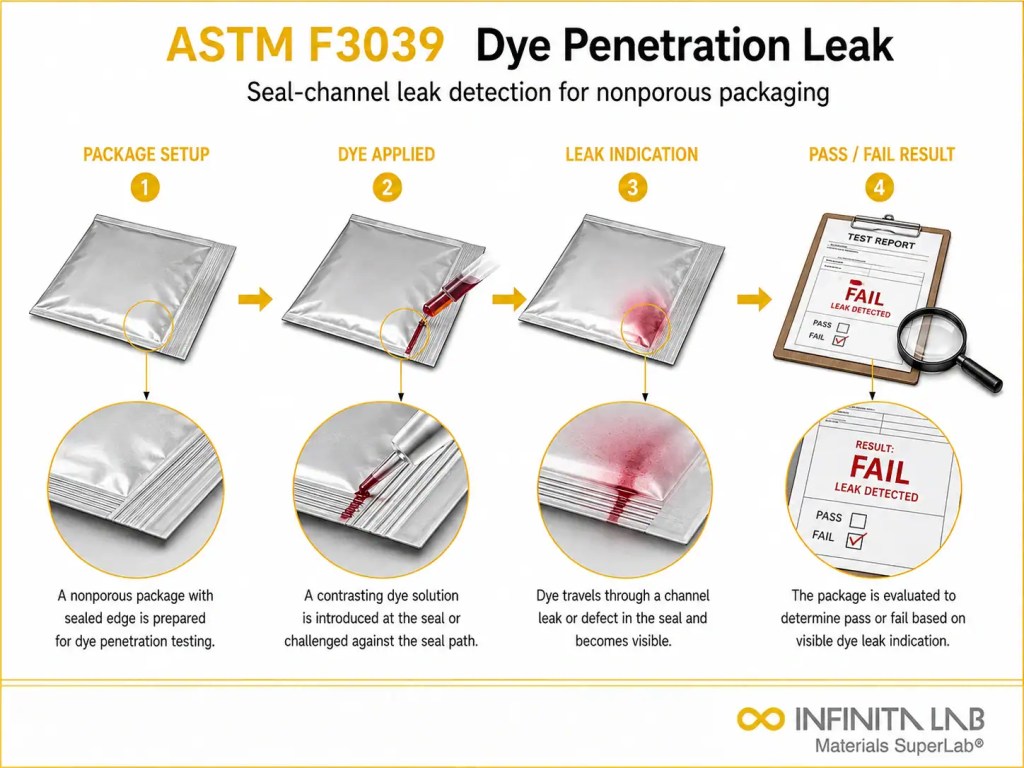


What Is ASTM F3039 Nonporous Packaging Dye Penetration Leak?
ASTM F3039 is a standardized method used to detect leaks in nonporous packaging systems by applying a dye solution to identify seal defects or channel leaks. It is widely used for flexible packaging, medical pouches, and sterile barrier systems where seal integrity is critical.
The test provides a rapid and sensitive way to identify defects such as pinholes, incomplete seals, or micro-channels. It supports quality control and validation by ensuring packaging maintains product protection and sterility throughout storage and handling.
Applications and Benefits of ASTM F3039 Nonporous Packaging Dye Penetration Leak Testing
Scope
ASTM F3039 defines a qualitative procedure for detecting leaks by observing dye penetration through seal areas under controlled conditions. It is particularly effective for identifying channel leaks in heat-sealed packaging.
The method supports validation of seal integrity and detection of defects that may compromise packaging performance.
- Detection of seal leaks and channel defects
- Identification of pinholes and micro-leak paths
- Evaluation of heat seal integrity
- Assessment of sterile barrier packaging performance
- Rapid screening for manufacturing defects
- Standardized qualitative leak detection
Applications
- Medical device sterile packaging validation
- Flexible pouch and blister packaging inspection
- Pharmaceutical packaging quality control
- Food packaging seal integrity testing
- Manufacturing process validation
- Packaging development and optimization
- Routine production inspection
Benefits
- Simple and rapid leak detection method
- Highly sensitive to small channel leaks
- Cost-effective quality control technique
- Improves packaging reliability and safety
- Supports compliance with packaging standards
- Enables early detection of sealing defects
Our ASTM F3039 Testing Procedure
Sample Setup
The sealed package is positioned to expose the seal area without damaging the structure.
1Dye Application
A colored dye solution is applied along the seal or suspected leak region.
2Observation
The package is monitored for dye movement through potential defects over a defined time.
3Evaluation
Visible dye penetration indicates leakage, while no penetration confirms seal integrity.
4ASTM F3039 Test Parameters and Requirements
| Parameter | Details |
|---|---|
| Applicable Materials | Nonporous packaging materials and seals |
| Dye Type | Water-based dye penetrant (e.g., blue dye solution) |
| Test Area | Package seals and suspected defect locations |
| Detection Method | Visual observation of dye penetration |
| Result Interpretation | Pass/Fail based on dye presence |
| Test Environment | Ambient laboratory conditions |
| Loading Type | Dye exposure along seal interface |


- Dye penetration solution
- Dropper or syringe applicator
- Inspection tray or surface
- Lighting system for visibility
- Magnification tools
- Sample holding fixtures
- Absorbent materials for excess dye
Equipment and Instrumentation Used for ASTM F3039 Testing
What You Receive: Test Report, Data, and Certification
- Leak presence or absence (pass/fail)
- Identification of channel leaks and defects
- Visual evidence of dye penetration
- Seal integrity assessment report
- Quality control inspection documentation
- Packaging validation results
- Recommendations for corrective action
ASTM F3039 Nonporous Packaging Dye Penetration Leak FAQs
The method applies to nonporous packaging, such as plastic films, foil-based packages, and rigid containers.
ASTM F3039 is highly effective in detecting channel leaks along seals, where incomplete bonding creates continuous pathways. It is particularly sensitive to defects that compromise sterile barrier integrity but may not be detectable using pressure-based methods.
The dye follows capillary pathways formed by seal defects. Even very fine channels allow liquid migration, making it possible to visually identify leak paths that are otherwise invisible under normal inspection.
Dye viscosity, surface tension, application method, seal geometry, and observation time all influence how effectively the dye can penetrate and reveal small defects.
Channel leaks provide direct pathways for microbial ingress, even if the rest of the package appears intact, making them a major risk for contamination.
Dye solution tightness testing under ASTM F3039 evaluates the integrity of nonporous packaging materials and flexible barrier seals by detecting leaks. A colored dye penetrant solution is applied to the package seal or material surface and allowed to contact the test area for a specified period. If a channel, hole, or leak is present, the dye passes through the defect and produces visible staining on an absorbent surface. This method helps identify packaging defects that could allow contaminants or moisture to enter or product contents to escape.
ASTM F3039 provides two methods for detecting leaks in nonporous packaging materials. Method A applies dye penetrant to package edge seals to identify leakage channels, while Method B spreads dye across a flat material specimen to detect holes. After dye application, the specimen is placed against an absorbent surface and examined for visible stains indicating leakage. The test helps assess seal integrity and identify defects in flexible barrier packaging.
Why Choose Infinita Lab for Nonporous Packaging Dye Penetration Leak Testing
When your Nonporous Packaging Dye Penetration Leak results have to hold up - for compliance, a customer audit, or an engineering decision - ASTM F3039 accuracy and an unbiased third-party report matter more than price. Infinita Lab routes your ASTM F3039 nonporous packaging dye penetration leak testing to ISO/IEC 17025-accredited U.S. partner labs with hands-on method experience, so you get defensible data, transparent reporting, and turnaround times built around your project deadline - not ours.

Need ASTM F3039 Nonporous Packaging Dye Penetration Leak Testing You Can Rely On?
Send query us at hello@infinitalab.com or call us at (888) 878-3090 to learn more about our services and how we can support you.



