


ASTM C1182: Alumina Particle Size Distribution Testing Services
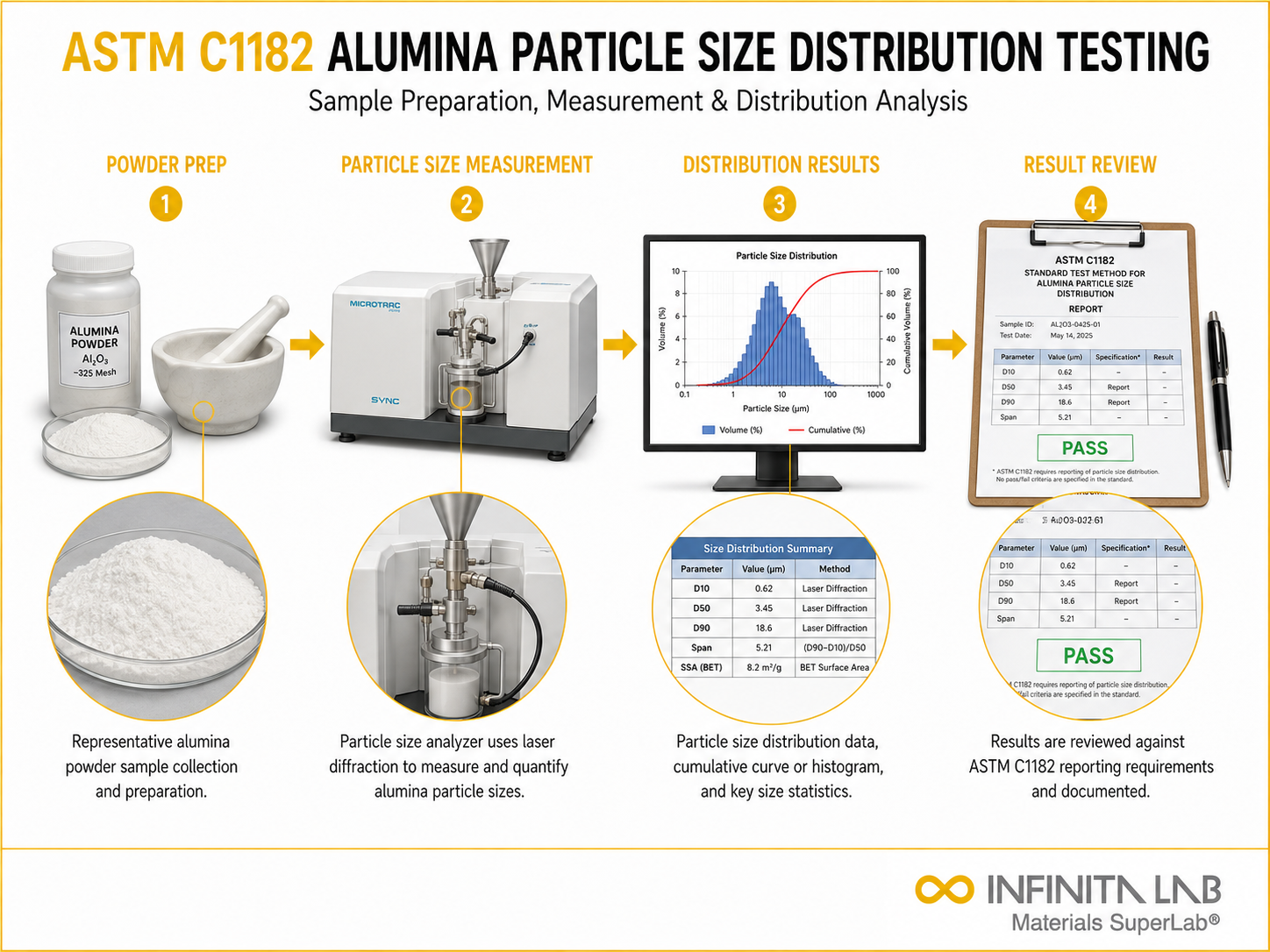
ASTM C1182 is useful for determining alumina powders' particle size distribution using the centrifugal photo sedimentation method. The procedure for ASTM C1182 described may be successfully applied to other ceramic powders in a general size range.
TRUSTED BY


Get ASTM C1182 compliant results — request your alumina particle size distribution testing quote
- Overview
- Scope, Applications, and Benefits
- Test Process
- Specifications
- Instrumentation
- Results and Deliverables
What Is ASTM C1182 Alumina Particle Size Distribution?
ASTM C1182 specifies a standard test method for determining the particle size distribution of alumina powders, typically using sedimentation techniques. The method evaluates how particles settle in a fluid under controlled conditions, allowing accurate measurement of fine particle sizes critical for processing and performance.
This standard is widely used in ceramics, refractories, and advanced materials industries where particle size significantly influences packing density, sintering behavior, and final product quality. ASTM C1182 ensures reliable and repeatable analysis for effective quality control and material optimization.

Applications and Benefits of ASTM C1182 Alumina Particle Size Distribution Testing
Scope
ASTM C1182 covers the determination of particle size distribution of alumina powders using sedimentation-based measurement techniques. It includes procedures for sample preparation, dispersion, measurement, and calculation to ensure accurate and reproducible results.
Includes:
- Sedimentation-based particle size analysis
- Sample dispersion and preparation methods
- Measurement of settling rates in a fluid medium
- Calculation of particle size distribution
- Quality control and repeatability requirements
Applications
- Ceramic manufacturing
- Refractory materials production
- Abrasives and polishing powders
- Electronic substrates
- Powder metallurgy processes
- Advanced material development
Benefits
- Accurate measurement of fine particle sizes
- Reliable and repeatable results
- Suitable for quality control processes
- Helps optimize powder processing
- Cost-effective analysis method
- Supports material performance improvement
Our ASTM C1182 Testing Procedure
Sample Preparation
Alumina powder is dispersed in a suitable liquid medium to prevent agglomeration.
1Dispersion & Stabilization
The suspension is stabilized to ensure uniform particle distribution during measurement.
2Sedimentation Measurement
Particles settle under controlled conditions and settling rates are recorded.
3Data Calculation
Particle size distribution is calculated based on sedimentation behavior and fluid properties.
4ASTM C1182 Test Parameters and Requirements
| Parameter | Details |
|---|---|
| Material Type | Alumina powders |
| Measurement Principle | Settling velocity based on particle size |
| Particle Size Range | Typically fine particles in micron range |
| Dispersion Medium | Liquid medium for suspension |
| Data Output | Particle size distribution and cumulative curves |
| Test Conditions | Controlled temperature and fluid properties |


- Sedimentation analyzer
- Balance for sample measurement
- Dispersion unit or mixer
- Temperature control system
- Stopwatch or automated timing system
- Data analysis software
Equipment and Instrumentation Used for ASTM C1182 Testing
What You Receive: Test Report, Data, and Certification
- Particle size distribution report
- Cumulative distribution curves
- Statistical parameters of particle sizes
- Test conditions and methodology details
- Compliance evaluation report
- Test summary and certification
ASTM C1182 Alumina Particle Size Distribution FAQs
It evaluates the sedimentation of particles in suspension, particularly centrifugal photo-sedimentation, to study the size distribution of alumina powders and similar powders based on them.
The procedure considers particles in the 0.1 to 20 μm range, with a median particle size of 0.5 to 5.0μm.
This helps maintain quality control, product specification, and material research by assuring the accuracy of the particle size measurements.
Particle size distribution affects packing density, sintering behavior, flowability, and final product quality, making it a critical parameter in manufacturing and material performance.
The law of strokes is applied to determine the resistance to movement, the speed at which particles move, and their arrangement during the given manipulations.
Why Choose Infinita Lab for Alumina Particle Size Distribution Testing
At the core of this breadth is our network of 2,000+ accredited laboratories across the USA, offering access to over 10,000 testing methods and analytical services. From advanced materials characterization (SEM, TEM, RBS, XPS) to mechanical, chemical, environmental, biological, and standardized ASTM/ISO-compliant testing, we deliver unmatched flexibility, specialization, and scale. You are never limited by geography, facility, or methodology — Infinita Lab connects you to the right expertise and testing solution, every time.

Looking for an Accredited Partner for ASTM C1182 Alumina Particle Size Distribution Testing?
Send query us at hello@infinitalab.com or call us at (888) 878-3090 to learn more about our services and how we can support you.



Request a Quote
Submit your material details and receive testing procedures, pricing, and turnaround time within 24 hours.
 Quick Turnaround and Hasslefree process
 Confidentiality Guarantee
 Free, No-obligation Consultation
 100% Customer Satisfaction
