


Magnetic Particle Inspection (MPI)
A nondestructive testing (NDT) technique called magnetic particle inspection (MPI), also referred to as magnetic particle testing (MPT), is used to find surface and near-surface faults and discontinuities in ferromagnetic materials. Particularly for checking components for cracks, laps, seams, inclusions, and other flaws, it is frequently employed in sectors including aerospace, automotive, and oil & gas.
TRUSTED BY


Magnetic Particle Inspection (MPI)
- Overview
- Scope, Applications, and Benefits
- Test Process
- Specifications
- Instrumentation
- Results and Deliverables
Magnetic Particle Inspection (MPI) Overview
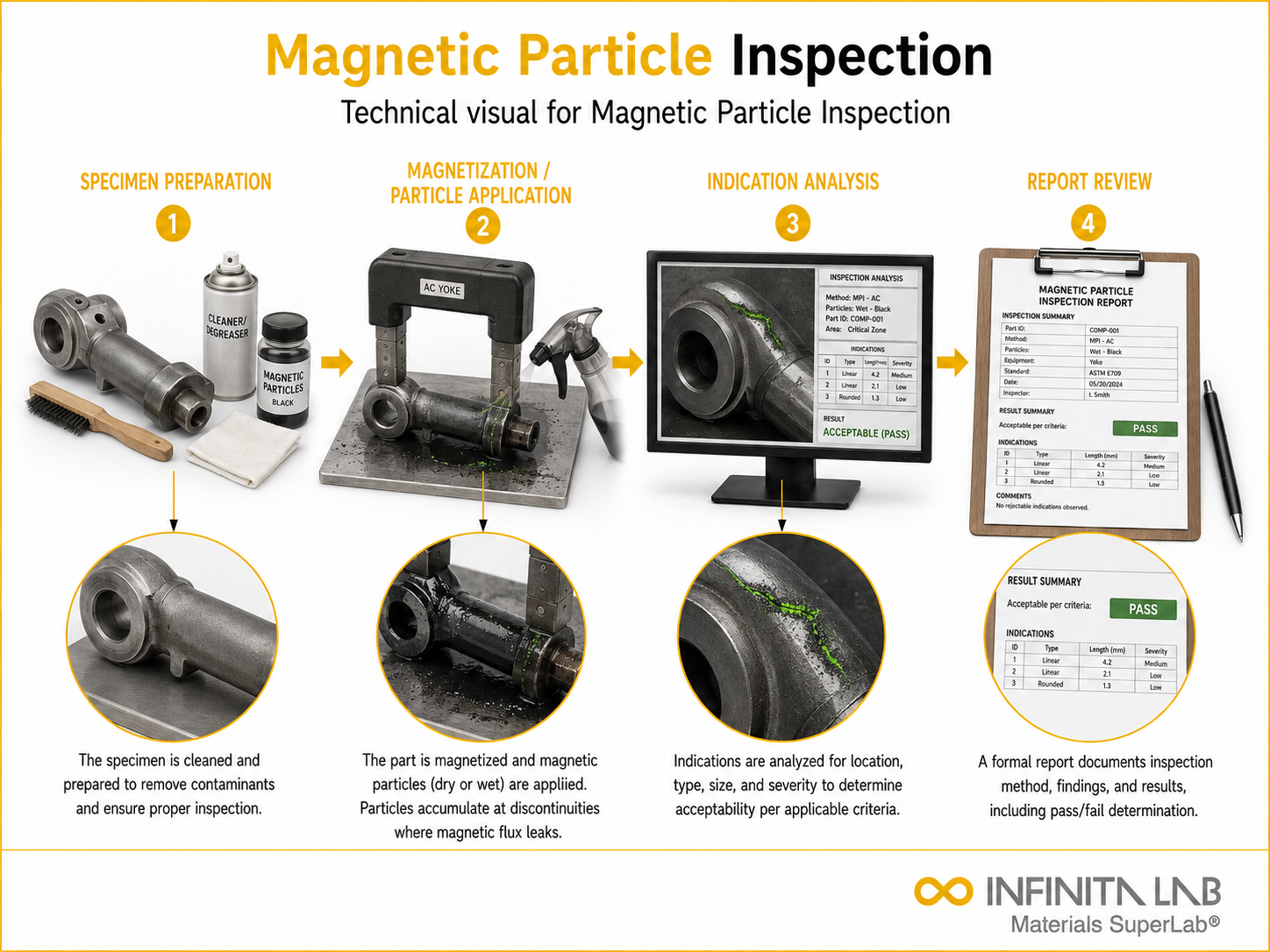
Magnetic particle inspection (MPI) is a nondestructive testing method used to detect surface and near-surface discontinuities -cracks, seams, laps, cold shuts, and other linear indications -in ferromagnetic materials. The method works by magnetizing the component and then applying ferromagnetic particles, either dry or suspended in a liquid carrier, to the surface. Where a discontinuity interrupts the magnetic flux lines within the material, flux leaks out of the surface at the discontinuity and the magnetic particles are attracted to and accumulate at that location, forming a visible indication that reveals the location, orientation, and approximate length of the discontinuity.
MPI is one of the most widely used NDT methods for ferromagnetic parts because it is fast, sensitive, relatively low cost, and can detect very tight surface cracks that are invisible to visual inspection alone. It is used extensively for in-process inspection of forgings, castings, welds, and machined components, and for maintenance inspection of aircraft components, pressure vessels, pipelines, and structural welds. Fluorescent MPI, where fluorescent particles are used with ultraviolet light, provides greater sensitivity for fine or tight indications than visible-light methods.
Governing standards include ASTM E1444 for magnetic particle testing of metallic parts, ASTM E3024 for MPI of welds, ASME V Article 7 for pressure vessel and boiler applications, and MIL-STD-1949 and ASTM E709 for general guidance. The method is limited to ferromagnetic materials -carbon steels, alloy steels, cast irons -and cannot be applied to austenitic stainless steels, aluminum, titanium, or other non-ferromagnetic materials.

Magnetic Particle Inspection (MPI) Scope, Applications, and Benefits
Scope
Magnetic particle inspection applies to ferromagnetic metallic materials including carbon steel, alloy steel, martensitic stainless steel, and cast and ductile iron. Surface and near-surface discontinuities are detected at or within approximately 6 mm of the surface. Magnetization methods include continuous DC or AC current (yoke, prod, or coil), permanent magnet yoke, and central conductor. Wet fluorescent and dry powder particle methods are both covered. The direction of magnetization relative to the expected discontinuity orientation must be considered -MPI detects discontinuities whose orientation is generally perpendicular to the magnetic flux direction, so two perpendicular magnetization directions are applied to detect indications in all orientations. Governing standards include ASTM E1444, ASTM E3024, and ASME Section V Article 7.
Applications
- Forging and casting inspection for surface cracks, seams, laps, and cold shuts
- Weld inspection for surface and near-surface cracking, lack of fusion, and undercut
- Aerospace component maintenance inspection -landing gear, engine components, and structural members
- Pressure vessel and boiler component inspection per ASME Section V and API standards
- Pipeline and tube inspection for longitudinal and transverse surface defects
- Machined component inspection after grinding, heat treatment, or plating operations
- Structural steel and bridge component inspection for fatigue cracks in service
- Automotive crankshaft, connecting rod, and axle shaft production inspection
Benefits
- Detects very fine surface cracks that are invisible to the unaided eye
- Fast inspection method suitable for high-volume production parts and large structures
- The fluorescent method provides higher sensitivity for tight cracks in critical applications
- Portable equipment allows inspection of installed components and field structures
- Applicable to complex geometries, including threaded surfaces, gear teeth, and fillet radii
- Real-time indication formation allows immediate identification and marking of defects
- Widely accepted by aerospace, pressure equipment, and structural inspection codes
Magnetic Particle Inspection (MPI) Process
Pre-Cleaning and Surface Preparation
The part is cleaned to remove oil, grease, paint, scale, and any other surface contamination that would interfere with particle mobility or indication formation.
1Magnetization
The part is magnetized using the selected method -AC or DC yoke, prod contacts, coil shot, or central conductor
2Particle Application and Indication Formation
Magnetic particles -dry powder or wet suspension, visible or fluorescent -are applied to the magnetized surface.
3Indication Evaluation, Demagnetization, and Reporting
Indications are evaluated for relevance, size, orientation, and location per the applicable acceptance criteria.
4Magnetic Particle Inspection (MPI) Technical Specifications
| Parameter | Details |
|---|---|
| Method | Magnetic particle inspection (MPI) -wet fluorescent and dry powder |
| Applicable Standards | ASTM E1444, ASTM E709, ASTM E3024, ASME Section V Article 7, MIL-STD-1949 |
| Applicable Materials | Ferromagnetic metals -carbon steel, alloy steel, martensitic SS, cast iron |
| Discontinuities Detected | Surface and near-surface cracks, seams, laps, cold shuts, lack of fusion in welds |
| Depth Sensitivity | Surface and subsurface to approximately 6 mm depth |
| Magnetization Methods | AC/DC yoke, prod contacts, coil shot, central conductorInstrumentation Used for |


- AC and DC electromagnetic yokes for field application on welds and surfaces
- Portable prod contact units for large flat surfaces and remote locations
- Fixed coil and central conductor magnetizing equipment for bars, rings, and tubes
- Fluorescent magnetic particle bath and UV black light source (365 nm)
- Dry magnetic powder applicators for high-temperature or dry surface applications
- Gauss meter and field indicator for magnetization level verification
- Demagnetizing coil or equipment for post-inspection demagnetization
Instrumentation Used for Magnetic Particle Inspection (MPI)
Magnetic Particle Inspection (MPI) Results and Deliverables
- Complete list of all relevant indications -location, orientation, length, and character
- Photographs of indications with scale reference and part identification
- Accept/reject determination per the applicable code or acceptance criteria
- Magnetization method, particle type, and lighting conditions used
- Part identification and surface preparation condition
- Demagnetization confirmation and residual field level
- Full inspection report formatted for quality records, code compliance documentation, or maintenance records
Frequently Asked Question
MPI is used to detect surface and near-surface discontinuities such as cracks, laps, seams, and fatigue-related defects in ferromagnetic materials. It is highly sensitive to linear defects that disrupt magnetic flux.
MPI is only applicable to ferromagnetic materials like iron, steel, cobalt, and nickel-based alloys. Non-magnetic materials such as aluminum, copper, or austenitic stainless steel cannot be evaluated using this method.
When a magnetic field is applied, discontinuities in the material cause flux leakage. Fine magnetic particles accumulate at these leakage points, forming a visible indication of the defect location and shape.
Common techniques include dry powder, wet fluorescent, and wet visible particle methods. The choice depends on required sensitivity, surface finish, and inspection conditions.
Why Choose Infinita Lab for Advanced Materials Testing and Characterization?
At the core of this breadth is our network of 2,000+ accredited laboratories across the USA, offering access to over 10,000 testing methods and analytical services. From advanced materials characterization (SEM, TEM, RBS, XPS) to mechanical, chemical, environmental, biological, and standardized ASTM/ISO-compliant testing, we deliver unmatched flexibility, specialization, and scale. You are never limited by geography, facility, or methodology — Infinita Lab connects you to the right expertise and testing solution, every time.

Looking for a Trusted Partner for Accurate and Reliable Testing Services?
Send query us at hello@infinitalab.com or call us at (888) 878-3090 to learn more about our services and how we can support you.



Request a Quote
Submit your material details and receive testing procedures, pricing, and turnaround time within 24 hours.
 Quick Turnaround and Hasslefree process
 Confidentiality Guarantee
 Free, No-obligation Consultation
 100% Customer Satisfaction
