


X Ray Diffraction XRD Testing Services
An effective, non-destructive analytical method for analyzing crystalline materials is X-ray diffraction (XRD).
TRUSTED BY


Get compliant results — request your x ray diffraction XRD testing quote
- Overview
- Scope, Applications, and Benefits
- Test Process
- Specifications
- Instrumentation
- Results and Deliverables
What Is X Ray Diffraction XRD?
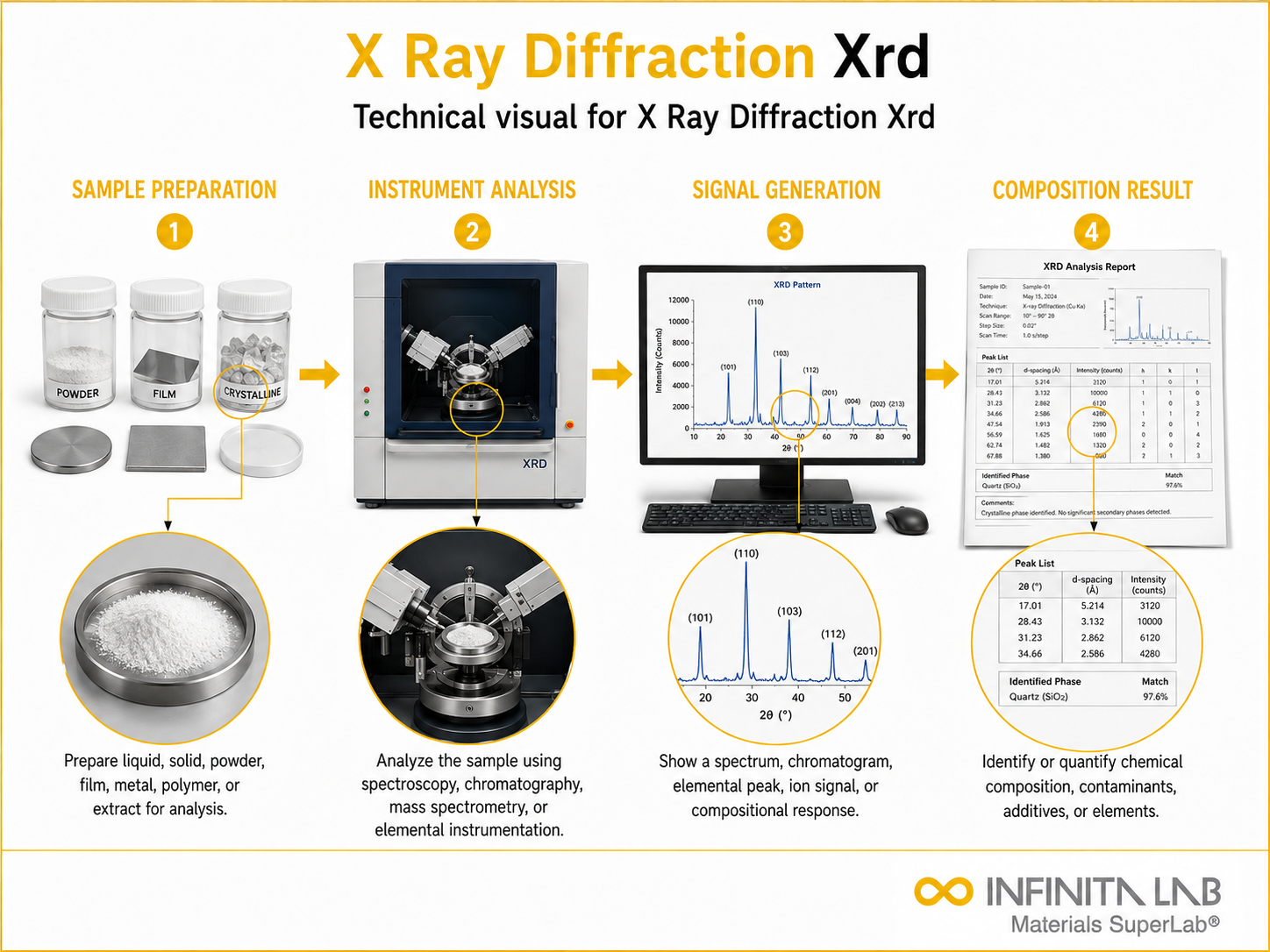
X-ray diffraction (XRD) is a non-destructive analytical technique used to identify and characterize the crystalline structure of materials. When a monochromatic X-ray beam strikes a crystalline sample, the regularly spaced atomic planes within the material’s lattice diffract the incident radiation at angles governed by Bragg’s Law. The resulting diffraction pattern — a plot of diffracted intensity versus diffraction angle — acts as a structural fingerprint that can be matched against reference databases to identify crystalline phases present in the sample.
Beyond phase identification, XRD provides quantitative information on crystal structure, lattice parameters, crystallite size, residual stress, preferred orientation (texture), and degree of crystallinity. The technique is applied to powders, bulk solids, thin films, and coatings across metals, ceramics, polymers, pharmaceuticals, minerals, and semiconductor materials.

Applications and Benefits of X Ray Diffraction XRD Testing
Scope
XRD analysis applies to any material possessing long-range crystalline order, including:
- Powder XRD — bulk polycrystalline samples, powders, and ground solids for phase identification and quantification
- Single-crystal XRD — well-ordered individual crystals for precise atomic structure determination
- Thin-film XRD — coatings and deposited layers on substrates, including grazing incidence configurations for shallow surface analysis
- Residual stress and texture analysis — metals and engineered components where processing-induced stress or crystallographic orientation affects performance
Applications
- Phase identification and quantification — determining which crystalline compounds are present in a sample and their relative proportions
- Semiconductor and thin-film characterization — assessing crystal quality, epitaxial layer orientation, doping-related lattice strain, and film thickness in devices such as transistors and solar cells
- Failure analysis — identifying unexpected crystalline phases, corrosion products, or contaminants responsible for component failure
- Pharmaceutical characterization — confirming polymorphic form, crystallinity, and phase purity of active pharmaceutical ingredients
- Residual stress measurement — evaluating stress introduced by machining, welding, heat treatment, or surface treatment processes
- Mineralogical and geological analysis — identifying mineral phases in ores, soils, and geological samples
Benefits
- Non-destructive — samples can typically be analyzed without damage, and in many cases returned for further testing
- Definitive phase identification — diffraction patterns provide unambiguous identification of crystalline phases, unlike techniques that only provide elemental composition
- Minimal sample preparation — powders and many solid samples can be analyzed with little to no preparation
- Quantitative structural data — lattice parameters, crystallite size, and strain can be calculated directly from diffraction data
- Broad material applicability — applicable to metals, ceramics, polymers, pharmaceuticals, and thin films across a wide range of industries
Our Testing Procedure
Prepare the Sample
Mount the powder, bulk specimen, or thin film with a flat, representative surface.
1Set Up the Instrument
Select the diffraction geometry, X-ray wavelength, scan range, and test conditions.
2Collect and Analyse Data
Record the diffraction pattern and compare it with reference databases to identify crystalline phases.
3Calculate and Report
Determine phase quantities, lattice parameters, crystallite size, or residual stress and report the results.
4Test parameters and requirements
| Parameter | Details |
|---|---|
| Radiation Source | Cu-Kα (most common), Co-Kα, or Mo-Kα, depending on material and application |
| Result Parameters | Crystalline phase identification, lattice parameters, crystallite size, residual stress, preferred orientation, degree of crystallinity |
| Sample Form | Powder, bulk solid, thin film, or coated substrate |
| Reference Database | ICDD Powder Diffraction File (PDF) or equivalent crystallographic databases |
| Specialty Techniques | Grazing Incidence XRD (GIXRD) for thin-film and near-surface analysis |
| Related Standards | ASTM E975 (residual stress by X-ray diffraction), ASTM F1926, ASTM C1365 |


- X-ray diffractometer with sealed-tube or rotating-anode X-ray source
- Goniometer for precise angular positioning of sample and detector
- Scintillation, proportional, or solid-state area detector for diffracted intensity measurement
- Sample stage accommodating powder holders, bulk mounts, or thin-film/grazing-incidence attachments
- Reference standard materials for instrument calibration and alignment verification
- Diffraction analysis software with access to crystallographic reference databases
Equipment and Instrumentation Used for Testing
What You Receive: Test Report, Data, and Certification
- Diffraction pattern — plot of diffracted intensity versus diffraction angle (2θ) for the analyzed sample
- Phase identification report — list of crystalline phases identified, with matching reference database entries
- Quantitative phase analysis — relative weight or volume percentage of each identified phase, where requested
- Structural parameters — calculated lattice parameters, crystallite size, and microstrain, where applicable
- Residual stress data — calculated stress values from diffraction peak shift analysis, where requested
- Comparative analysis — side-by-side comparison of multiple samples or processing conditions where relevant to the investigation
X Ray Diffraction XRD FAQs
XRD is a non-destructive technique for determining a material's chemical composition, crystal structure, crystal orientation, crystallite size, lattice strain, preferred orientation, and layer thickness.
There are two forms of XRD techniques: single-crystal and powder. The difference between these methods is scale. As the name suggests, a single-crystal analysis focuses on the exact atomic positions of a single well-ordered crystal, whereas powder XRD characterizes a bulk material sample.
It is non-destructive and provides detailed crystallographic information. It is relatively speedy and can be applied to studying different varieties of materials without major sample preparations.
XRD helps characterize semiconductor materials by determining the crystal quality, doping levels, and properties of thin films applied to semiconductor devices such as transistors and solar cells.
Grazing Incidence X-ray Diffraction is considered a specialty XRD technique that is very helpful in studying thin films and surface structures at shallow angles to provide detailed surface analysis.
Why Choose Infinita Lab for X Ray Diffraction XRD Testing?
At the core of this breadth is our network of 2,000+ accredited laboratories across the USA, offering access to over 10,000 testing methods and analytical services. From advanced materials characterization (SEM, TEM, RBS, XPS) to mechanical, chemical, environmental, biological, and standardized ASTM/ISO-compliant testing, we deliver unmatched flexibility, specialization, and scale. You are never limited by geography, facility, or methodology — Infinita Lab connects you to the right expertise and testing solution, every time.

Looking for an Accredited Partner for X Ray Diffraction XRD Testing?
Send query us at hello@infinitalab.com or call us at (888) 878-3090 to learn more about our services and how we can support you.



Request a Quote
Submit your material details and receive testing procedures, pricing, and turnaround time within 24 hours.
 Quick Turnaround and Hasslefree process
 Confidentiality Guarantee
 Free, No-obligation Consultation
 100% Customer Satisfaction
