


ASTM D5657 Fluid Tightness Testing of Adhesives on Threaded Fasteners
The ability of adhesives that are used to lock and seal threaded fasteners to form leak-tight assemblies is determined by ASTM D5657. The performance of specimens assessed by this method is quantified in terms of the inch-pound units.
TRUSTED BY


Precision-driven testing for dimensional accuracy and compliance
- Overview
- Scope, Applications, and Benefits
- Test Process
- Specifications
- Instrumentation
- Results and Deliverables
Overview
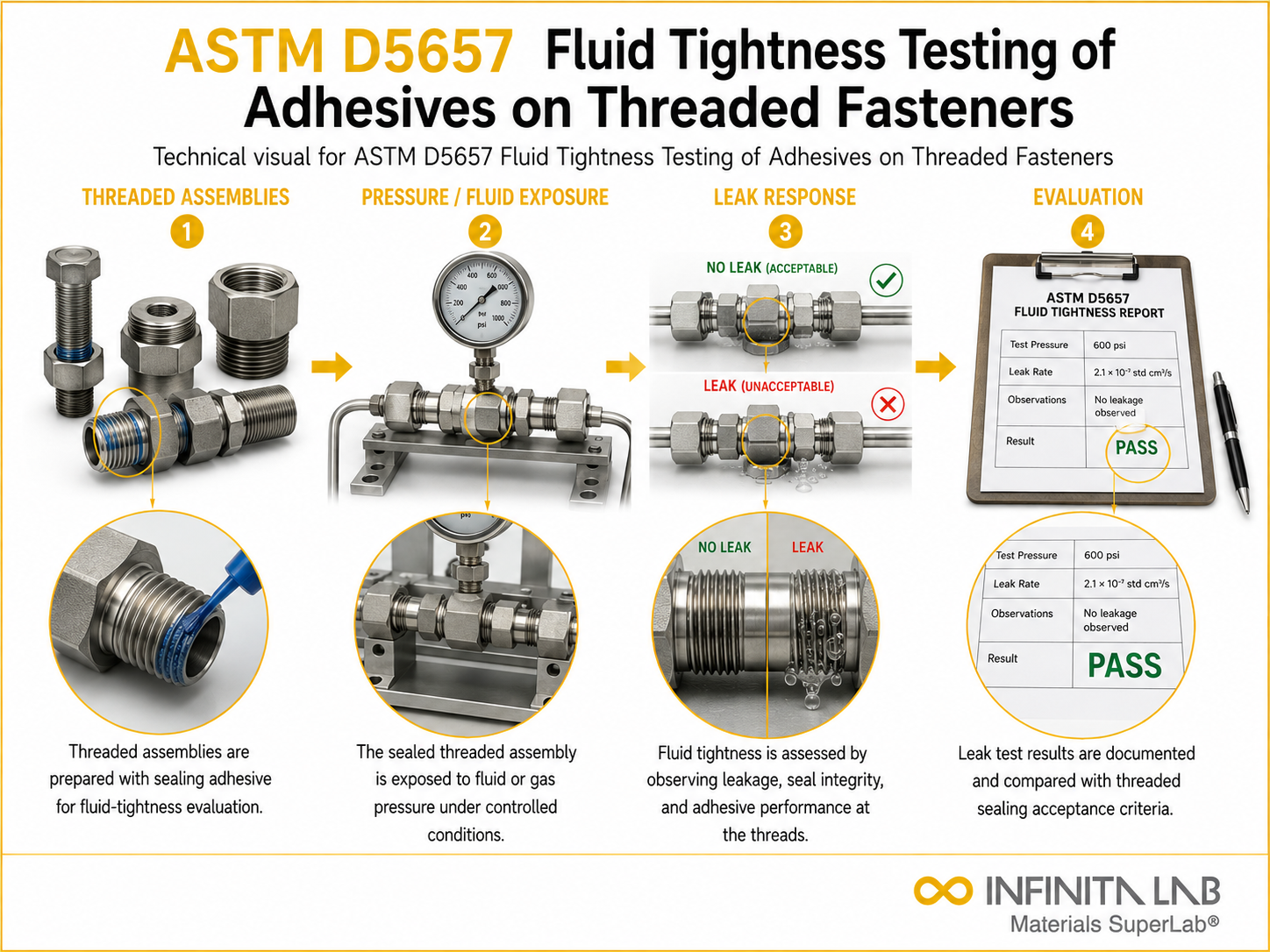
ASTM D5657 evaluates the fluid tightness ability of adhesives used on threaded fasteners. It determines how effectively an adhesive seals threaded joints to prevent leakage of liquids or gases under specified conditions.
This method is critical for applications requiring leak-proof sealing and joint integrity. It helps assess sealing performance, ensures reliability in pressurized systems, and supports the selection of suitable adhesives for preventing fluid escape in demanding environments.

Scope, Applications, and Benefits
Scope
ASTM D5657 covers the determination of sealing effectiveness of adhesives applied to threaded fasteners. It focuses on evaluating the ability to prevent fluid leakage under controlled test conditions.
- Applicable to threaded fasteners with sealing adhesives
- Measures resistance to fluid leakage
- Evaluates sealing performance under pressure
- Suitable for liquids and gases
- Supports quality control and product validation
Applications
- Thread sealing in pipelines and fittings
- Automotive fluid system sealing
- Aerospace hydraulic and fuel systems
- Industrial machinery and equipment
- Plumbing and mechanical assemblies
- Pressure vessel sealing applications
- Quality assurance testing
Benefits
- Ensures leak-proof joint performance
- Improves system reliability and safety
- Reduces maintenance and failures
- Supports proper adhesive selection
- Enhances sealing efficiency
- Enables consistent assembly quality
Test Process
Specimen Preparation
Adhesive is applied to threaded fasteners and assembled under specified conditions.
1Curing Stage
Assembly is allowed to cure for a defined period to develop sealing properties.
2Pressure Application
Fluid or gas pressure is applied to the joint under controlled conditions.
3Leak Detection
Leakage is monitored and evaluated to determine sealing effectiveness.
4Technical Specifications
| Parameter | Details |
|---|---|
| Property Measured | Fluid tightness (leak resistance) |
| Sample Type | Threaded fasteners with adhesive |
| Test Medium | Liquid or gas |
| Pressure Range | Defined test pressure conditions |
| Output | Leakage or pass/fail result |
| Test Condition | After adhesive curing |
| Detection Method | Visual or instrument-based |
| Units | Leakage rate or qualitative result |


- Pressure test system
- Leak detection equipment
- Threaded fastener fixtures
- Fluid or gas supply system
- Monitoring instruments
- Calibration tools
Instrumentation Used for Testing
Results and Deliverables
- Leakage assessment
- Pressure resistance data
- Sealing performance evaluation
- Test conditions and observations
- Comparative adhesive analysis
- Detailed test report
Frequently Asked Question
ASTM D5657 is important because it evaluates the ability of adhesives to prevent leakage in threaded joints. Ensuring fluid tightness is critical for maintaining system integrity, safety, and performance in applications involving pressurized fluids or gases.
ASTM D5657 defines fluid tightness as the ability of an adhesive-sealed joint to resist leakage under applied pressure. It reflects the sealing effectiveness of the adhesive in real-world conditions.
ASTM D5657 identifies whether an adhesive can effectively seal threaded joints, helping prevent leakage-related failures, system inefficiencies, and safety hazards in operational environments.
Factors such as adhesive type, curing time, thread condition, pressure level, and test medium influence results. ASTM D5657 requires controlled conditions for accurate evaluation.
ASTM D5657 ensures that threaded joints remain leak-free, directly improving reliability, efficiency, and safety of fluid systems.
Why Choose Infinita Lab for Advanced Materials Testing and Characterization?
At the core of this breadth is our network of 2,000+ accredited laboratories across the USA, offering access to over 10,000 testing methods and analytical services. From advanced materials characterization (SEM, TEM, RBS, XPS) to mechanical, chemical, environmental, biological, and standardized ASTM/ISO-compliant testing, we deliver unmatched flexibility, specialization, and scale. You are never limited by geography, facility, or methodology — Infinita Lab connects you to the right expertise and testing solution, every time.

Looking for a Trusted Partner for Accurate and Reliable Testing Services?
Send query us at hello@infinitalab.com or call us at (888) 878-3090 to learn more about our services and how we can support you.



Request a Quote
Submit your material details and receive testing procedures, pricing, and turnaround time within 24 hours.
 Quick Turnaround and Hasslefree process
 Confidentiality Guarantee
 Free, No-obligation Consultation
 100% Customer Satisfaction
