


ASTM D5151: Medical Glove Hole Detection Testing Services
Accredited ASTM D5151 medical glove hole detection testing from Infinita Lab, performed to the exact standard requirements - accurate, reproducible results with full documentation for compliance, R&D, and quality control programs.
TRUSTED BY


Get ASTM D5151 compliant results - request your medical glove hole detection testing quote
- Overview
- Scope, Applications, and Benefits
- Test Process
- Specifications
- Instrumentation
- Results and Deliverables
What Is ASTM D5151 Medical Glove Hole Detection?
Medical gloves are the last line of defence between a clinician’s hands and whatever they happen to be touching – blood, chemicals, infectious material. If a glove has even a pinhole, that barrier is compromised, and nobody finds out until it’s too late. ASTM D5151 exists to catch that kind of failure before a glove ever reaches a hospital shelf or a lab bench.
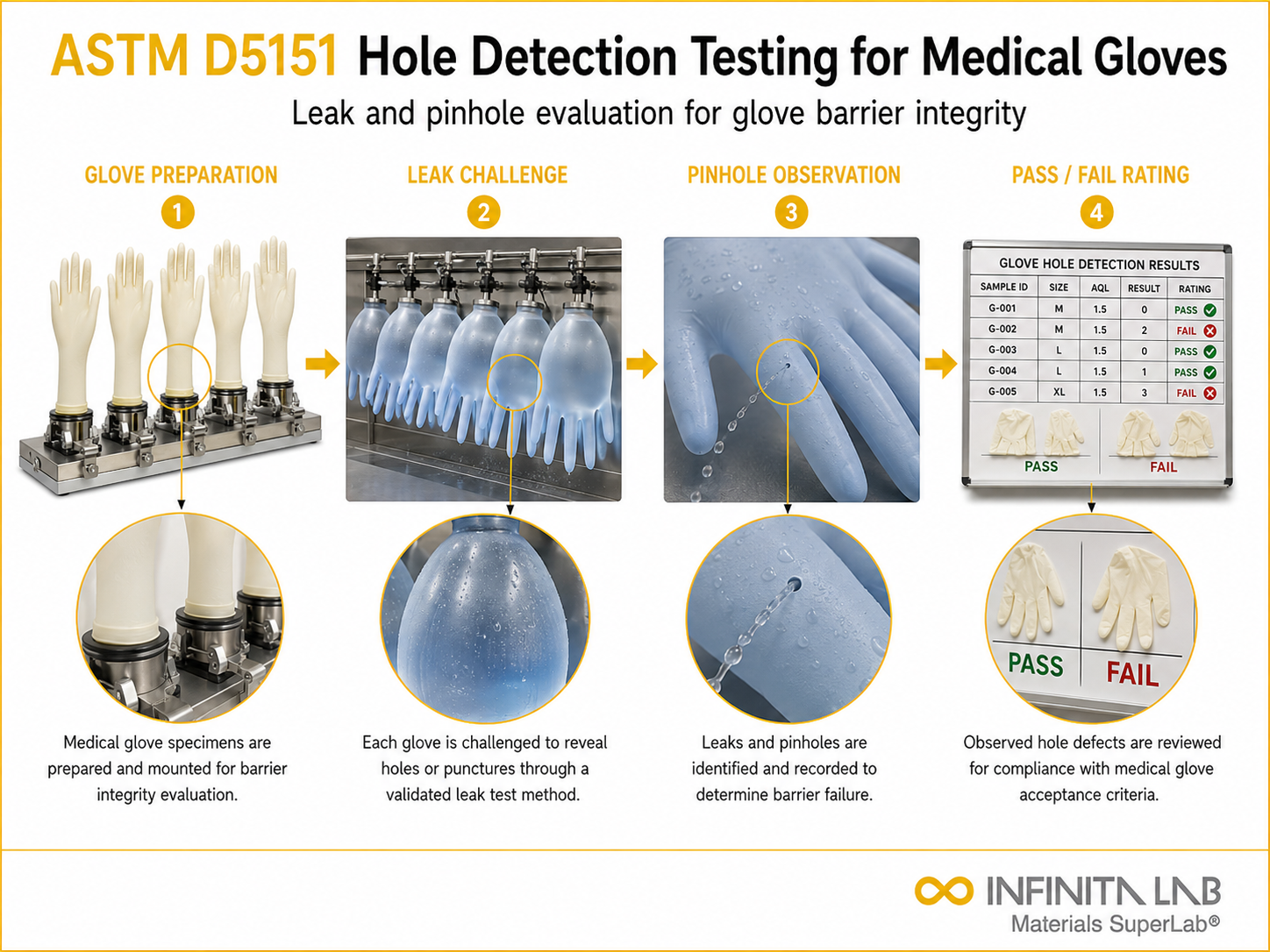
The standard, formally titled Standard Test Method for Detection of Holes in Medical Gloves, gives manufacturers and labs a simple, repeatable way to check for leaks: fill the glove with water, suspend it, and watch. It sounds almost too basic for a method that underpins regulatory clearance in multiple countries, but that simplicity is exactly why it works so well as a screening tool. A glove is secured over a cylinder, filled with a measured volume of room-temperature water, and inspected – once right after filling, and again after a short observation period – for any sign of water escaping through the material. If moisture shows up on the outside, the glove has failed.
D5151 rarely stands on its own. Manufacturers pair it with acceptable quality level (AQL) sampling plans, most often drawn from ISO 2859-1, to determine how many gloves from a given lot need to be pulled and tested, and how many failures a lot can tolerate before the whole batch gets rejected. Regulatory bodies, including the FDA, reference this same cylinder-based approach when setting barrier-integrity requirements for surgical and examination gloves.
At Infinita Lab, we connect glove manufacturers, importers, and healthcare suppliers with accredited partner laboratories that run ASTM D5151 testing to the letter – consistent water volumes, controlled observation windows, and documented AQL-based lot decisions – so you walk away with defensible data you can hand straight to a regulator, an auditor, or a customer.

Applications and Benefits of ASTM D5151 Medical Glove Hole Detection Testing
Scope
- ASTM D5151 establishes a standardised water-leak procedure for detecting pinholes and other barrier defects in medical gloves.
- The method applies to both patient examination gloves and surgical gloves made from natural rubber latex, nitrile, neoprene, polychloroprene, or vinyl/PVC.
- It covers gloves in powdered and powder-free finishes, tested in the manufacturer’s stated sizes.
- Testing is qualitative and effectively destructive for the tested glove, which is why it’s run on a statistical sample rather than every unit in a lot.
- The standard specifies water volume, temperature range, and observation timing so results stay comparable across different labs and manufacturers.
- It excludes defects located in the outer 40 mm of the glove cuff, since that zone falls outside the functional barrier area.
- Sample conditioning requirements – temperature and humidity, held for a defined period before testing – are part of the scope to keep material behaviour consistent.
- D5151 is frequently applied alongside AQL sampling plans, typically drawn from ISO 2859-1, to translate individual glove results into a lot-level accept or reject decision.
- The method does not evaluate mechanical properties like tensile strength or elongation; those are covered separately under standards such as ASTM D3577, D3578, or D6319.
- Regulatory bodies, including the FDA, recognise D5151 as the reference cylinder and leak-detection methodology for medical glove barrier-integrity requirements.
Applications
- Manufacturers use ASTM D5151 as a routine in-process and finished-goods quality control check before gloves ever leave the plant.
- Importers and distributors rely on the test to confirm that incoming lots meet barrier-integrity claims before the gloves reach hospitals or clinics.
- Regulatory submissions for examination and surgical gloves often include D5151 data to demonstrate compliance with FDA and comparable international requirements.
- Hospital and health system procurement teams request D5151 results as part of vendor qualification and periodic lot verification.
- Contract manufacturers apply the test to validate new production lines, raw material substitutions, or process changes before scaling output.
- Industrial and laboratory glove suppliers use the same method to confirm barrier performance for high-risk chemical or biological handling applications.
- Third-party certification bodies fold D5151 results into broader glove certification packages alongside physical property and biocompatibility data.
Benefits
- The test is fast and inexpensive relative to the risk it screens out, which makes it practical for routine, high-volume QC programs.
- Results are binary and easy to interpret – a glove either holds water or it doesn’t – keeping inspection decisions consistent across shifts and operators.
- Because the procedure is standardised, results generated at different labs or production sites remain directly comparable.
- AQL-based sampling lets manufacturers make statistically sound lot decisions without testing every glove, saving both time and material.
- Passing D5151 testing supports regulatory filings and helps demonstrate due diligence if a barrier-failure claim ever surfaces downstream.
- Catching pinhole defects early in manufacturing reduces the odds of costly recalls or field failures later on.
Our ASTM D5151 Testing Procedure
Glove Preparation & Filling
The glove is inspected and filled with 1000 ± 50 mL of water.
1Sealing the Cuff
The glove cuff is securely closed to prevent leakage from the opening.
2Hanging & Observation
The glove is hung vertically for 2 minutes and observed for leaks.
3Leakage Detection & Recording
Any leakage is noted, and gloves are classified as pass or fail.
4ASTM D5151 Test Parameters and Requirements
| Parameter | Details |
|---|---|
| Applicable Materials | Latex, nitrile, neoprene, elastomers |
| Sample Condition | New, unused gloves |
| Water Volume | 1000 ± 50 mL |
| Observation Time | 2 minutes |
| Test Temperature | 23 ± 2°C (room temperature) |
| Output Units | Qualitative |


- Clear Test Cylinder/Mandrel – holds the glove upright and lets technicians observe the full glove surface for leakage during the water fill.
- Calibrated Water Dispensing System – measures and delivers the 1000 ± 50 mL water volume consistently across every test.
- Vertical Suspension Rack/Clips – secures filled gloves in position for the observation period without adding stress that could mask or mimic leakage.
- Timing Device – tracks the two-minute observation window so results are recorded at the correct, standardised interval.
- Environmental Conditioning Chamber – maintains the temperature and humidity range specimens need before testing begins.
- Inspection Lighting Station – improves visibility of small droplets or seepage points on the glove surface during examination.
- Data Logging and Reporting System – records pass/fail results per glove and compiles them into lot-level AQL determinations.
Equipment and Instrumentation Used for ASTM D5151 Testing
What You Receive: Test Report, Data, and Certification
- A pass/fail classification for every glove tested, documenting whether water leakage was observed at either checkpoint.
- Defect counts and, where applicable, defect locations, helping manufacturers trace recurring failures back to a process or raw material issue.
- A lot-level acceptance or rejection determination based on the applicable AQL sampling plan.
- A formal test report suitable for regulatory submissions, customer audits, or internal quality records.
- Batch and lot traceability details tying results back to specific production runs.
- Guidance on retesting or resampling procedures whenever a lot falls outside the acceptance criteria.
ASTM D5151 Medical Glove Hole Detection FAQs
The test is critical for assessing glove integrity and user safety. Even microscopic holes can allow fluids or pathogens to pass through, posing infection risks. ASTM D5151 helps verify that gloves meet strict safety standards required in medical and laboratory applications.
This test method applies to a variety of medical gloves, including latex, nitrile, vinyl, neoprene, and other elastomeric gloves used in surgical, examination, or laboratory environments.
Each glove is filled with approximately 1000 mL of water and suspended vertically for 2 minutes. The glove is then inspected visually for leaks. Any visible dripping or water seepage indicates the presence of a hole or defect.
Chemical glove usage monitoring evaluates chemical exposure, permeation, degradation, wear, and replacement intervals. Samples or glove materials may be tested against specific chemicals to determine protection performance and safe usage limits.
Why Choose Infinita Lab for Medical Glove Hole Detection Testing
When your Medical Glove Hole Detection results have to hold up - for compliance, a customer audit, or an engineering decision - ASTM D5151 accuracy and an unbiased third-party report matter more than price. Infinita Lab routes your ASTM D5151 medical glove hole detection testing to ISO/IEC 17025-accredited U.S. partner labs with hands-on method experience, so you get defensible data, transparent reporting, and turnaround times built around your project deadline - not ours.

Need ASTM D5151 Medical Glove Hole Detection Testing You Can Rely On?
Send query us at hello@infinitalab.com or call us at (888) 878-3090 to learn more about our services and how we can support you.



Request a Quote
Submit your material details and receive testing procedures, pricing, and turnaround time within 24 hours.
 Quick Turnaround and Hasslefree process
 Confidentiality Guarantee
 Free, No-obligation Consultation
 100% Customer Satisfaction
