

What Is ASTM C326 Ceramic Clay Drying Firing Shrinkage?
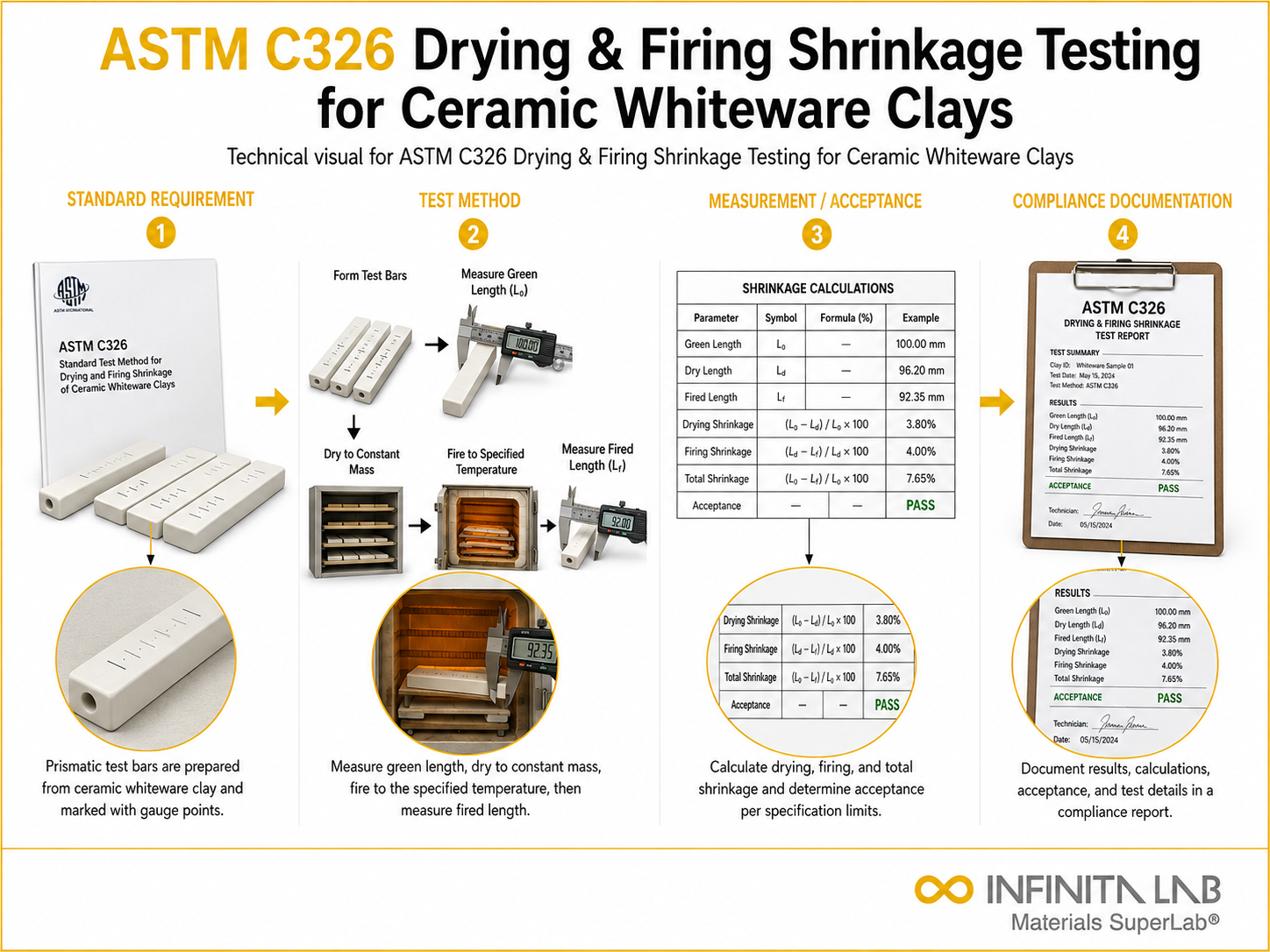
ASTM C326 defines a standardized method for determining drying and firing shrinkage of ceramic whiteware clays. It measures dimensional changes that occur when clay bodies are dried and subsequently fired, which directly influence product size accuracy, warpage, and structural integrity.
This test is essential for controlling ceramic processing and ensuring dimensional stability. By quantifying shrinkage behavior, ASTM C326 helps manufacturers optimize formulations, adjust firing conditions, and reduce defects such as cracking or distortion in finished ceramic products.

Applications and Benefits of ASTM C326 Ceramic Clay Drying Firing Shrinkage Testing
Scope
ASTM C326 outlines procedures for measuring linear shrinkage of whiteware clays during drying and firing under controlled conditions.
- Applicable to ceramic whiteware clays and bodies
- Measures drying shrinkage before firing
- Determines firing shrinkage after kiln processing
- Includes specimen preparation and marking
- Ensures controlled drying and firing conditions
- Supports dimensional accuracy and quality control
Applications
- Ceramic tiles and sanitaryware production
- Tableware and porcelain manufacturing
- Clay body formulation development
- Quality control in ceramic processing
- Kiln process optimization
- Research and development of whiteware materials
Benefits
- Provides accurate shrinkage measurement
- Helps prevent cracking and warping defects
- Supports dimensional control in products
- Improves formulation and process optimization
- Ensures consistent product quality
- Enables reliable comparison of clay bodies
Our ASTM C326 Testing Procedure
Specimen Preparation
Form and mark clay specimens with defined reference lengths.
1Drying Stage
Dry specimens under controlled conditions and measure dimensional change.
2Firing Stage
Fire specimens at specified temperature and measure further shrinkage.
3Shrinkage Calculation
Calculate drying and firing shrinkage percentages from dimensional differences.
4ASTM C326 Test Parameters and Requirements
| Parameter | Details |
|---|---|
| Material Type | Ceramic whiteware clays |
| Specimen Geometry | Formed clay bars with marked gauge length |
| Measurement Parameter | Drying and firing shrinkage (%) |
| Drying Condition | Controlled temperature and humidity |
| Firing Temperature | Specified kiln temperature |
| Measurement Accuracy | High precision length measurement |
| Test Environment | Controlled laboratory conditions |
| Output Data | Percentage shrinkage values |


- Vernier caliper or micrometer
- Drying oven
- Kiln or furnace
- Measuring scale or ruler
- Marking tools for gauge length
- Data recording system
Equipment and Instrumentation Used for ASTM C326 Testing
What You Receive: Test Report, Data, and Certification
- Drying shrinkage percentage
- Firing shrinkage percentage
- Total linear shrinkage values
- Dimensional change analysis
- Quality and performance assessment
- Detailed test report with calculations
ASTM C326 Ceramic Clay Drying Firing Shrinkage FAQs
Shrinkage testing helps identify how clay behaves during drying and firing. This information is crucial for preventing defects like warping, cracking, or dimensional inaccuracies and ensuring high-quality final products.
The vitrification stage is when shrinkage occurs. This is caused by the particles' tighter arrangement in their glassy matrix and decreasing size as they get closer to fusion. Clay typically shrinks roughly the same amount during burning as it does drying. The overall shrinkage is between 8 and 12%.
While the standard is designed for whiteware clays, its principles can be adapted with appropriate modifications for other ceramic materials.
Factors include clay composition, moisture content, particle size, drying conditions, and firing temperature, all of which influence dimensional changes.
It helps manufacturers control dimensional changes, improve product quality, reduce defects, and ensure reliable performance of ceramic products in various applications.
Why Choose Infinita Lab for Ceramic Clay Drying Firing Shrinkage Testing
At the core of this breadth is our network of 2,000+ accredited laboratories across the USA, offering access to over 10,000 testing methods and analytical services. From advanced materials characterization (SEM, TEM, RBS, XPS) to mechanical, chemical, environmental, biological, and standardized ASTM/ISO-compliant testing, we deliver unmatched flexibility, specialization, and scale. You are never limited by geography, facility, or methodology — Infinita Lab connects you to the right expertise and testing solution, every time.

Looking for an Accredited Partner for ASTM C326 Ceramic Clay Drying Firing Shrinkage Testing?
Send query us at hello@infinitalab.com or call us at (888) 878-3090 to learn more about our services and how we can support you.





