


ICP-MS (Inductively Coupled Plasma Mass Spectrometry) Testing Services
In ICP-MS, an inductively coupled plasma (ICP) uses argon gas plasma to decompose the sample into its constituent atoms or singly-charged ions.
TRUSTED BY


Precision-driven testing for dimensional accuracy and compliance
- Overview
- Scope, Applications, and Benefits
- Test Process
- Specifications
- Instrumentation
- Results and Deliverables
Overview
Inductively Coupled Plasma Mass Spectrometry (ICP-MS) is an ultra-sensitive analytical technique used to detect, identify, and quantify trace concentrations of metals, metalloids, and certain non-metals in liquid and dissolved solid matrices at parts-per-trillion levels. ICP-MS is a definitive analytical technique that provides comprehensive multi-element analysis across the periodic table in a single run, which is of significant value to materials engineers and analysts for determining the trace composition of materials.

Scope, Applications, and Benefits
Scope
ICP-MS uses a high-temperature inductively coupled argon plasma to atomize and ionize liquid samples containing elements, which are then introduced into the mass spectrometer for separation, identification, and quantitative analysis of the elements present. This enables simultaneous multi-element trace analysis with parts-per-trillion sensitivity across a broad range of elements.
ICP-MS analysis evaluates:
- Ultra-trace multi-element quantification in liquid, dissolved solid, and digested material samples
- Heavy metal and toxic element detection at parts-per-trillion concentration levels
- Isotopic ratio measurement and isotope dilution analysis for high-accuracy elemental quantification
- Elemental impurity profiling in pharmaceutical, electronic, and high-purity material systems
- Compliance of elemental composition against the defined material specification and purity requirements
Applications
- High-purity materials, electronic-grade chemicals, and semiconductor process fluids requiring trace elemental certification
- Pharmaceutical elemental impurity analysis per ICH Q3D and USP guidelines
- Environmental water, soil, and sediment sample analysis for heavy metal and toxic element quantification
- Food, beverage, and dietary supplement trace element and heavy metal screening
- Failure analysis and contamination investigation programs requiring ultra-trace elemental identification
Benefits
- Delivers ultra-sensitive multi-element trace analysis at parts-per-trillion detection levels
- Provides simultaneous full periodic table elemental coverage within a single analytical run
- Identifies trace elemental contaminants and impurities in complex sample matrices
- Delivers traceable, laboratory-certified elemental data for material
- Reduces material risk by detecting elemental impurities early in the characterization cycle
Test Process
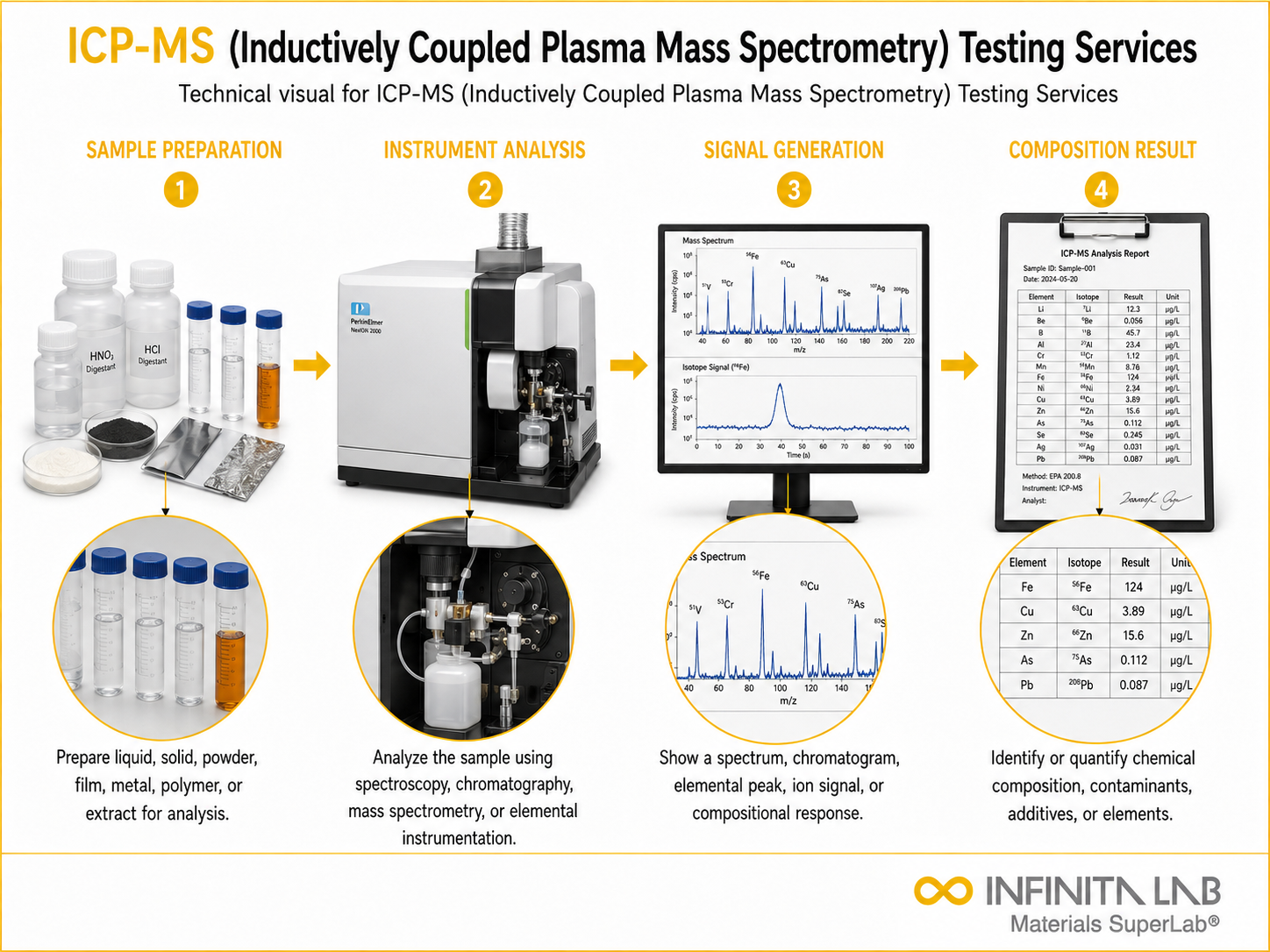
Sample Preparation
Samples acid digested, diluted, or dissolved into aqueous solution for analysis.
1Plasma Ionization
Liquid sample nebulized and introduced into high-temperature argon plasma for ionization.
2Mass Spectrometric Detection
Ionized elements separated by mass-to-charge ratio generating quantitative elemental signals.
3Data Analysis & Reporting
Multi-element data processed to generate elemental profiles and test compliance result.
4Technical Specifications
| Parameter | Details |
|---|---|
| Applicable Samples | Aqueous solutions, digested metals, semiconductors, pharmaceuticals, environmental samples |
| Analytical Technique | Inductively coupled argon plasma ionization with mass spectrometric detection |
| Detection Capability | Ultra-trace multi-element detection at parts-per-trillion levels |
| Measured Parameters | Elemental identity, mass-to-charge ratio, isotopic composition, concentration |
| Measured Outputs | Multi-element profiles, isotopic data, mass spectra, test compliance result |


Instrumentation Used for Testing
- Calibrated ICP-MS system with an inductively coupled argon plasma ionization source
- Quadrupole or high-resolution sector field mass spectrometer for elemental detection
- Multi-element reference standards for quantitative calibration and method validation
- Collision and reaction cell technology for polyatomic interference elimination
- Specialist multi-element data acquisition and quantification software
- Sample preparation equipment for acid digestion, dilution, and dissolution procedures
Results and Deliverables
- Multi-element concentration profiles across the periodic table for all analyzed samples
- Ultra-trace elemental impurity data at parts-per-trillion detection levels
- Isotopic ratio measurement data for selected elemental systems
- Test compliance result assessed against defined material purity and elemental specification criteria
- ICP-MS analytical report
Frequently Asked Questions
ICP-MS is an ultra-sensitive technique for elemental characterization that employs high-temperature argon plasma ionization and mass spectrometry for quantification of trace and ultra-trace levels of metals, metalloids, and certain nonmetals at parts-per-trillion concentrations in matrices.
ICP-MS can detect and quantify most elements in the periodic table, including heavy metals, toxic elements, rare-earth elements, and isotopic species, providing multi-element concentration data at the parts-per-trillion level in a single analytical run.
ICP-MS can be employed to investigate aqueous solutions, digested metals, alloys, semiconductors, pharmaceutical formulations, environmental water samples, and soil samples, as well as food products and high-purity chemical materials.
ICP-MS offers a significant improvement in detection limits, moving from parts-per-million to parts-per-trillion level, and also offers isotopic ratio capability and simultaneous coverage of the entire periodic table, making ICP-MS a preferred technique over ICP-OES.
ICP-MS is utilized in various industries, such as semiconductor, pharmaceutical, environmental, food and beverage, aerospace, nuclear, and materials, for trace element characterization, contamination investigations, high-purity material certification, and elemental impurity analysis programs.
Why Choose Infinita Lab for Advanced Materials Testing and Characterization?
At the core of this breadth is our network of 2,000+ accredited laboratories across the USA, offering access to over 10,000 testing methods and analytical services. From advanced materials characterization (SEM, TEM, RBS, XPS) to mechanical, chemical, environmental, biological, and standardized ASTM/ISO-compliant testing, we deliver unmatched flexibility, specialization, and scale. You are never limited by geography, facility, or methodology — Infinita Lab connects you to the right expertise and testing solution, every time.

Looking for a Trusted Partner for Accurate and Reliable Testing Services?
Send query us at hello@infinitlab.com or call us at (888) 878-3090 to learn more about our services and how we can support you.



Request a Quote
Submit your material details and receive testing procedures, pricing, and turnaround time within 24 hours.
 Quick Turnaround and Hasslefree process
 Confidentiality Guarantee
 Free, No-obligation Consultation
 100% Customer Satisfaction
