

What Is High Resolution Mass Spectrometry HRMS?
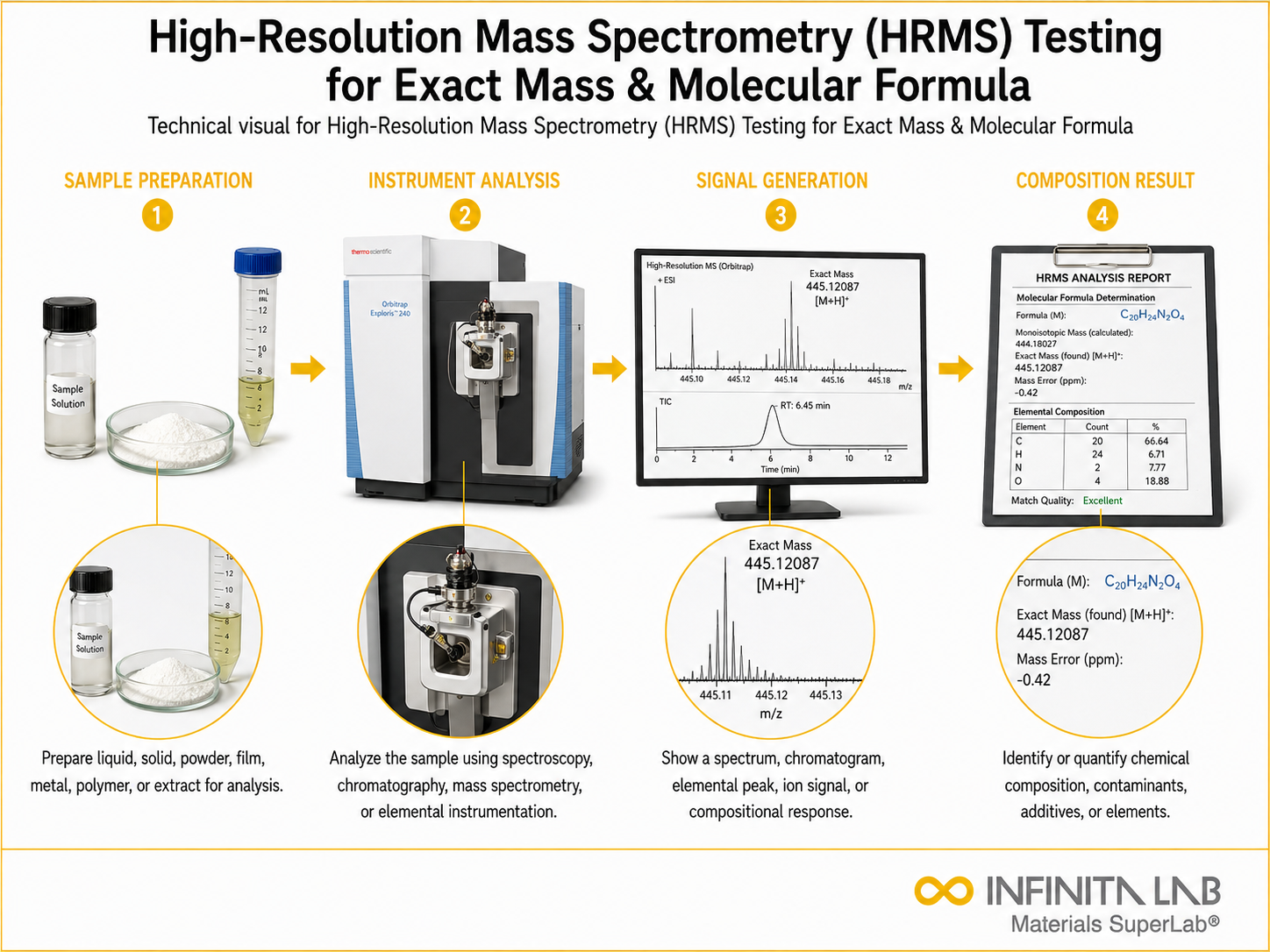
High-Resolution Mass Spectrometry (HRMS) is an advanced analytical technology that determines the exact mass of ions with high accuracy, enabling definitive determination of molecular formulas and identification of chemical compounds in a sample. HRMS differs from low-resolution technology in that it uses Orbitrap, Time-of-Flight (TOF), and Fourier Transform Ion Cyclotron Resonance (FT-ICR) technologies to achieve high accuracy at the sub-ppm level, which is essential for trace-level analysis, identification of unknown compounds, and structural determination.
HRMS technology plays a crucial role in the development of various industries, including pharmaceuticals, petrochemicals, polymers, food safety, environmental monitoring, and materials science, as it allows for advancements in formulation development, regulatory support, investigation of contaminants, and quality control, where low-resolution technology is limited in resolving co-eluting compounds and identifying unknown compounds.

Applications and Benefits of High Resolution Mass Spectrometry HRMS Testing
Scope
HRMS covers exact mass measurement and structural identification of organic and inorganic compounds across a wide range of industrial matrices, supporting both targeted quantification and untargeted screening workflows.
- Exact mass measurement with mass accuracy typically better than 5 ppm
- Molecular formula determination and isotope pattern confirmation
- Targeted and untargeted screening for known and unknown compounds
- Applicable to pharmaceuticals, petrochemicals, polymers, food, environment, and materials
- Supports structural elucidation via MS/MS fragmentation and database matching
- Covers trace-level detection down to ng/L or pg/g depending on matrix and technique
Applications
- Petrochemical and polymer additive identification
- Environmental contaminant screening in water, soil, and air
- Food adulteration detection and safety testing
- Metabolomics and proteomics in industrial biotechnology
- Forensic and failure analysis for unknown compound identification
Benefits
- Sub-ppm mass accuracy enables confident molecular formula assignment
- Single run covers both targeted and untargeted analysis
- Resolves co-eluting isobaric compounds that low-resolution instruments cannot distinguish
- Reduces reliance on reference standards for unknown identification
- Supports regulatory submissions with high-quality, defensible data
- Retrospective data analysis is possible without re-running samples
Our Testing Procedure
Sample Preparation
Samples extracted, digested, or diluted based on matrix type and target analytes.
1Chromatographic Separation
Compounds separated by LC or GC prior to MS introduction to reduce matrix interference.
2High-Resolution Analysis
Ionised compounds measured at high mass accuracy; MS/MS fragmentation acquired for structural confirmation.
3Data Processing & Identification
Exact masses matched against spectral databases; molecular formulas and structures confirmed.
4Test parameters and requirements
| Parameter | Details |
|---|---|
| Mass Accuracy | Typically <5 ppm RMS; high-end instruments achieve <1–2 ppm |
| Mass Resolution | 30,000 – 1,000,000+ FWHM depending on instrument and scan mode |
| Ionisation Modes | ESI, APCI, APPI, EI, MALDI — selected based on compound class and polarity |
| Separation Techniques | LC-HRMS, GC-HRMS, UHPLC-HRMS, direct infusion |
| Measured Parameter | Mass-to-charge ratio (m/z) |
| Detection Limit | Trace to ultra-trace levels |


High-Resolution Mass Spectrometer (Orbitrap, TOF, FT-ICR)
Ionization Source (ESI, MALDI, APCI)
Sample Introduction System
Vacuum System
Data Analysis Software
Equipment and Instrumentation Used for Testing
What You Receive: Test Report, Data, and Certification
High-resolution mass spectra
Exact mass and molecular formula identification
Impurity and contaminant analysis
Structural interpretation reports
Comprehensive analytical report
High Resolution Mass Spectrometry HRMS FAQs
HRMS is an advanced analytical technique in which molecules in a sample can be precisely identified and quantified by measuring mass accurately. It detects even the smallest mass variations between molecules, thereby enabling the analysis of complex materials in great detail.
HRMS is widely used in material science to analyze polymers, nanomaterials, alloys, and composite materials. It helps identify trace elements, contaminants, and molecular structures influencing material performance, durability, and safety.
HRMS provides insight into the material composition and purity, essential in developing higher-quality, more reliable materials. By identifying contaminants and unknown compounds, such materials ensure performance and safety standards, opening a pathway to innovation.
The HRMS can differentiate between isotopes based on their mass-to-charge ratio (m/z). It could be utilized to accurately determine the isotopic distributions and ratios that could help trace material origin or forensic analysis.
HRMS examines complex samples, such as alloys and composites, where sensitivity and resolution are high. Thus, the technique best detects trace constituents and impurities in complex mixtures.
High-resolution mass spectrometry (HRMS) testing identifies and characterizes compounds by measuring the mass-to-charge ratios of ions with high resolving power and mass accuracy. The sample is ionized, and the resulting ions are separated and detected by a high-resolution mass analyzer. The resulting spectra help determine molecular mass, support elemental composition assignments, and identify unknown compounds or impurities.
HR mass spectrometry converts sample molecules into charged ions using an appropriate ionization method, such as electrospray ionization (ESI). The ions enter a high-resolution mass analyzer, such as a time-of-flight (TOF) or Orbitrap analyzer, which distinguishes ions based on their mass-to-charge ratios. A detector records the signals, producing a spectrum for compound identification and chemical characterization.
HRMS in mass spectrometry provides detailed molecular information by distinguishing ions with very similar mass-to-charge ratios. After ionization, the instrument separates ions according to their mass-to-charge ratios and records their signals. Analysts interpret accurate-mass measurements, isotope patterns, and, when applicable, fragmentation data to support compound identification and elemental formula assignments.
Why Choose Infinita Lab for High Resolution Mass Spectrometry HRMS Testing
When your High Resolution Mass Spectrometry HRMS results have to hold up - for compliance, a customer audit, or an engineering decision - accuracy and an unbiased third-party report matter more than price. Infinita Lab routes your high resolution mass spectrometry HRMS testing to ISO/IEC 17025-accredited U.S. partner labs with hands-on method experience, so you get defensible data, transparent reporting, and turnaround times built around your project deadline - not ours.

Looking for an Accredited Partner for High Resolution Mass Spectrometry HRMS Testing?
Send query us at hello@infinitalab.com or call us at (888) 878-3090 to learn more about our services and how we can support you.





