


Hydrogen Forward Scattering Spectrometry HFS Testing Services
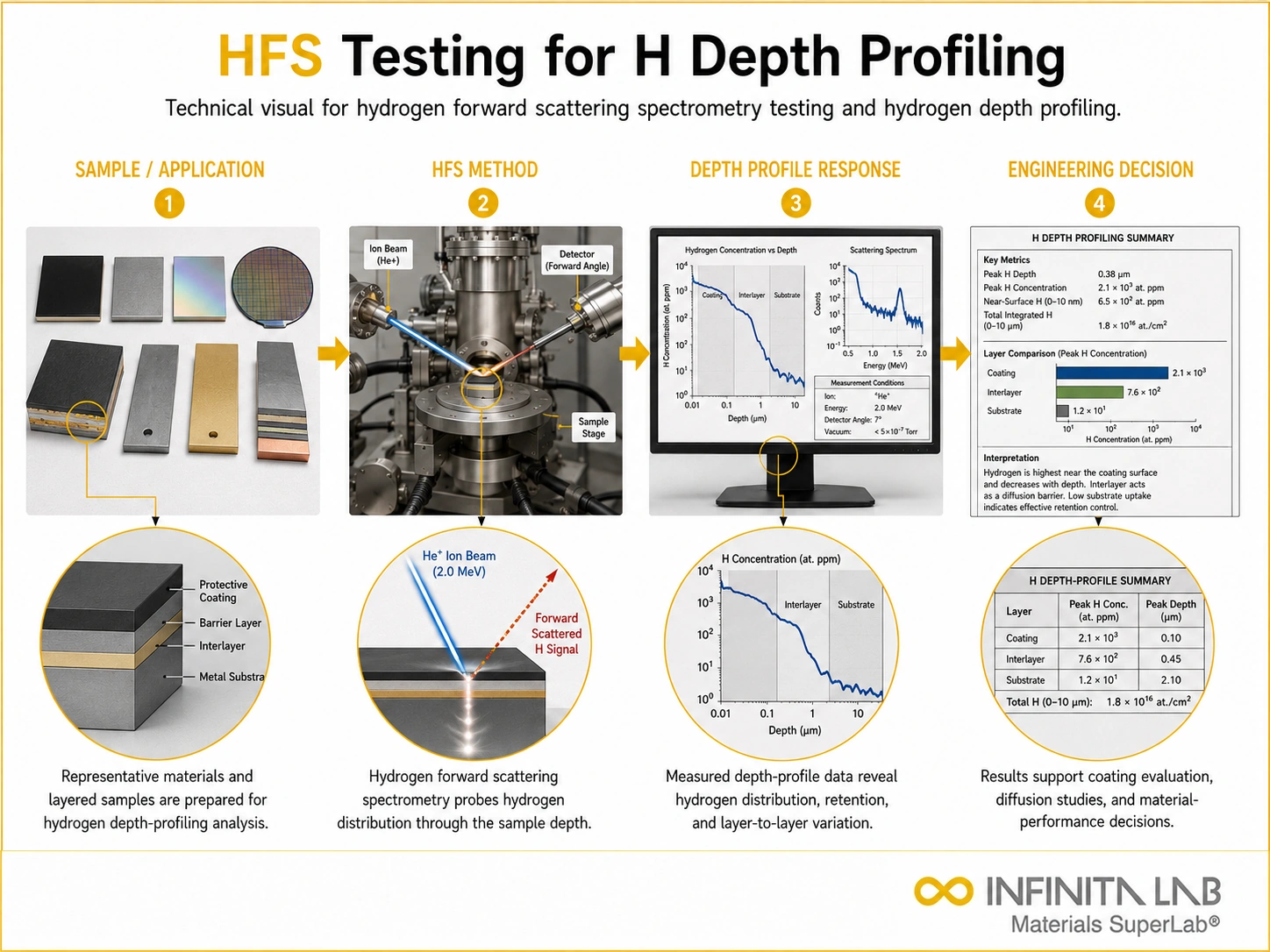
Hydrogen Forward Scattering Spectrometry (HFS) uses forward recoil detection of Hydrogen nuclei, due to impinging Helium ions, to quantify Hydrogen atoms in thin films and near surface layers of solids. The Infinita Lab network of testing labs, USA offers the HFS test to our clients in the USA and other places.
TRUSTED BY


Get compliant results — request your hydrogen forward scattering spectrometry HFS testing quote
- Overview
- Scope, Applications, and Benefits
- Test Process
- Specifications
- Instrumentation
- Results and Deliverables
What Is Hydrogen Forward Scattering Spectrometry HFS?
Hydrogen Forward Scattering Spectrometry (HFS) is an advanced, specialized ion-beam analysis technique used for quantitative depth profiling of hydrogen concentration in thin films, coatings, and surface layers of solid materials. With hydrogen content analysis and depth profiling, the HFS technique provides accurate, non-destructive measurement and analysis of hydrogen content in thin films and coatings, helping materials engineers, thin-film experts, and researchers achieve critical hydrogen-content quantification intelligence for material and thin-film characterization and analysis programs.

Applications and Benefits of Hydrogen Forward Scattering Spectrometry HFS Testing
Scope
A high-energy ion beam is focused on the surface of the sample material by HFS, and forward-scattered hydrogen recoil atoms are detected by a particle detector at a fixed forward scattering angle. Quantitative hydrogen concentration and depth-profile analysis of surface and surface-layer materials is thus made possible without sample damage or complex sample preparation.
HFS analysis evaluates:
- Quantitative hydrogen concentration measurement in thin films, coatings, and surface layers
- Hydrogen depth profile distribution across defined near-surface material regions
- Hydrogen incorporation in diamond-like carbon, nitride, oxide, and semiconductor thin film systems
- Surface and bulk hydrogen content in metals, ceramics, and advanced material systems
- Hydrogen concentration compliance against the defined material specification requirements
Applications
- Diamond-like carbon (DLC) and hard coating thin films require hydrogen content characterization
- Semiconductor and electronic device materials with hydrogen-sensitive performance properties
- Nitride, oxide, and carbide thin film coatings requiring hydrogen incorporation analysis
- Hydrogen storage and energy materials requiring quantitative bulk hydrogen measurement
- Advanced materials research programs requiring non-destructive hydrogen depth profiling
Benefits
- Provides quantitative hydrogen concentration and depth profile data unavailable through conventional analysis techniques
- Delivers non-destructive hydrogen measurement without requiring specimen sectioning or dissolution
- Supports thin film development, coating characterization, and material qualification programs
- Delivers traceable, laboratory-certified hydrogen quantification data
- Reduces material development risk by providing accurate hydrogen content data early in the characterization cycle
Our Testing Procedure
Sample Preparation
Specimens cleaned and mounted within ion beam analysis chamber under high vacuum.
1Ion Beam Irradiation
High-energy ion beam directed at specimen surface generating forward-scattered hydrogen recoil atoms.
2Hydrogen Recoil Detection
Forward-scattered hydrogen atoms energy-analyzed generating quantitative concentration and depth data.
3Data Analysis & Reporting
Recoil spectra processed using simulation software to generate hydrogen concentration profiles.
4Test parameters and requirements
| Parameter | Details |
|---|---|
| Applicable Materials | Thin films, coatings, semiconductors, DLC films, metals, and ceramics |
| Analytical Technique | High-energy ion beam forward scattering with hydrogen recoil particle detection |
| Detection Capability | Quantitative hydrogen concentration across surface to near-surface depth regions |
| Measured Parameters | Hydrogen concentration, depth distribution, and areal hydrogen density |
| Measured Outputs | Hydrogen depth profiles, areal density data, recoil spectra, test compliance result |


- High-energy ion beam accelerator system for HFS ion beam generation
- Forward scattering particle detector positioned at a defined recoil detection angle
- High vacuum specimen analysis chamber for ion beam irradiation
- Hydrogen reference standards for quantitative calibration and method validation
- Specialist HFS simulation and data analysis software for depth profile extraction
- Data reporting and hydrogen concentration profile visualization system
Equipment and Instrumentation Used for Testing
What You Receive: Test Report, Data, and Certification
- Hydrogen recoil energy spectra and raw detection data for all analyzed specimens
- Quantitative hydrogen concentration depth profiles across defined near-surface material regions
- Areal hydrogen density measurements and surface hydrogen content data
- Test compliance result assessed against the defined material hydrogen specification criteria
- HFS analytical report
Hydrogen Forward Scattering Spectrometry HFS FAQs
HFS is a specialized ion beam analysis technique for quantitative measurement of hydrogen concentration and depth distribution in thin films, coatings, and surface layers, using forward-scattered hydrogen recoil atoms produced by high-energy irradiation of the specimen surface.
These include thin films, hard coatings, DLC films, semiconductor materials, nitride and oxide coatings, metals, and ceramics, and it offers quantitative hydrogen content and depth-profile information across a broad range of solid material systems where hydrogen content is significant.
This is because HFS offers non-destructive quantitative depth profiling of hydrogen without specimen dissolution and sectioning, which provides concentration-depth data within near-surface material layers and has unique advantages over combustion analysis, SIMS, and conventional methods of bulk hydrogen determination.
This is because HFS offers non-destructive quantitative depth profiling of hydrogen without specimen dissolution or sectioning, providing concentration-depth data within near-surface material layers and offering unique advantages over combustion analysis, SIMS, and conventional methods of bulk hydrogen determination.
This is because HFS offers non-destructive quantitative depth profiling of hydrogen without specimen dissolution or sectioning, providing concentration-depth data within near-surface material layers and offering unique advantages over combustion analysis, SIMS, and conventional methods of bulk hydrogen determination.
Why Choose Infinita Lab for Hydrogen Forward Scattering Spectrometry HFS Testing?
At the core of this breadth is our network of 2,000+ accredited laboratories across the USA, offering access to over 10,000 testing methods and analytical services. From advanced materials characterization (SEM, TEM, RBS, XPS) to mechanical, chemical, environmental, biological, and standardized ASTM/ISO-compliant testing, we deliver unmatched flexibility, specialization, and scale. You are never limited by geography, facility, or methodology — Infinita Lab connects you to the right expertise and testing solution, every time.

Looking for an Accredited Partner for Hydrogen Forward Scattering Spectrometry HFS Testing?
Send query us at hello@infinitalab.com or call us at (888) 878-3090 to learn more about our services and how we can support you.



Request a Quote
Submit your material details and receive testing procedures, pricing, and turnaround time within 24 hours.
 Quick Turnaround and Hasslefree process
 Confidentiality Guarantee
 Free, No-obligation Consultation
 100% Customer Satisfaction
