


Heavy Metals Analysis Testing for Materials, Products & Environmental Samples
Know how heavy metals are used in cosmetics and the methods involved in the preparation and validation of the products
TRUSTED BY


Precision-driven testing for dimensional accuracy and compliance
- Overview
- Scope, Applications, and Benefits
- Test Process
- Specifications
- Instrumentation
- Results and Deliverables
Overview
Analysis of heavy metals is used to detect and quantify trace levels of toxic metals present in materials, products, and environmental samples. The test identifies elements such as lead, cadmium, mercury, arsenic, and others that may pose health and environmental risks.
This analysis is widely used in industries such as environmental monitoring, food safety, pharmaceuticals, and consumer products. It helps ensure regulatory compliance, product safety, and contamination control by accurately measuring metal concentrations.

Scope, Applications, and Benefits
Scope
Heavy metal analysis evaluates the presence and concentration of toxic and trace metals in various matrices using advanced analytical techniques. The test supports safety assessment and regulatory compliance.
The test evaluates:
- Presence of heavy metals such as Pb, Cd, Hg, and As
- Trace metal concentration levels in samples
- Contamination in raw materials and finished products
- Compliance with regulatory limits
- Environmental and health risk factors
Applications
- Food and beverage testing
- Pharmaceutical and cosmetic products
- Environmental water and soil analysis
- Packaging and consumer goods
- Industrial materials and chemicals
- Regulatory compliance testing
Benefits
- Provides accurate detection of toxic metal contaminants
- Ensures compliance with safety regulations
- Supports product quality and safety assessment
- Helps identify sources of contamination
- Enables comparison of material purity
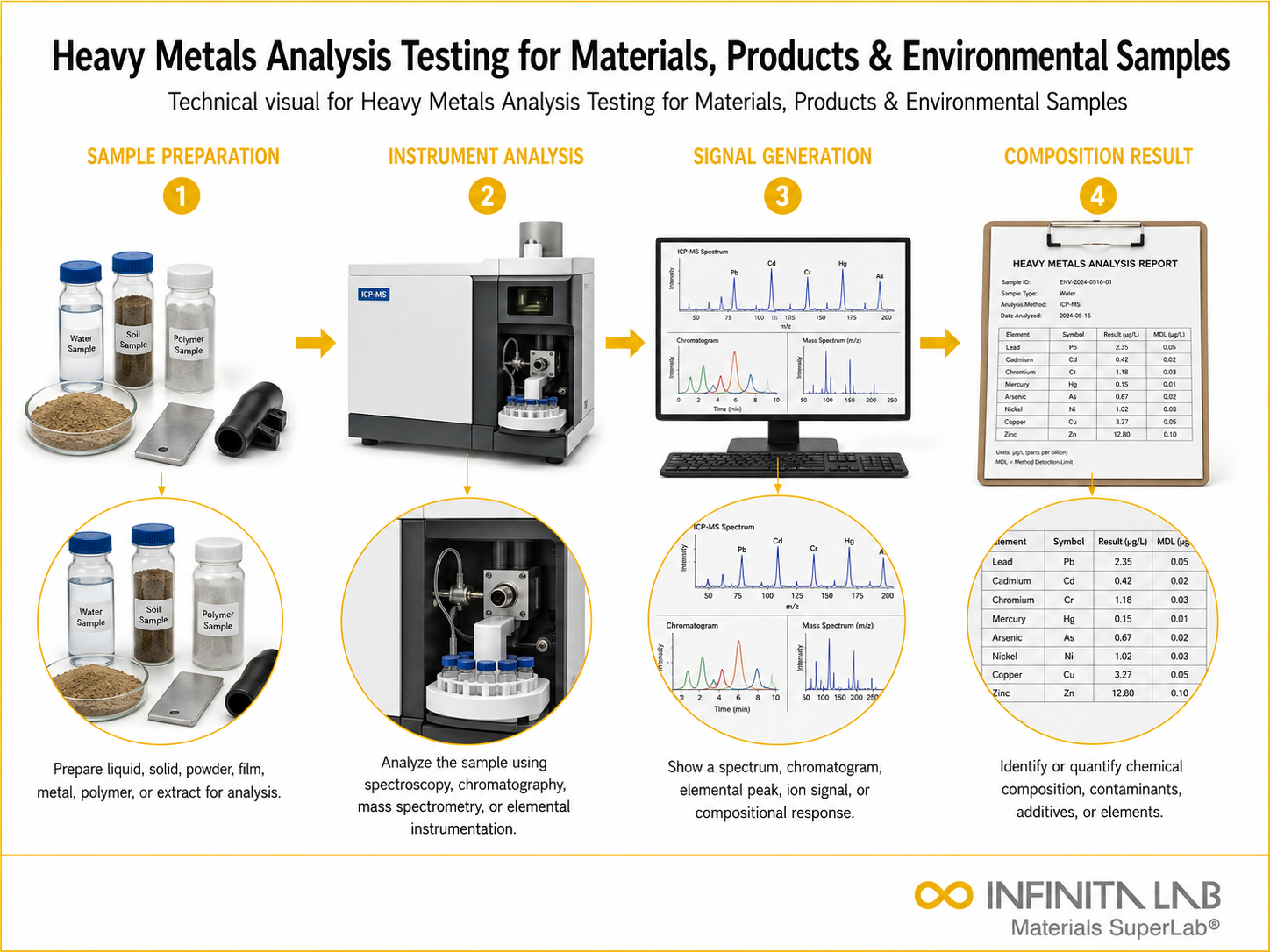
Test Process
Sample Preparation
Samples are digested using acid digestion or appropriate preparation techniques.
1Elemental Analysis
Prepared samples are analyzed using spectroscopic methods to detect metal content.
2Quantification
Concentration of each metal is measured and calculated.
3Data Recording & Evaluation
Results are compared with regulatory limits and evaluated for compliance.
4Technical Specifications
| Parameter | Details |
|---|---|
| Applicable Materials | Food, water, soil, polymers, pharmaceuticals |
| Detection Method | ICP-MS, ICP-OES, AAS |
| Detection Limit | ~0.001 ppm to 1 ppm |
| Target Elements | Pb, Cd, Hg, As, Cr, Ni |
| Sample Preparation | Metal concentration (ppm or mg/kg) |


Instrumentation Used for Testing
- ICP-MS (Inductively Coupled Plasma Mass Spectrometer)
- ICP-OES (Optical Emission Spectrometer)
- Atomic Absorption Spectrometer (AAS)
- Microwave digestion system
- Analytical balance
- Data acquisition and analysis software
Results and Deliverables
- Heavy metal concentration data
- Compliance assessment with regulatory limits
- Contamination source evaluation
- Comparative material analysis
- Test condition summary
- ASTM compliance report
Frequently Asked Questions
Heavy metal analysis includes detection limits, sample preparation, digestion method, instrument calibration, and concentration measurement, determining levels of metals such as lead, cadmium, mercury, and arsenic in various materials and environmental samples.
Heavy metal analysis ensures compliance with environmental and safety regulations, protecting human health by identifying toxic metal contamination in water, soil, food, and industrial products.
Heavy metal analysis uses techniques such as atomic absorption spectroscopy, inductively coupled plasma optical emission spectroscopy, mass spectrometry, and X-ray fluorescence to quantify metal concentrations.
Heavy metal analysis is commonly applied to water, soil, food, pharmaceuticals, cosmetics, and industrial materials where contamination must be monitored and controlled.
Heavy metal analysis may be affected by matrix interference, sample preparation errors, and instrument sensitivity, requiring proper calibration and quality control procedures to ensure accurate and reliable results.
Why Choose Infinita Lab for Advanced Materials Testing and Characterization?
At the core of this breadth is our network of 2,000+ accredited laboratories across the USA, offering access to over 10,000 testing methods and analytical services. From advanced materials characterization (SEM, TEM, RBS, XPS) to mechanical, chemical, environmental, biological, and standardized ASTM/ISO-compliant testing, we deliver unmatched flexibility, specialization, and scale. You are never limited by geography, facility, or methodology — Infinita Lab connects you to the right expertise and testing solution, every time.

Looking for a Trusted Partner for Accurate and Reliable Testing Services?
Send query us at hello@infinitlab.com or call us at (888) 878-3090 to learn more about our services and how we can support you.



Request a Quote
Submit your material details and receive testing procedures, pricing, and turnaround time within 24 hours.
 Quick Turnaround and Hasslefree process
 Confidentiality Guarantee
 Free, No-obligation Consultation
 100% Customer Satisfaction
