


ASTM D7536: Dispersive Xrf Spectrometry Testing Services
Accredited ASTM D7536 dispersive xrf spectrometry testing from Infinita Lab, performed to the exact standard requirements - accurate, reproducible results with full documentation for compliance, R&D, and quality control programs.
TRUSTED BY


Get ASTM D7536 compliant results - request your dispersive XRF spectrometry testing quote
- Overview
- Scope, Applications, and Benefits
- Test Process
- Specifications
- Instrumentation
- Results and Deliverables
What Is ASTM D7536 Dispersive Xrf Spectrometry?
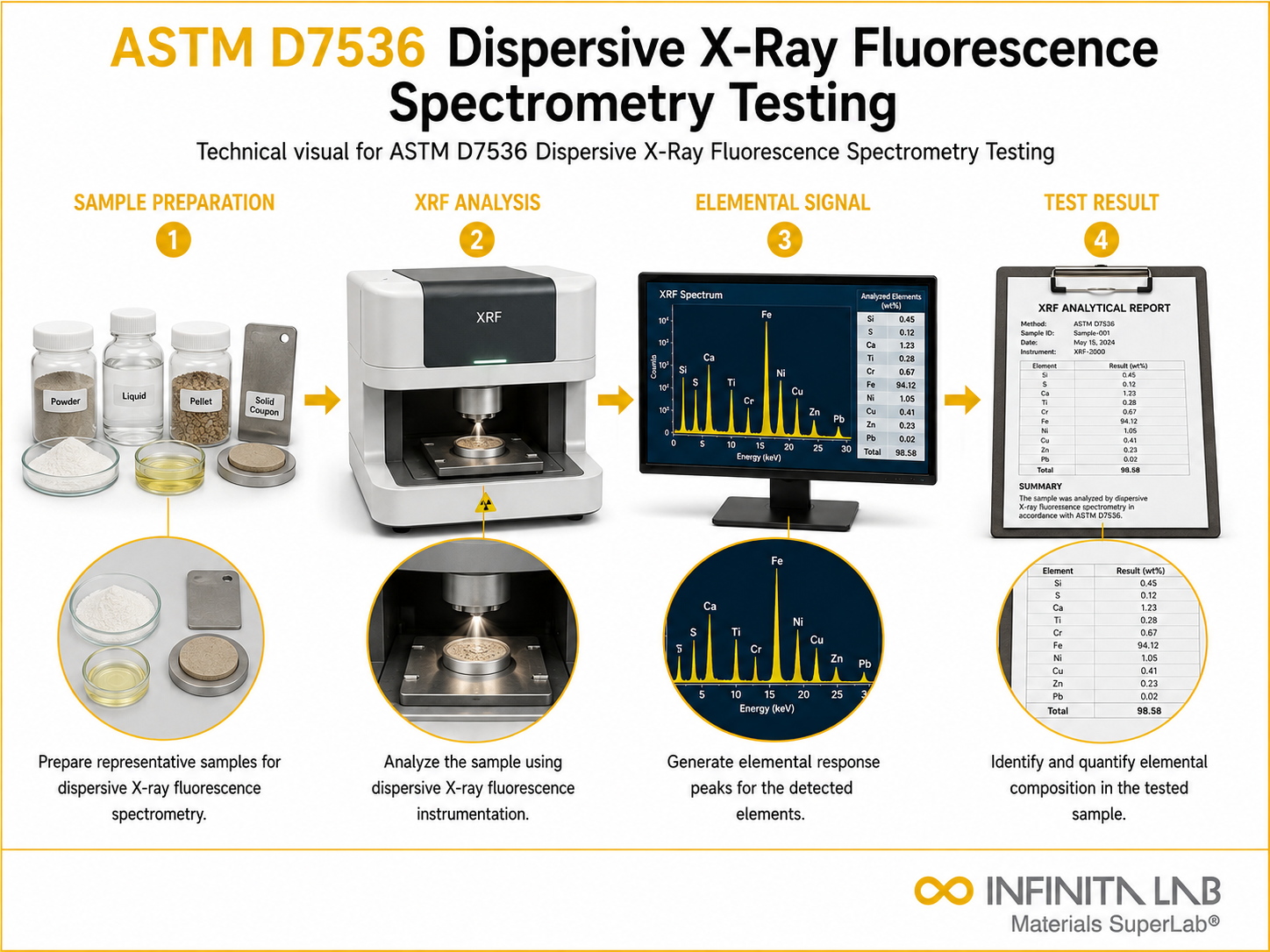
ASTM D7536, Standard Test Method for Chlorine in Aromatics by Monochromatic Wavelength Dispersive X-ray Fluorescence Spectrometry, is the recognised method for determining trace chlorine content in aromatic hydrocarbons, their derivatives, and related chemical streams. The method relies on monochromatic wavelength dispersive X-ray fluorescence (MWDXRF), a refinement of conventional XRF in which doubly curved crystal optics focus a narrow, monochromatic X-ray beam onto the sample and then selectively collect the characteristic chlorine fluorescence line. This monochromatic excitation improves the signal-to-background ratio, reduces detector noise, and simplifies matrix-effect correction, allowing the technique to resolve chlorine concentrations far below what routine energy-dispersive XRF screening can reliably detect. A liquid sample is placed in a sealed cell and irradiated directly, requiring little to no chemical pretreatment, which keeps turnaround fast and analyst handling minimal. Because organic and inorganic chlorides are potent catalyst poisons in downstream reforming, alkylation, and polymerisation steps, and because chlorine species contribute to corrosion in process equipment and pipelines, tracking chlorine at low parts-per-million levels is a routine requirement across petrochemical manufacturing, refining, and speciality chemical production. Producers and blenders of benzene, toluene, xylenes, styrene, and related aromatic feedstocks use ASTM D7536 data to qualify incoming raw materials, monitor process streams, verify product specifications before shipment, and support regulatory reporting obligations tied to chlorine content limits. Infinita Lab connects manufacturers, refiners, and chemical distributors with accredited partner laboratories equipped to run ASTM D7536 testing to strict quality and reporting standards, giving clients defensible, standards-compliant chlorine data without having to manage instrument access, calibration, or lab qualification in-house.

Applications and Benefits of ASTM D7536 Dispersive Xrf Spectrometry Testing
Scope
- This test method determines chlorine content in aromatic hydrocarbons, their derivatives, and related chemical substances.
- The technique uses monochromatic wavelength-dispersive X-ray fluorescence (MWDXRF) spectrometry as the analytical principle.
- The method applies to chlorine concentrations up to approximately 10 mg/kg, with higher levels accessible through sample dilution.
- Reported detection performance includes a limit of detection near 0.2 mg/kg and a limit of quantitation near 0.7 mg/kg.
- Samples are typically analysed as received in a sealed liquid cell, requiring minimal sample preparation.
- A single analysis is generally completed within five to ten minutes once the instrument is calibrated.
- The method covers both organically bound and inorganic chlorine species present in the sample matrix.
- Results are used to support process control, product qualification, and regulatory compliance decisions.
- The method falls under the jurisdiction of ASTM Subcommittee D16.04 on Instrumental Analysis.
- The procedure is intended for laboratory use with appropriately calibrated and maintained MWDXRF instrumentation.
Applications
- Aromatics and petrochemical producers use this testing to verify chlorine levels in benzene, toluene, xylenes, and styrene feedstocks before they enter downstream processing.
- Refiners rely on chlorine data to protect reforming, alkylation, and polymerisation catalysts from deactivation caused by chloride contamination.
- Chemical manufacturers apply the method to monitor process streams for chlorine that could accelerate corrosion in reactors, piping, and heat exchangers.
- Product blenders use chlorine results to confirm that finished aromatic products meet internal and customer purity specifications.
- Quality assurance teams use the test to support certificate-of-analysis reporting for aromatic hydrocarbon shipments.
- Environmental, health, and safety departments reference chlorine data when meeting applicable regulatory reporting requirements for chlorine-bearing petroleum products.
- Research and process development groups use the method to evaluate chlorine removal or scavenging steps within a production process.
Benefits
- The method delivers trace-level chlorine detection well below what conventional energy-dispersive XRF screening can reliably resolve.
- Minimal sample preparation reduces analyst handling time and the risk of contamination during preparation.
- Fast analysis turnaround, typically five to ten minutes per sample, supports high sample throughput in production environments.
- Monochromatic excitation improves signal-to-background performance, giving more consistent and reproducible results across sample batches.
- The non-destructive nature of XRF analysis allows retained samples to be reserved for additional testing if needed.
- Standardised, ASTM-defined procedures give results that are broadly recognized and defensible across the petrochemical and chemical industries.
Our ASTM D7536 Testing Procedure
Sample Preparation & Excitation
The sample is placed in the XRF cell and excited using a monochromatic X-ray beam.
1Fluorescence Detection
Emitted chlorine Kα radiation is collected by the analyzer.
2Signal Measurement & Calibration
X-ray intensity is measured and converted to concentration using a calibration curve.
3Data Processing
Chlorine concentration is calculated in mg/kg.
4ASTM D7536 Test Parameters and Requirements
| Parameter | Details |
|---|---|
| Applicable Materials | Aromatic hydrocarbons (benzene, toluene, xylene) |
| Concentration Range | Up to 10 mg/kg |
| Detection Limit | 0.2 mg/kg |
| Quantitation Limit | 0.7 mg/kg |
| Analysis Time | 5–10 minutes |


- Monochromatic Wavelength Dispersive XRF Spectrometer – Serves as the core analytical instrument, using doubly curved crystal optics to focus a monochromatic X-ray beam onto the sample.
- Low-Power X-ray Tube – Generates the primary X-ray excitation source used to induce chlorine fluorescence in the sample.
- Doubly Curved Crystal Optics – Focus and select narrow X-ray wavelength bands on both the excitation and collection sides of the instrument to improve sensitivity and reduce background noise.
- Sealed Liquid Sample Cells – Hold the aromatic hydrocarbon sample securely during irradiation while allowing X-rays to pass through a thin film window.
- X-ray Detector – Measures the intensity of the characteristic chlorine fluorescence signal returned from the sample.
- Certified Chlorine Calibration Standards – Used to establish and verify the calibration curve that converts fluorescence signal into chlorine concentration.
- Laboratory Information Management System (LIMS) – Tracks sample chain of custody, instrument calibration records, and result reporting throughout the testing workflow.
Equipment and Instrumentation Used for ASTM D7536 Testing
What You Receive: Test Report, Data, and Certification
- A certificate of analysis reporting the measured chlorine concentration in the submitted aromatic hydrocarbon sample.
- Clear identification of whether results fall above or below the method’s limit of detection and limit of quantitation.
- Documentation referencing the ASTM D7536 method and any applicable quality control checks performed during analysis.
- Supporting data suitable for internal process control records, vendor qualification files, or customer specification compliance.
- Guidance on next steps when chlorine results approach specification limits, such as retesting or additional diagnostic analysis.
- Digital and/or hard-copy report delivery formatted for direct use in quality, regulatory, or engineering documentation.
ASTM D7536 Dispersive Xrf Spectrometry FAQs
Dispersive XRF measures the fluorescence emitted by a material when it is excited by X-rays. The emitted X-rays are detected and analyzed to determine the elemental composition.
When an atom absorbs energy, its outer electrons move to fill inner electron shells. As the atom returns to its normal state, it emits X-ray fluorescence radiation. This process happens without touching or damaging the sample. The emitted radiation is unique to each element, much like a fingerprint, which helps identify the elements in the sample.
It helps to determine the chemical composition of various materials, including solids, liquids, slurries, and loose powders.
It cannot measure the beryllium content and is expensive and complex.
Why Choose Infinita Lab for Dispersive Xrf Spectrometry Testing
When your Dispersive Xrf Spectrometry results have to hold up - for compliance, a customer audit, or an engineering decision - ASTM D7536 accuracy and an unbiased third-party report matter more than price. Infinita Lab routes your ASTM D7536 dispersive xrf spectrometry testing to ISO/IEC 17025-accredited U.S. partner labs with hands-on method experience, so you get defensible data, transparent reporting, and turnaround times built around your project deadline - not ours.

Need ASTM D7536 Dispersive Xrf Spectrometry Testing You Can Rely On?
Send query us at hello@infinitalab.com or call us at (888) 878-3090 to learn more about our services and how we can support you.



Request a Quote
Submit your material details and receive testing procedures, pricing, and turnaround time within 24 hours.
 Quick Turnaround and Hasslefree process
 Confidentiality Guarantee
 Free, No-obligation Consultation
 100% Customer Satisfaction
