


Positive Material Identification PMI Testing Services
Explore PMI, an NDT technique used in industrial settings to determine the chemical composition of materials.
TRUSTED BY


Get compliant results — request your positive material identification PMI testing quote
- Overview
- Scope, Applications, and Benefits
- Test Process
- Specifications
- Instrumentation
- Results and Deliverables
What Is Positive Material Identification PMI?
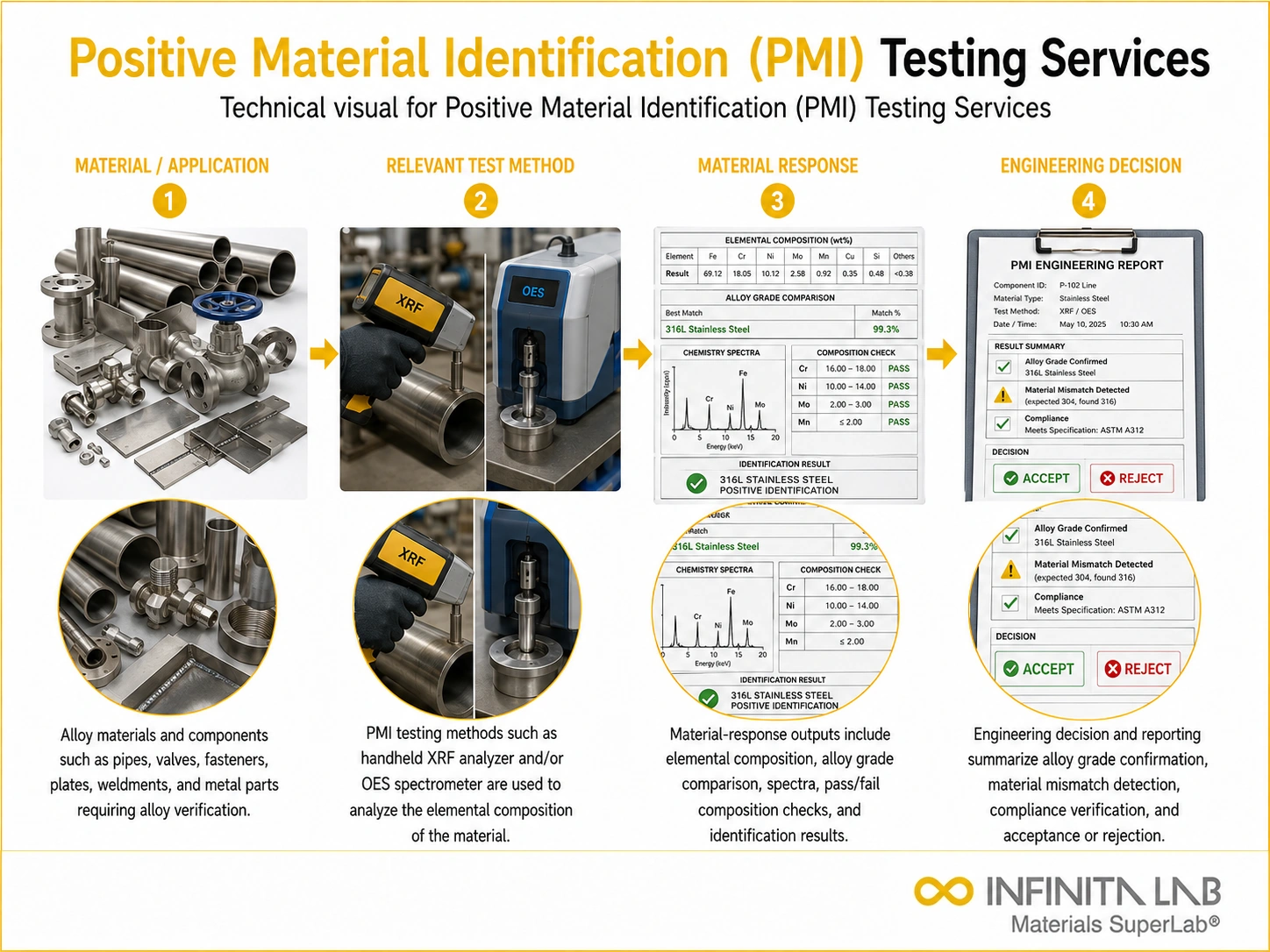
Positive Material Identification (PMI) Testing is a non-destructive analytical technique used to verify the elemental composition of metallic materials. It ensures that the correct alloy grade is used in manufacturing and installation, preventing material mix-ups that can lead to severe operational failures.
The testing is commonly performed using spectroscopic methods to rapidly identify key alloying elements. It provides immediate verification of material grade, supporting quality assurance, safety compliance, and traceability in critical industries such as oil and gas, power generation, and chemical processing.

Applications and Benefits of Positive Material Identification PMI Testing
Scope
PMI Testing focuses on verifying and confirming the chemical composition of metallic materials to ensure compliance with specified alloy grades and standards.
It includes elemental analysis, alloy verification, and material traceability to prevent incorrect material usage in critical applications.
- Verification of alloy composition and grade
- Detection of material mix-ups and substitutions
- Elemental analysis of metallic components
- Assessment of stainless steel, carbon steel, and alloys
- On-site and laboratory-based testing
- Quality assurance in fabrication and maintenance
- Material traceability verification
- Compliance with engineering specifications
Applications
- Oil and gas pipelines
- Petrochemical and refinery systems
- Power plants and boilers
- Pressure vessels and heat exchangers
- Aerospace and defense components
- Manufacturing quality control
Benefits
- Prevents material misidentification failures
- Ensures compliance with design specifications
- Enhances safety in critical systems
- Provides rapid and non-destructive results
- Improves quality assurance processes
- Reduces operational risk and downtime
Our Testing Procedure
Surface Preparation & Cleaning
Material surfaces are cleaned to remove contamination and ensure accurate elemental detection.
1Instrument Calibration & Setup
PMI devices are calibrated and configured for accurate spectral or elemental analysis.
2Elemental Analysis & Verification
The material is scanned to identify and quantify alloying elements for grade confirmation.
3Result Interpretation & Reporting
Results are compared with standards and documented for compliance verification.
4Test parameters and requirements
| Parameter | Details |
|---|---|
| Test Method | X-ray fluorescence (XRF) or optical emission spectroscopy (OES) |
| Measurement Type | Elemental composition analysis |
| Sample Type | Metals and alloys |
| Loading Type | Non-destructive surface excitation |
| Units | wt% (weight percentage of elements) |
| Test Conditions | Ambient or field inspection environments |


- Portable XRF analyzer
- Optical emission spectrometer (OES)
- Calibration standards
- Surface cleaning tools
- Data acquisition system
- Portable handheld analyzers
Equipment and Instrumentation Used for Testing
What You Receive: Test Report, Data, and Certification
- Elemental composition report
- Alloy grade verification
- Material conformity assessment
- Traceability documentation
- Non-compliance identification report
- Inspection and certification report
Positive Material Identification PMI FAQs
PMI Testing is used to verify the elemental composition of metallic materials to ensure correct alloy grade usage, preventing material mix-ups that could lead to equipment failure, safety risks, or non-compliance with engineering specifications.
By confirming the correct alloy composition before installation or use, PMI Testing eliminates risks associated with incorrect material substitution, which can cause corrosion, cracking, or catastrophic mechanical failure in service conditions.
The measured elemental composition is compared against standard alloy specifications, ensuring that the tested material matches the required grade and meets engineering design and safety requirements.
Surface preparation removes oxidation, coatings, or contaminants that may interfere with spectral readings, ensuring accurate detection of underlying elemental composition.
XRF is portable and suitable for quick field analysis, while OES provides more precise elemental quantification but typically requires a more controlled testing setup.
Why Choose Infinita Lab for Positive Material Identification PMI Testing
At the core of this breadth is our network of 2,000+ accredited laboratories across the USA, offering access to over 10,000 testing methods and analytical services. From advanced materials characterization (SEM, TEM, RBS, XPS) to mechanical, chemical, environmental, biological, and standardized ASTM/ISO-compliant testing, we deliver unmatched flexibility, specialization, and scale. You are never limited by geography, facility, or methodology — Infinita Lab connects you to the right expertise and testing solution, every time.

Looking for an Accredited Partner for Positive Material Identification PMI Testing?
Send query us at hello@infinitalab.com or call us at (888) 878-3090 to learn more about our services and how we can support you.



Request a Quote
Submit your material details and receive testing procedures, pricing, and turnaround time within 24 hours.
 Quick Turnaround and Hasslefree process
 Confidentiality Guarantee
 Free, No-obligation Consultation
 100% Customer Satisfaction
