


ASTM E539: Ferrosilicon Chemical Analysis Testing Services
ASTM E539 – 11 covers the X-ray fluorescence examination of titanium alloys with specific ranges of various elements. The values are considered as a standard when expressed in SI units.
TRUSTED BY


Get ASTM E539 compliant results — request your ferrosilicon chemical analysis testing quote
- Overview
- Scope, Applications, and Benefits
- Test Process
- Specifications
- Instrumentation
- Results and Deliverables
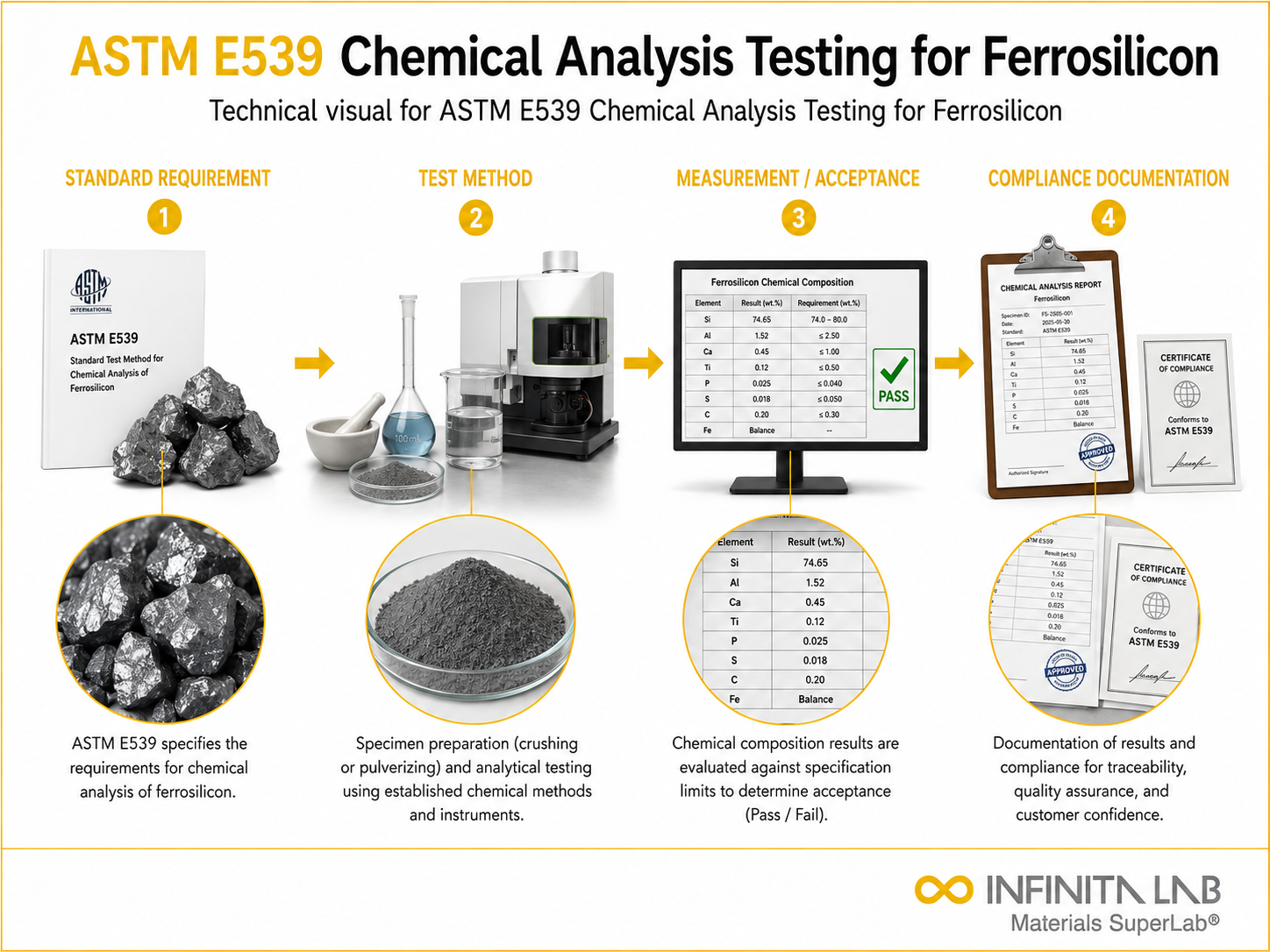
What Is ASTM E539 Ferrosilicon Chemical Analysis?
ASTM E539 – 11 specifies the use of X-ray fluorescence (XRF) spectrometry for the chemical analysis of titanium alloys. The method enables rapid and non-destructive determination of major and minor alloying elements based on characteristic X-ray emissions from the sample.
This standard is essential for accurate composition verification of titanium alloys used in critical applications. It supports quality control, alloy identification, and process monitoring by providing reliable multi-element analysis with minimal sample preparation and high repeatability.

Applications and Benefits of ASTM E539 Ferrosilicon Chemical Analysis Testing
Scope
ASTM E539 outlines procedures for determining elemental composition of titanium alloys using XRF spectrometry. It ensures accurate and reproducible multi-element analysis under controlled conditions.
- Applicable to titanium and titanium-based alloys
- Covers major, minor, and trace element analysis
- Based on X-ray fluorescence spectrometric principles
- Enables rapid and non-destructive testing
Applications
- Titanium alloy grade verification
- Quality control in manufacturing
- Raw material inspection
- Aerospace and high-performance material analysis
- Process monitoring and optimization
Benefits
- Non-destructive elemental analysis
- Rapid multi-element detection
- Minimal sample preparation required
- High repeatability and consistency
- Suitable for routine and production testing
Our ASTM E539 Testing Procedure
Sample Preparation
Prepare a clean, flat, and representative sample surface to ensure consistent XRF measurement.
1Instrument Calibration
Calibrate XRF system using certified reference standards matching titanium alloy matrices.
2XRF Measurement
Expose sample to X-rays and record emitted characteristic radiation from elements present.
3Composition Determination
Quantify elemental concentrations using calibration curves and spectral analysis.
4ASTM E539 Test Parameters and Requirements
| Parameter | Details |
|---|---|
| Standard | ASTM E539 – 11 |
| Method | X-ray fluorescence spectrometry (XRF) |
| Analytes | Titanium and alloying elements (Al, V, Mo, Fe, etc.) |
| Sample Type | Solid titanium alloy samples |
| Detection Range | Major to trace element levels |
| Units | Percentage (%) and ppm |


- X-ray fluorescence spectrometer (XRF)
- Sample preparation tools (grinder/polisher)
- Calibration standards
- Data acquisition and analysis software
- Radiation shielding and safety systems
Equipment and Instrumentation Used for ASTM E539 Testing
What You Receive: Test Report, Data, and Certification
- Elemental composition (% or ppm)
- Alloy grade identification
- Calibration and spectral data
- Test conditions and parameters
- Final analytical report
ASTM E539 Ferrosilicon Chemical Analysis FAQs
XRF excites atoms in the sample using X-rays, causing emission of characteristic secondary radiation. Since no material removal is required, the technique preserves sample integrity while providing accurate elemental composition.
Titanium matrix significantly affects X-ray absorption and emission. Matrix-matched standards ensure calibration accurately reflects sample behavior, minimizing systematic errors in elemental quantification.
Light elements such as oxygen or carbon produce low-energy X-rays that are easily absorbed, making them difficult to detect accurately with conventional XRF systems.
Surface roughness, oxidation, or contamination can distort X-ray signals. Proper polishing and cleaning ensure consistent and representative measurements.
ICP offers higher sensitivity and lower detection limits, while XRF is faster, non-destructive, and more suitable for routine analysis.
Why Choose Infinita Lab for Ferrosilicon Chemical Analysis Testing
At the core of this breadth is our network of 2,000+ accredited laboratories across the USA, offering access to over 10,000 testing methods and analytical services. From advanced materials characterization (SEM, TEM, RBS, XPS) to mechanical, chemical, environmental, biological, and standardized ASTM/ISO-compliant testing, we deliver unmatched flexibility, specialization, and scale. You are never limited by geography, facility, or methodology — Infinita Lab connects you to the right expertise and testing solution, every time.

Need ASTM E539 Ferrosilicon Chemical Analysis Testing You Can Rely On?
Send query us at hello@infinitalab.com or call us at (888) 878-3090 to learn more about our services and how we can support you.



Request a Quote
Submit your material details and receive testing procedures, pricing, and turnaround time within 24 hours.
 Quick Turnaround and Hasslefree process
 Confidentiality Guarantee
 Free, No-obligation Consultation
 100% Customer Satisfaction
