


ASTM D6653 High-Altitude Effects Testing for Packaging Systems
ASTM D6653/D6653M evaluates the effects of pressure differential when forms deliver pre-packed products of transportation such as feeder craft or ground across high mountain passes. These test results will be used for qualitative purposes.
TRUSTED BY


Precision-driven testing for dimensional accuracy and compliance
- Overview
- Scope, Applications, and Benefits
- Test Process
- Specifications
- Instrumentation
- Results and Deliverables
Overview
ASTM D6653/D6653M is a standard test method for determining the effects of reduced atmospheric pressure (high altitude or low-pressure conditions) on packaging systems. It simulates the conditions packages experience during air transport or storage at high elevations, where reduced atmospheric pressure can cause package deformation, seal failure, or product leakage.
This method is critical for validating packaging designs intended for air freight shipment and for distribution systems that traverse high-altitude regions. ASTM D6653 is widely referenced in packaging qualification programs for pharmaceuticals, food, beverages, consumer goods, and industrial products.

Scope, Applications, and Benefits
Scope
ASTM D6653/D6653M evaluates:
- Package integrity under simulated low-pressure conditions
- Seal strength retention after pressure differential exposure
- Deformation, leakage, or failure modes in flexible and rigid packaging
- Performance at equivalent altitudes up to ~15,000 feet (4,572 m)
Applications
- Air cargo and air courier packaging qualification
- Pharmaceutical and medical device packaging validation
- Food and beverage packaging for air transport
- E-commerce and distribution packaging testing
- High-altitude distribution and retail packaging
Benefits
- Validates packaging before costly air shipment failures
- Identifies weak seals and closures susceptible to pressure changes
- Supports ISTA, ASTM, and IESNA packaging qualification protocols
- Reduces product loss, returns, and liability from shipping damage
- Enables informed packaging design for global air distribution
Test Process
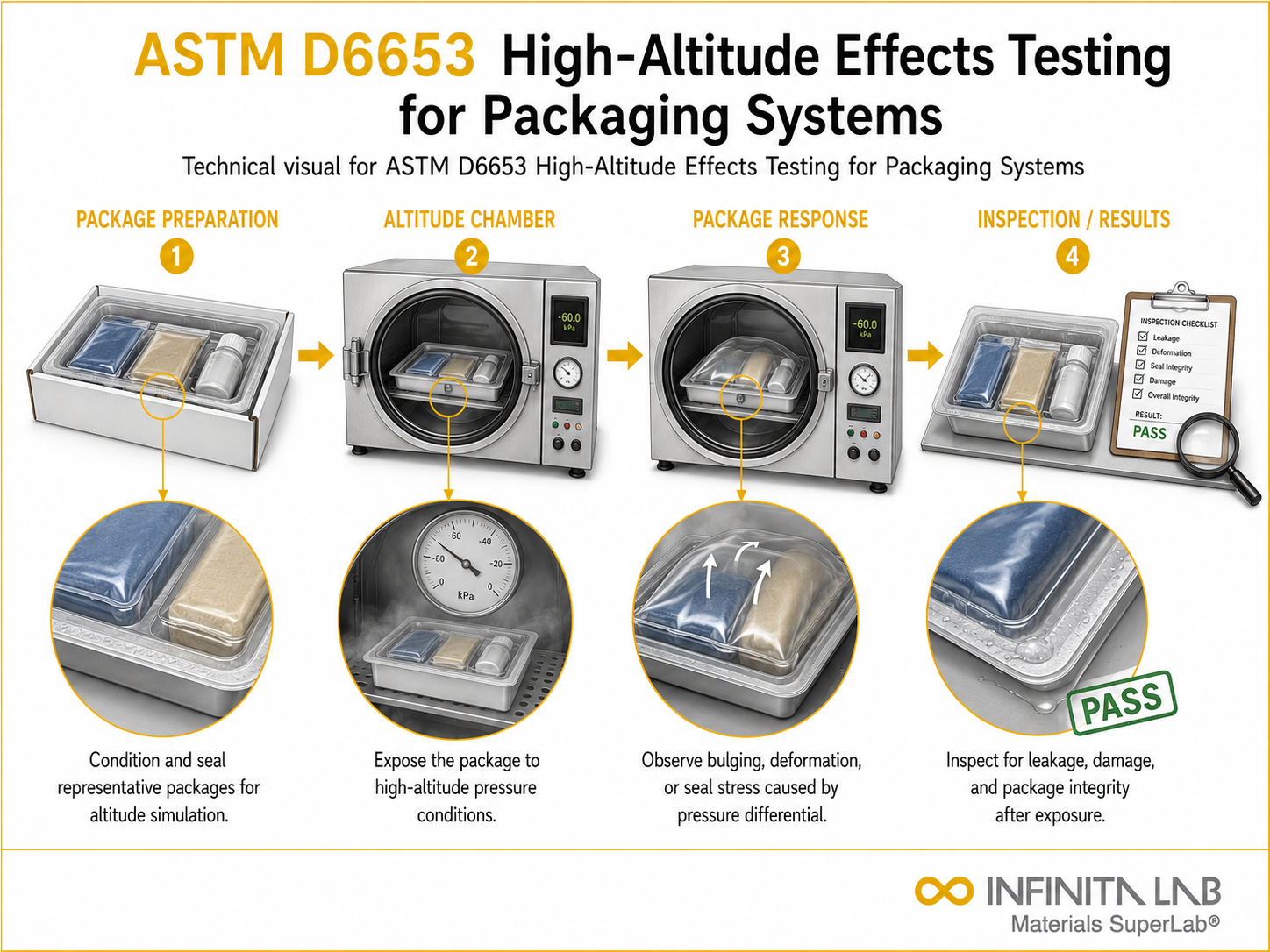
Sample Conditioning
Packages are conditioned at standard temperature and humidity prior to testing.
1Chamber Loading
Test packages are placed in a vacuum or altitude simulation chamber without stacking or constraint that would inhibit deformation.
2Pressure Reduction
Chamber pressure is reduced at a controlled rate to the target equivalent altitude pressure and held for the specified dwell time.
3Post-Exposure Assessment
Packages are returned to ambient pressure and evaluated for leakage, seal failure, deformation, or product damage.
4Technical Specifications
| Parameter | Details |
|---|---|
| Standard | ASTM D6653 / D6653M (SI) |
| Test Principle | Controlled vacuum/altitude simulation chamber exposure |
| Applicable Materials | Flexible, rigid, and semi-rigid packaging systems |
| Simulated Altitude | Up to ~15,000 ft (4,572 m) or as specified |
| Dwell Time | As specified per test protocol |
| Evaluation | Visual inspection, leak test, seal integrity checks |


Instrumentation Used for Testing
- Altitude simulation or vacuum chamber
- Pressure controller and calibrated pressure gauges
- Data logging system for pressure vs. time recording
- Post-test leak detection equipment (dye, pressure decay, or visual)
- Conditioning chamber for pre-test sample preparation
Results and Deliverables
- Pass/fail determination for package integrity at test altitude
- Pressure-time profile records
- Documentation of failure modes (seal rupture, deformation, leakage)
- Photographs of any package damage or deformation
- Packaging qualification and compliance reports
Frequently Asked Questions
At high altitudes, reduced atmospheric pressure causes a pressure differential between the inside and outside of sealed packages. This can expand flexible packages, stress seals, and cause leakage of pressurized or gas-flushed packages.
ASTM D6653 commonly simulates pressures equivalent to approximately 11,500–15,000 feet (3,500–4,572 m), which corresponds to conditions in the unpressurized cargo holds of commercial aircraft.
Commercial passenger aircraft cargo holds are typically pressurized, but not always to sea-level pressure. Cargo aircraft and certain freight carriers may carry packages in partially or fully unpressurized holds.
Common failures include seal peeling or bursting, cap loosening, flexible pouch ballooning and rupture, and container deformation that compromises reclosure or product protection.
The test yields both quantitative data (pressure-time profiles) and qualitative assessment (visual inspection and leak testing). Pass/fail criteria are defined based on the packaging system's performance requirements.
Why Choose Infinita Lab for Advanced Materials Testing and Characterization?
At the core of this breadth is our network of 2,000+ accredited laboratories across the USA, offering access to over 10,000 testing methods and analytical services. From advanced materials characterization (SEM, TEM, RBS, XPS) to mechanical, chemical, environmental, biological, and standardized ASTM/ISO-compliant testing, we deliver unmatched flexibility, specialization, and scale. You are never limited by geography, facility, or methodology — Infinita Lab connects you to the right expertise and testing solution, every time.

Looking for a Trusted Partner for Accurate and Reliable Testing Services?
Send query us at hello@infinitlab.com or call us at (888) 878-3090 to learn more about our services and how we can support you.



Request a Quote
Submit your material details and receive testing procedures, pricing, and turnaround time within 24 hours.
 Quick Turnaround and Hasslefree process
 Confidentiality Guarantee
 Free, No-obligation Consultation
 100% Customer Satisfaction
