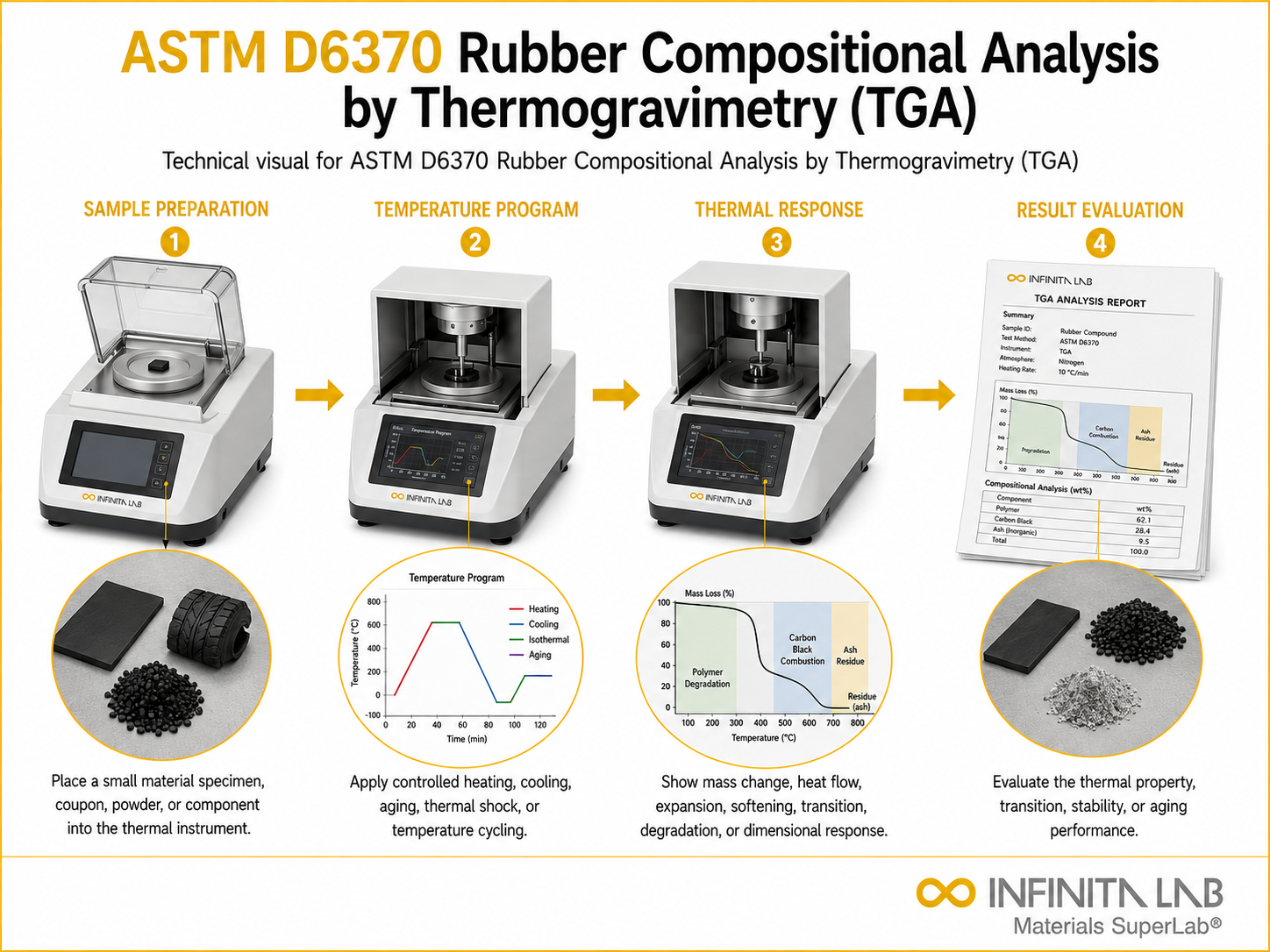


What Is ASTM D6370 Rubber Compositional Analysis TGA?
ASTM D6370 is a standardised thermogravimetric analysis (TGA) test method for pinning down what a compounded rubber material is actually made of. Here’s how it works: a small rubber specimen is heated through a controlled temperature program while its mass is monitored continuously, first under an inert atmosphere such as nitrogen, then under an oxidising atmosphere such as air or oxygen. As the sample heats up, its constituents decompose or volatilize within characteristic temperature ranges, and the resulting mass losses are recorded to quantify how much of the compound is organic material (oil, plasticisers, and polymer), how much is carbon black, and how much is inorganic ash or mineral filler.
During the inert-atmosphere phase, volatile organics like processing oils, plasticisers, and low-molecular-weight additives burn off first, and the polymer backbone follows with pyrolytic decomposition. Once the furnace atmosphere switches to air or oxygen and heating continues, the carbon black in the compound oxidises and burns away, leaving an inorganic residue of ash, mineral fillers, and other non-combustible additives. By tracking mass loss across each of these temperature windows, ASTM D6370 builds a quantitative compositional profile of the compound, without the extensive sample preparation or solvent extraction that some wet-chemistry approaches require.
This method sees wide use across the rubber and tyre industries, whether it’s for quality control of incoming raw materials and finished compounds, confirming that a supplied compound matches an approved formulation, troubleshooting manufacturing or performance issues, or running competitive and reverse-engineering analysis on competitor products. Because TGA is fast and needs only a small sample, it works well both for routine compound auditing and for more detailed formulation investigations. Infinita Lab connects manufacturers, compounders, and quality teams with accredited laboratories equipped to perform ASTM D6370 testing accurately and efficiently, supporting compound verification, formulation development, and ongoing quality assurance programs.

Applications and Benefits of ASTM D6370 Rubber Compositional Analysis TGA Testing
Scope
This standard is used to determine the compositional breakdown of rubber using controlled thermal degradation.
- This test method applies to the compositional analysis of compounded rubber by thermogravimetric mass-loss measurement.
- The relative proportions of organic constituents (oil, plasticiser, and polymer), carbon black, and ash/mineral filler in a rubber sample are quantified by the procedure.
- A two-stage atmosphere drives the process: an inert gas, such as nitrogen or argon, handles the organics and polymer decomposition stages, followed by air or oxygen for carbon black combustion.
- Small specimens are used for testing, typically on the order of tens of milligrams, placed in a platinum or ceramic sample pan.
- A wide range of natural and synthetic rubber compounds used in tyres, seals, hoses, and moulded rubber goods fall within the method’s applicability.
- Compounds containing fillers that decompose within the test’s temperature range, such as calcium carbonate or aluminium hydroxide, aren’t suitable candidates, since their decomposition can be mistaken for organic or carbon black loss.
- Mass-based compositional fractions are what the test reports; it doesn’t identify the specific chemical identity of the polymer, oil, or filler.
- Results come out as a continuous thermogram showing mass loss, and often its derivative, as a function of temperature.
- Raw, uncured rubber as well as cured or vulcanised rubber compounds and components can both be tested with this method.
- Both routine quality-control screening and more detailed formulation comparison or troubleshooting investigations are supported by testing.
Applications
- Verifying that incoming raw rubber or compounded stock matches an approved formulation or supplier specification.
- Auditing finished rubber products, such as tyres, gaskets, and hoses, for consistency in polymer, filler, and oil content.
- Supporting competitive benchmarking and reverse-engineering studies to estimate the general composition of a competitor’s rubber compound.
- Investigating manufacturing or field-performance issues that may trace back to compound composition, such as inconsistent carbon black loading or oil content.
- Helping compound development and formulation engineers confirm that laboratory or production batches meet target compositional ranges.
- Serving as a rapid screening tool for incoming material inspection in quality assurance programs.
- Rounding out a broader compound qualification program alongside other rubber characterisation methods, such as cure and physical property testing.
Benefits
- Delivers a quantitative compositional breakdown using a relatively small sample and minimal preparation.
- Turns around faster than many wet-chemistry extraction methods when the goal is basic compositional screening.
- Generates objective, instrument-based data that supports formulation verification and dispute resolution.
- Helps catch formulation deviations before they turn into costly production or field-performance issues.
- Works across a broad range of rubber compound types, which makes it useful for comparative studies across multiple suppliers or products.
- Fits both routine quality control needs and deeper investigative or competitive analysis work.
Our ASTM D6370 Testing Procedure
Sample Preparation
A small, representative rubber sample is prepared and weighed to ensure accurate baseline measurement.
1Controlled Heating
The sample is heated at a programmed rate under controlled atmosphere to initiate decomposition.
2Mass Loss Monitoring
Continuous measurement of weight loss is recorded as different components volatilize or decompose.
3Data Analysis
The mass loss data is analyzed to determine the percentage composition of each rubber component.
4ASTM D6370 Test Parameters and Requirements
| Parameter | Details |
|---|---|
| Sample mass | Small, representative quantity for precise measurement |
| Temperature range | Controlled heating up to decomposition temperature |
| Heating rate | Defined and programmable rate for consistency |
| Atmosphere | Inert or oxidative environment depending on analysis |
| Mass resolution | High-precision balance for accurate detection |
| Data acquisition | Continuous real-time recording system |
| Residue analysis | Determination of ash and inorganic content |
| Volatile detection | Identification of moisture and low-boiling compounds |
| Polymer degradation | Monitored via thermal breakdown stages |


- Thermogravimetric Analyser (TGA) – Continuously measures sample mass as a function of temperature and time under a controlled atmosphere.
- Furnace with Programmable Temperature Control – Provides the precise, ramped heating profile required to separate the organic, polymer, and carbon black decomposition stages.
- Analytical Microbalance – Delivers the high-sensitivity mass measurement needed to resolve small compositional mass-loss steps.
- Gas Flow and Purge Control System – Manages the switch between inert purge gas (nitrogen or argon) and oxidising gas (air or oxygen) during the test.
- Platinum or Ceramic Sample Pans – Hold the rubber specimen and withstand repeated heating to high temperatures without contamination.
- Data Acquisition and Thermal Analysis Software – Records the thermogram and calculates mass-loss fractions for each compositional stage.
- Precision Analytical Balance – Used to accurately weigh the small test specimen before loading into the TGA instrument.
Equipment and Instrumentation Used for ASTM D6370 Testing
What You Receive: Test Report, Data, and Certification
- A detailed thermogram showing sample mass loss and typically its derivative, as a function of temperature.
- Quantified mass percentages for organic content (oil/plasticizer and polymer), carbon black, and ash/filler residue.
- A written test report summarising methodology, instrument parameters, and calculated compositional results.
- Comparative data suitable for benchmarking a compound against a target formulation, specification, or competitor sample.
- Supporting raw data files that engineering or quality teams can review for further analysis.
- Guidance from the testing laboratory on result interpretation and any observed anomalies in the decomposition profile.
ASTM D6370 Rubber Compositional Analysis TGA FAQs
ASTM D6370-99 is a thermogravimetric analysis (TGA) method dedicated to evaluating rubber compound composition. It evaluates the contents of organics, carbon black, and ash, which contribute to the quality of materials. Therefore, it is helpful in QA/QC, material screening, and troubleshooting.
ASTM D6370 uses controlled heating to measure mass loss at different temperature stages. Each component—moisture, polymers, fillers—decomposes or volatilizes at specific ranges, allowing precise quantification of each constituent in the rubber sample.
The initial purging of the test is performed using an inert gas such as nitrogen or argon of high purity (99.99%), and during the final heating stage, reactive gases such as Air or oxygen are used. The inert purge gas should contain oxygen of not more than ten µg/g level.
TGA provides continuous, real-time mass loss data with high precision. Unlike chemical extraction methods, it requires minimal sample preparation and delivers rapid, accurate compositional insights, making it highly efficient for industrial and research applications.
By comparing expected and actual compositional data, deviations in filler or polymer content can be identified. This helps detect errors in compounding, raw material variation, or processing inconsistencies.
ASTM D6370 is the Standard Test Method for Rubber - Compositional Analysis by Thermogravimetry (TGA). It measures organic content, carbon black, and ash (fillers) in rubber compounds by recording weight changes during controlled heating.
Why Choose Infinita Lab for Rubber Compositional Analysis TGA Testing
When your Rubber Compositional Analysis TGA results have to hold up - for compliance, a customer audit, or an engineering decision - ASTM D6370 accuracy and an unbiased third-party report matter more than price. Infinita Lab routes your ASTM D6370 rubber compositional analysis TGA testing to ISO/IEC 17025-accredited U.S. partner labs with hands-on method experience, so you get defensible data, transparent reporting, and turnaround times built around your project deadline - not ours.

Need ASTM D6370 Rubber Compositional Analysis TGA Testing You Can Rely On?
Send query us at hello@infinitalab.com or call us at (888) 878-3090 to learn more about our services and how we can support you.





