

What Is ASTM E1641 Thermal Decomposition Kinetics?
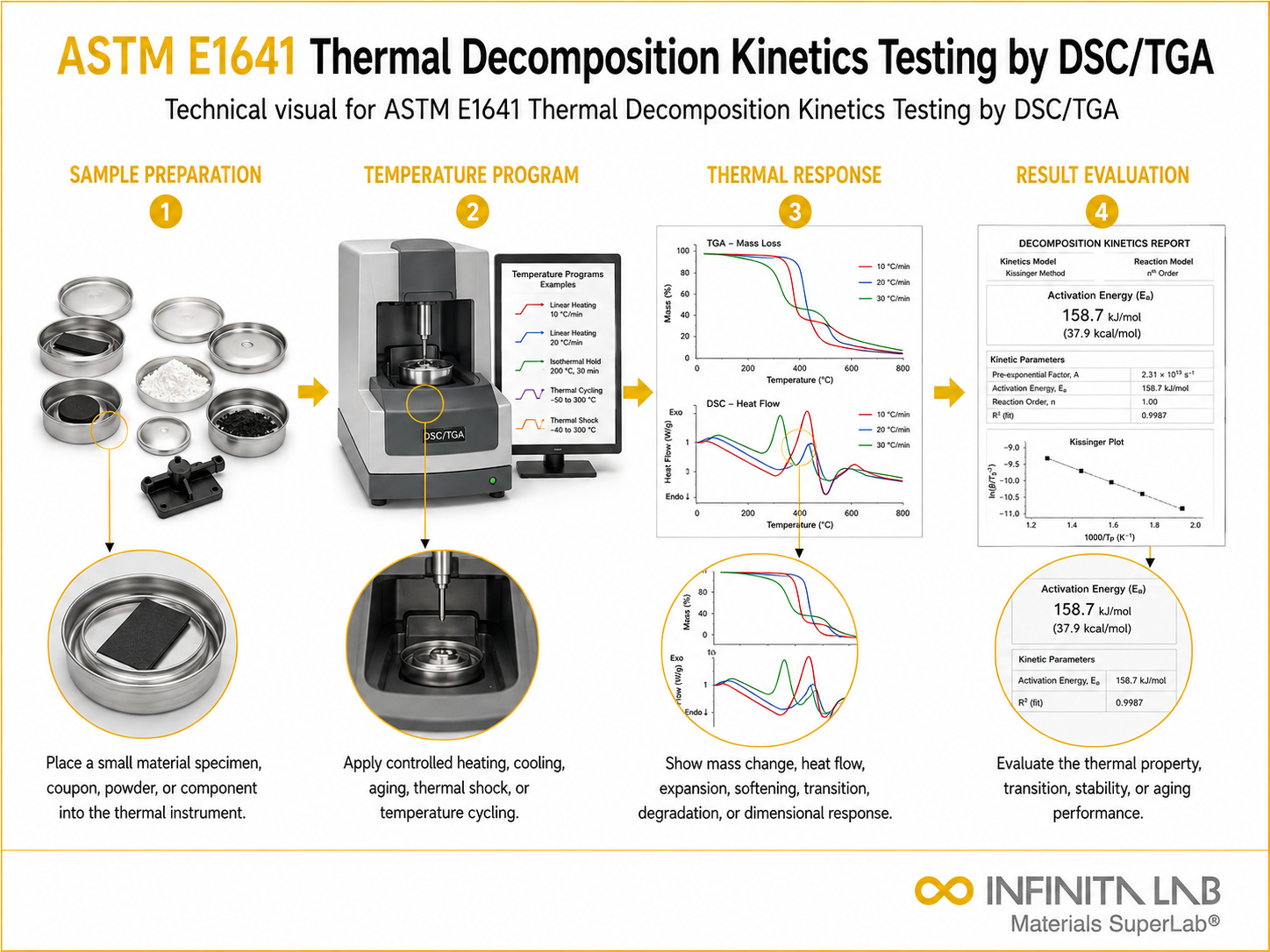
ASTM E1641-13 provides a test method for determining the decomposition kinetics of materials using thermogravimetric analysis (TGA) and the Ozawa/Flynn/Wall (OFW) method. This approach evaluates how materials decompose as a function of temperature without requiring a predefined reaction model.
The standard is widely used for polymers, chemicals, and materials to estimate activation energy and understand thermal stability and degradation behavior.

Applications and Benefits of ASTM E1641 Thermal Decomposition Kinetics Testing
Scope
ASTM E1641-13 focuses on determining kinetic parameters such as activation energy by analyzing weight loss at different heating rates. It ensures accurate assessment of thermal decomposition behavior.
The test evaluates:
- Activation energy of decomposition
- Thermal degradation behavior
- Weight loss vs temperature
- Reaction kinetics
- Material stability
Applications
- Polymer and plastic materials
- Chemical and pharmaceutical compounds
- Coatings and composites
- Thermal stability studies
- Research and quality control laboratories
Benefits
- Provides model-free kinetic analysis
- Improves understanding of material stability
- Supports product development
- Enables prediction of material lifetime
- Allows comparison of materials
Our ASTM E1641 Testing Procedure
Sample Preparation
Small sample is weighed and placed in TGA pan.
1Multi-Rate Heating
Sample is heated at multiple heating rates.
2Weight Loss Measurement
Mass loss is recorded as a function of temperature.
3Data Recording & Evaluation
Activation energy is calculated using OFW method.
4ASTM E1641 Test Parameters and Requirements
| Parameter | Details |
|---|---|
| Applicable Materials | Polymers, chemicals, composites |
| Heating Rates | Typically 5, 10, 15, 20°C/min |
| Temperature Range | Typically ambient to 600°C or higher |
| Atmosphere | Nitrogen or air |
| Measured Outputs | Activation energy (kJ/mol), weight loss (%) |


- Thermogravimetric analyzer (TGA)
- Temperature control system
- Gas supply (nitrogen or air)
- Microbalance
- Sample pans
- Data acquisition system
Equipment and Instrumentation Used for ASTM E1641 Testing
What You Receive: Test Report, Data, and Certification
- Activation energy values
- Decomposition kinetics analysis
- Weight loss curves
- Thermal stability assessment
- Test condition summary
- ASTM compliance report
ASTM E1641 Thermal Decomposition Kinetics FAQs
ASTM E1641-13 is a standard test method used to determine decomposition kinetics of materials using thermogravimetry and the Ozawa/Flynn/Wall method under varying heating rates.
ASTM E1641-13 is important because it helps predict material lifetime, stability, and performance by analyzing how materials decompose under different temperature conditions.
ASTM E1641-13 uses thermogravimetric analysis at multiple heating rates to calculate activation energy without assuming reaction mechanisms, applying the Ozawa/Flynn/Wall method.
ASTM E1641-13 requires a thermogravimetric analyzer, controlled heating system, inert or reactive gas environment, and data analysis tools to evaluate weight loss behavior.
Results are reported as activation energy and kinetic parameters, helping predict decomposition rates and thermal stability of materials under various conditions.
Why Choose Infinita Lab for Thermal Decomposition Kinetics Testing
At the core of this breadth is our network of 2,000+ accredited laboratories across the USA, offering access to over 10,000 testing methods and analytical services. From advanced materials characterization (SEM, TEM, RBS, XPS) to mechanical, chemical, environmental, biological, and standardized ASTM/ISO-compliant testing, we deliver unmatched flexibility, specialization, and scale. You are never limited by geography, facility, or methodology — Infinita Lab connects you to the right expertise and testing solution, every time.

Looking for an Accredited Partner for ASTM E1641 Thermal Decomposition Kinetics Testing?
Send query us at hello@infinitalab.com or call us at (888) 878-3090 to learn more about our services and how we can support you.





