


ISO 11358: TGA Polymer Testing Services
ISO 11358 are standards that provide guidelines for the use of differential scanning calorimetry (DSC) and thermogravimetric analysis (TGA), respectively, in the thermal analysis of polymers. These standards cover calibration, operation, and data analysis to ensure reliable and accurate measurement of the heat flow rate and temperature of polymers.
TRUSTED BY


Get ISO 11358 compliant results — request your TGA polymer testing quote
- Overview
- Scope, Applications, and Benefits
- Test Process
- Specifications
- Instrumentation
- Results and Deliverables
What Is ISO 11358 TGA Polymer?
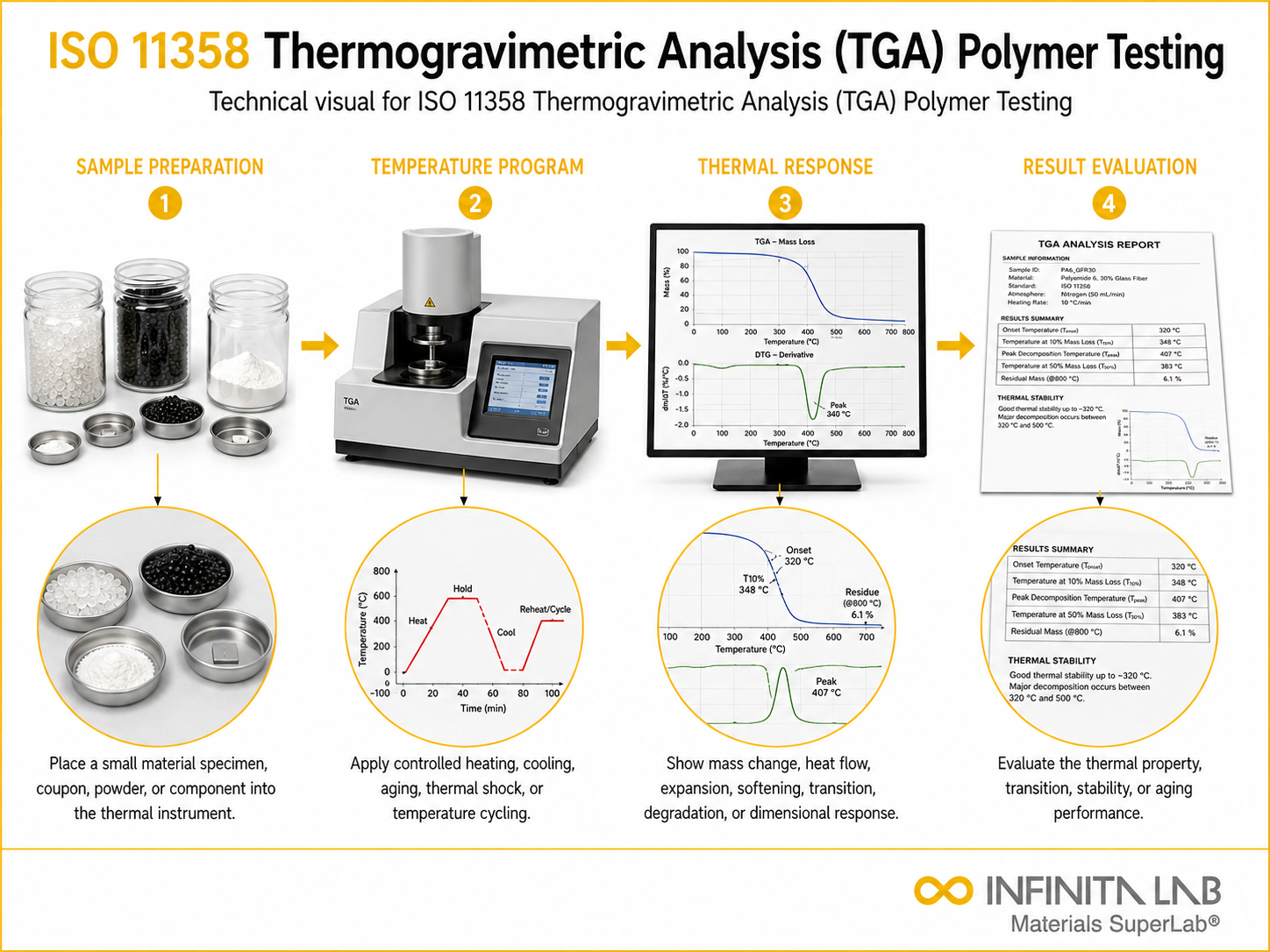
ISO 11358 describes a procedure for determining the thermal stability of a polymer-based material using thermogravimetric analysis (TGA). TGA is a technique used to determine the mass change of a polymer sample when it is exposed to a constant temperature.
TGA is a technique used to determine the thermal stability, oxidation, and filler content of a polymer-based material.

Applications and Benefits of ISO 11358 TGA Polymer Testing
Scope
ISO 11358 defines procedures for measuring the mass change of polymer materials as a function of temperature or time under controlled heating conditions to evaluate thermal stability and composition.
The scope includes:
- Determination of thermal stability of polymers
- Measurement of mass loss during heating
- Evaluation of decomposition behavior
- Determination of filler and additive content
- Analysis of polymer composition and degradation
Applications
- Polymer and plastic materials
- Composite materials
- Rubber and elastomers
- Polymer additives and fillers
- Research and material development
Benefits
- Evaluates the thermal stability of materials
- Identifies decomposition temperatures
- Determines filler and additive content
- Supports material development and quality control
- Improves product reliability at high temperatures
Our ISO 11358 Testing Procedure
Sample Preparation
A small polymer sample is weighed and placed in a TGA sample pan.
1Instrument Setup
The sample is placed inside the thermogravimetric analyzer with controlled heating conditions.
2Controlled Heating
The sample is heated at a specified rate while the instrument continuously records mass changes.
3Data Analysis
The mass loss data is analyzed to determine decomposition temperatures and material composition.
4ISO 11358 Test Parameters and Requirements
| Parameter | Details |
|---|---|
| Applicable Materials | Polymers, plastics, and composites |
| Sample Size | Typically 5–20 mg |
| Heating Rate | Commonly 10 °C/min |
| Temperature Range | Up to ~1000 °C depending on equipment |
| Atmosphere | Nitrogen, air, or inert gas |
| Measured Parameter | Mass change (%) vs temperature |
| Output Data | TGA curve and decomposition profile |


- Thermogravimetric Analyzer (TGA)
- High-Temperature Furnace
- Microbalance System
- Gas Flow Controller
- Data Acquisition Software
Equipment and Instrumentation Used for ISO 11358 Testing
What You Receive: Test Report, Data, and Certification
- TGA mass loss curve
- Decomposition temperature data
- Thermal stability evaluation
- Filler or residue content analysis
- Test conditions and parameters
- Detailed laboratory test report
ISO 11358 TGA Polymer FAQs
ISO 11358 is used to evaluate the thermal stability and composition of polymeric materials by measuring the change in mass as the sample is heated under controlled temperature and atmospheric conditions.
This method is commonly applied to thermoplastics, thermosetting plastics, elastomers, polymer blends, and composite materials to study their thermal degradation behavior and filler content.
The test provides data on decomposition temperature, moisture or volatile content, oxidation behavior, and residual inorganic content such as fillers or ash in polymeric materials.
Testing is usually performed in inert atmospheres such as nitrogen or argon, or in oxidative environments like air or oxygen, depending on the material and analysis objective.
The test generally covers a temperature range from room temperature up to about 800–1000 °C, depending on the instrument capability and material type.
Why Choose Infinita Lab for TGA Polymer Testing
At the core of this breadth is our network of 2,000+ accredited laboratories across the USA, offering access to over 10,000 testing methods and analytical services. From advanced materials characterization (SEM, TEM, RBS, XPS) to mechanical, chemical, environmental, biological, and standardized ASTM/ISO-compliant testing, we deliver unmatched flexibility, specialization, and scale. You are never limited by geography, facility, or methodology — Infinita Lab connects you to the right expertise and testing solution, every time.

Need ISO 11358 TGA Polymer Testing You Can Rely On?
Send query us at hello@infinitalab.com or call us at (888) 878-3090 to learn more about our services and how we can support you.



Request a Quote
Submit your material details and receive testing procedures, pricing, and turnaround time within 24 hours.
 Quick Turnaround and Hasslefree process
 Confidentiality Guarantee
 Free, No-obligation Consultation
 100% Customer Satisfaction
